










Partial Shipments vs. Split Shipments: When to Split an Order, When to Hold, and Who Pays
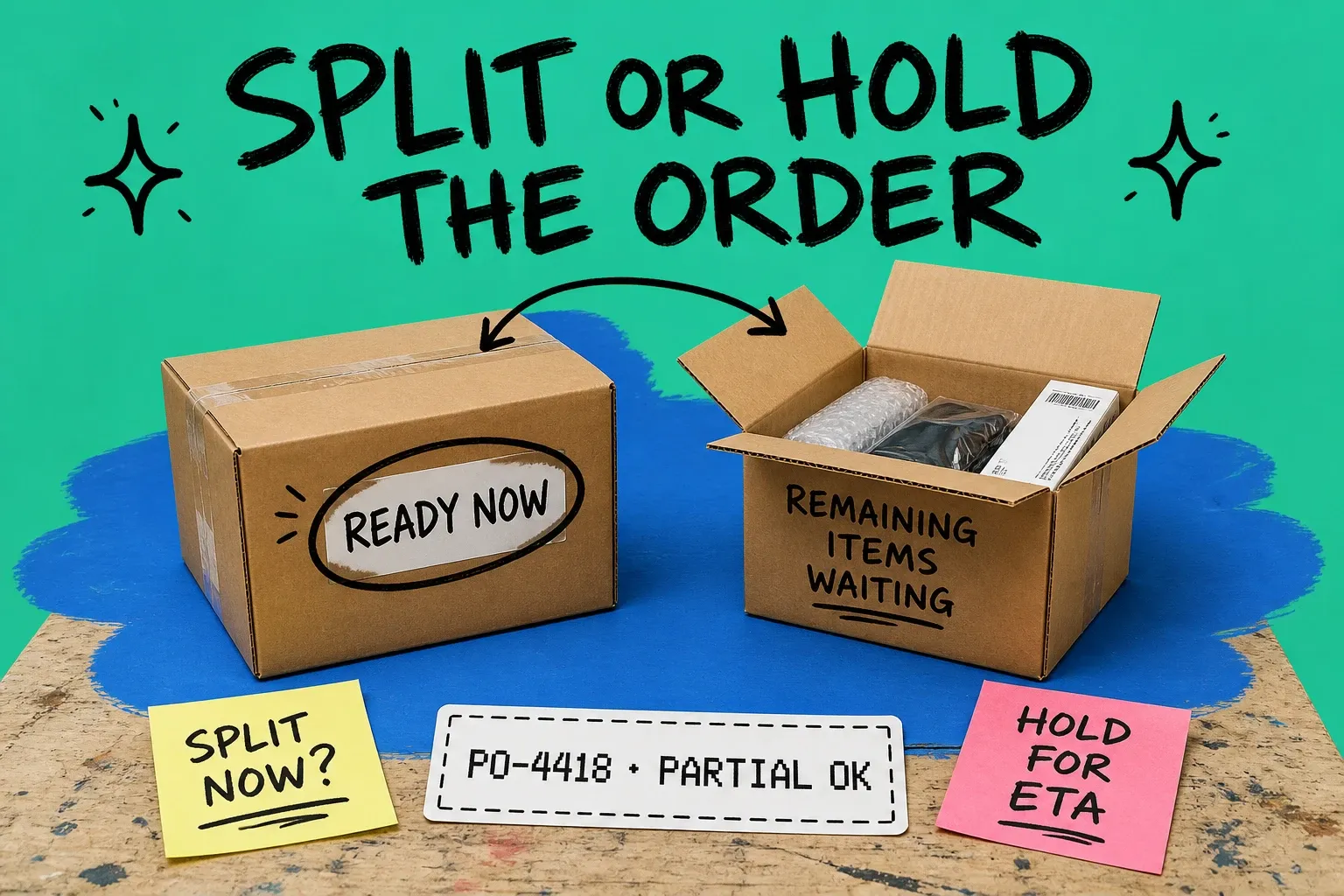
Two boxes arrive on the porch, two days apart, from one order. The customer sees an accident. Your fulfillment stack made a decision — or worse, defaulted into one nobody ever set.
Every order that ships in pieces is the output of a rule: hold until complete, or ship what's ready. Most brands never write that rule down. It emerges from whatever the OMS shipped with, whatever the 3PL prefers, or whatever a stressed ops lead decided at 4pm on a Tuesday. Then it quietly sets your shipping costs, your support ticket volume, and — on retail purchase orders — your chargeback exposure.
This guide settles the terminology, walks through the five reasons orders split, gives you the decision matrix for the split-or-hold call, and covers the two places the logic forks: consumer communication and B2B compliance.
What is a partial shipment?
A partial shipment is when part of an order ships now and the remainder follows later — same order, same fulfillment flow, staggered departure. The delayed remainder is usually a backordered line item: the customer bought three SKUs, two are on the shelf, one is on a container somewhere in the Pacific.
One terminology footnote, because the search results blur it: in freight and trade finance, "partial shipment" also describes goods under a single contract or letter of credit moving in multiple consignments. Same concept, different paperwork. This guide covers the order-fulfillment sense — what happens between your checkout and your customer's door.
The defining trait of a partial shipment is time. Something ships later because it isn't available yet.
What is a split shipment?
A split shipment is when a single order leaves in multiple packages — possibly on the same day, often from different origins. Your routing logic sourced the order from two warehouses. One item needed its own carton. One line came from a dropship vendor while the rest picked from your shelf.
Split shipment is the umbrella term. Every partial shipment is a split shipment, but plenty of split shipments have nothing delayed at all — two warehouses can ship their halves of an order within the same hour. The defining trait of a split shipment is plurality: one order, more than one box, for any reason.
Partial vs. split vs. ship complete: the terminology, settled
Support macros, checkout copy, and retailer paperwork all depend on which of these you mean. Here's the whole vocabulary in one place:
Term | What it means | Typical trigger | Who usually absorbs the cost |
|---|---|---|---|
Partial shipment | Part of the order ships now, the rest ships when available | A backordered or delayed line item | Merchant eats the extra label (B2C); requires buyer authorization (B2B) |
Split shipment | One order leaves in multiple packages, from one or more locations | Multi-warehouse routing, carton limits, mixed fulfillment paths | Merchant, unless the customer requested the split |
Ship complete | Nothing leaves until every line can ship together | Policy setting, or a retailer's PO terms | No extra freight — the cost shows up as delay risk instead |
Backorder | An order accepted against inventory that hasn't arrived yet | Stock gap with a restock committed | The obligation that usually causes the partial shipment |
The five reasons orders split
1. Inventory lives in more than one warehouse. Your routing engine sourced line 1 from New Jersey and line 2 from Nevada because that's where the units were. Sometimes this is deliberate omnichannel fulfillment — positioning stock near demand to cut zone costs. Sometimes it's placement drift nobody noticed until the split-shipment rate crept up.
2. Part of the order is backordered. The classic partial shipment. The whole communication playbook for this case — expectation-setting, the T+48h update, cancellation paths — is in our backorder management guide.
3. The items can't share a box. Dimensional limits, weight caps, hazmat rules. The kayak ships freight; the paddle and life vest ship parcel. No policy decision here — physics made the call. Your only job is making sure the customer knows two deliveries are coming.
4. The lines follow different fulfillment paths. One SKU dropships from the vendor, the rest picks from your 3PL. One item lives in your FBA pool while the rest sits elsewhere — Amazon MCF is famous for splitting multi-line orders across its own network even when you did nothing. Subscription items and one-time purchases on the same checkout ship on different cadences by design.
5. The customer asked. Gifts to two addresses. One line rushed for a birthday while the rest takes the free-shipping lane. This is the one split category where the customer expects — and will often pay for — the extra package.
Triggers 1, 3, and 4 are structural: they're set by inventory placement and routing rules long before any single order exists. Trigger 2 is temporal — it's the one you decide order-by-order. Trigger 5 is service. Fix structural splits upstream; decide temporal splits with the matrix below.
The decision matrix: split or hold
For the orders where you actually have a choice — something's missing, the rest is ready — here's the call:
Scenario | Default call | The reasoning |
|---|---|---|
Restock ETA is short (under a week) and reliable | Hold | One label, one delivery; the wait sits inside normal expectations |
ETA is long or uncertain | Ship partial | Long silent holds become cancellations and disputes; move the sure thing |
In-stock lines are high-value or high-margin | Ship partial | Protect revenue already earned; the second label is cheap insurance |
The second label erases the order's margin | Hold — or offer a paid split | Don't silently convert a profitable order into a loss; let the customer buy speed if they want it |
The items only work together | Hold | A partial with no standalone utility doubles WISMO tickets and delights no one |
Perishable, seasonal, or event-dated lines | Ship partial | A Halloween costume on November 2nd is a return, not a delivery |
Marketplace SLA clock is running | Ship partial | Late-shipment defects damage account health worth far more than a label |
It's a retail purchase order | Neither — get authorization | On a PO, this is a compliance decision, not a freight decision (see the B2B fork below) |
The math underneath: the second label is the visible cost. The invisible costs sit on both sides — hold too long and you're funding cancellations, chargebacks, and support time; split without telling anyone and you're funding "where's the rest of my order?" tickets that per-shipment tracking would have prevented. Plot every ambiguous order on two axes — how long is the wait, and how much margin headroom does the order have — and the matrix above falls out. The point of writing it down is that your ops team stops re-deriving it at 4pm on Tuesdays.
Ship complete vs. ship partial: setting the default in your OMS
This policy belongs in system configuration, not tribal knowledge. What that looks like in practice:
- An order-level default. Ship-partial or ship-complete, stated once, applied everywhere — so the checkout promise, the warehouse behavior, and the support macro all agree.
- Threshold overrides. Split only when the backorder ETA exceeds N days, or when in-stock value clears a floor, or when margin covers the second label. The matrix above, expressed as rules.
- Channel-aware behavior. Marketplace orders racing an SLA clock deserve a different default than your own DTC storefront.
- An honest availability check behind the promise. Available-to-promise (ATP) is the inventory answer — stock on hand minus what's already committed — that tells the system whether "ships today" is true before the customer sees it.
An order management system applies whichever policy you set consistently, on every order, without a human re-litigating each case: available lines release to fulfillment, backordered lines queue, notifications fire at each status change, and synced inventory keeps the oversell-driven splits from happening in the first place. If you want to see how OmniOrders would run the matrix above against your actual order profile, start a free trial — bring your split-shipment rate and we'll show you where the rules would move it.
The B2C fork: communication
For consumer orders, the split decision is half the job — the other half is the backorder communication playbook applied to packages: say it at checkout, confirm it by email, and give every shipment its own tracking number. The rule that covers all of it: a split the customer expected is service; a surprise second box is a ticket.
On cost messaging, the customer's price is locked at checkout. They paid one shipping charge — or earned free shipping — and however many boxes it takes, that number doesn't move. The delta is yours. Eat it silently; itemizing your own fulfillment problem on a customer's order is a bad look.
The B2B fork: split shipments and retailer compliance
Retail purchase orders invert everything above. On a PO from a major retailer, split-or-hold is not your decision — the retailer's routing guide governs how orders ship, and shipping outside it costs real money.
The mechanics: retailers score suppliers on filling POs completely and on time. Fill-rate violations — short ships and unauthorized substitutions — commonly carry penalties in the range of 5–15% of the merchandise cost. Walmart's OTIF (On-Time In-Full) program docks around 3% of item value on orders that miss its in-full threshold, and industry estimates put total chargeback leakage at 2–10% of a supplier's revenue. If you're selling into Walmart or onboarding with big-box EDI programs, the split decision is a compliance decision first and a freight decision a distant second.
And there's paperwork: every physical shipment needs its own EDI 856 advance ship notice. Split a PO into two shipments and you owe two ASNs, each accurate to its cartons — a wrong or missing ASN is its own chargeback category.
When you genuinely can't ship a PO complete, the sequence is: notify the buyer before anything moves, get the split or the revised ship window authorized in writing, send one accurate ASN per shipment, and keep the documentation — disputed chargebacks get reversed when the paper trail is clean.
When splitting is a symptom, not a strategy
If the same SKU pairs keep splitting across warehouses week after week, you don't have a policy problem — you have a placement problem. Co-purchased items should live in the same node. Recurring oversell-driven partials point at inventory sync, not shipping policy. Backorder-driven partials that spike every quarter point at demand forecasting.
This is the layer above any single order. Order routing rules are the configured logic deciding which warehouse, path, or method fulfills each order the moment it lands — and weak routing rules manufacture avoidable splits all day. At enterprise scale the same discipline gets a bigger name — distributed order management (DOM), the practice of treating every warehouse, store, and vendor as a fulfillment node and routing dynamically across them — but the principle is identical at every size: the cheapest split shipment is the one your routing and placement never created.
Frequently asked questions
What is the difference between a partial shipment and a split shipment?
A partial shipment is a timing split: part of the order ships now, the rest ships when it becomes available. A split shipment is any order that leaves in more than one package, for any reason — different warehouses, carton limits, or a delay. Every partial shipment is a split shipment; not every split shipment involves a delay.
Why did my order ship in two packages?
Usually one of five reasons: the items were stocked in different warehouses, one item was temporarily out of stock, the items couldn't share a box, one item shipped from a different source such as a vendor or marketplace fulfillment network, or the order was set to ship to multiple addresses. It rarely costs the buyer anything extra.
Who pays for shipping when an order is split?
The seller. The customer's shipping price is fixed at checkout regardless of how many packages the order becomes. The cost of additional labels comes out of the seller's margin — which is why split-or-hold is a per-order economics decision.
What does ship complete mean?
Ship complete means holding an order until every line item can ship together in one dispatch. It's the opposite default to ship-partial, and it's common as a requirement on retail purchase orders, where partial fulfillment without authorization triggers penalties.
Should I ship partial or wait for backordered items?
Ship the in-stock items when the restock date is distant or uncertain, the available items are useful on their own, and their margin absorbs a second label. Hold when the restock is days away, the items only work as a set, or the extra label erases the order's profit.
Do split shipments cost more?
For the seller, generally yes — each additional package carries its own label, and two smaller parcels usually cost more than one combined one. The comparison that matters is against the alternative: the cancellations, disputes, and support load of holding an order too long often cost more than the label.
Can a retailer penalize me for splitting a purchase order?
Yes. Retail routing guides treat unauthorized splits and short ships as compliance violations, with penalties commonly running 5–15% of merchandise cost, plus scorecard damage that affects future orders. Always get a split authorized in writing and send a separate, accurate ASN for each shipment.
Start your 14-day free trial
See how OmniOrders connects your sales channels, 3PLs, and carriers into one operational layer — free for 14 days, no credit card.