










Orders Arriving by Phone, Instagram and WhatsApp: Getting Them Into One Queue
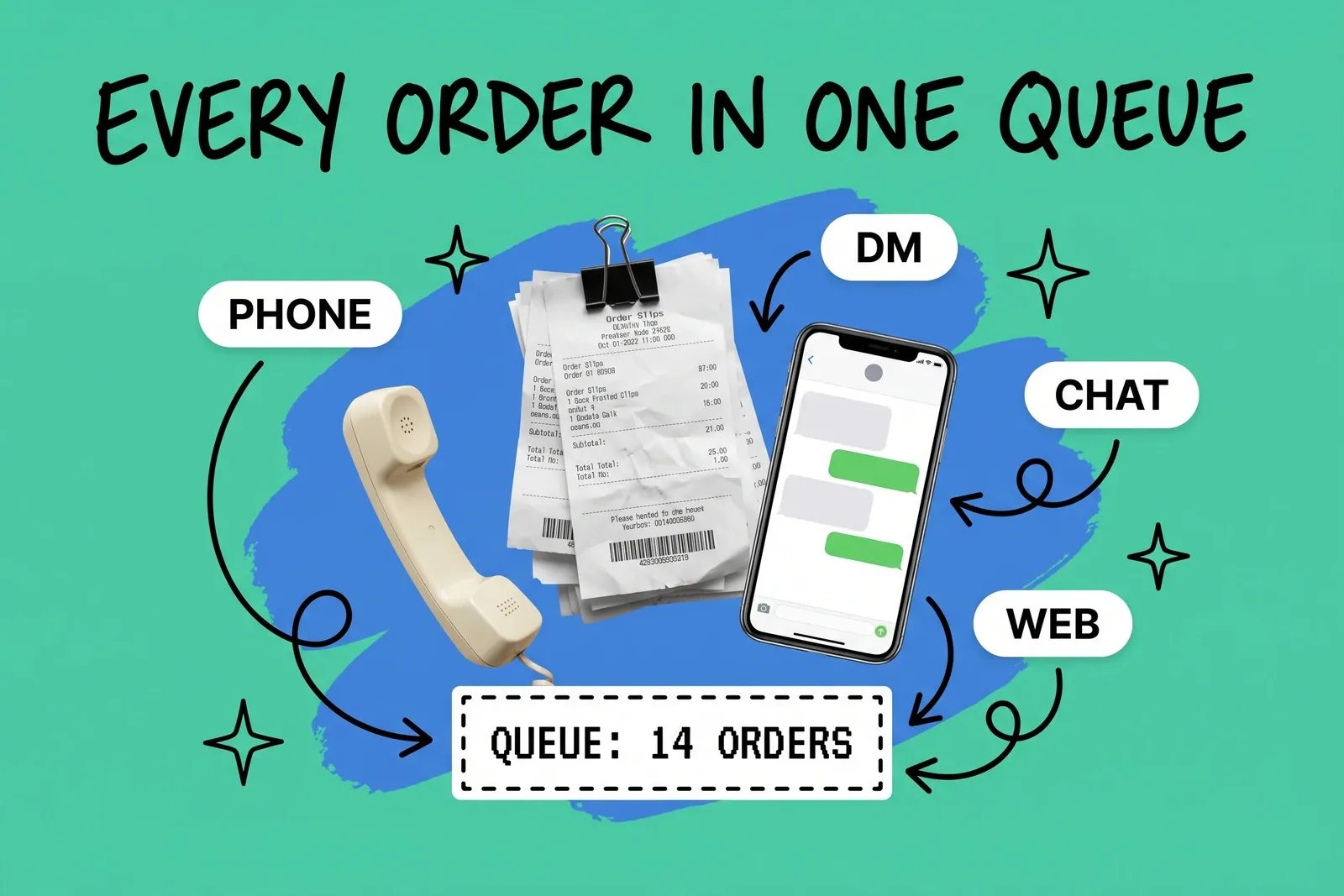
The short answer: an order agreed in a phone call, an Instagram DM or a WhatsApp chat holds no stock anywhere until someone enters it into the system the website sells from. On the most common platforms, entering it does not always hold stock either. So the fix has three parts: every manual order goes into the same order list as web orders before you confirm it to the customer, you decide on purpose when each kind of manual order reserves stock, and payment goes by link so nobody types a card number into a chat.
The setup this is written for is a familiar one. A shop with a website, a register or two, and a steady stream of orders that arrive some other way. One florist with a store, a Shopify store, a WooCommerce store and orders coming in on WhatsApp, LINE, Instagram and Facebook described their order system as a group chat and printed slips. That works until the same last unit is promised in the chat and sold on the website in the same afternoon.
Why do phone and DM orders go missing?
Because a chat is not an order system, and the messaging app puts the transaction on you. WhatsApp's Business Messaging Policy tells businesses, "You are solely responsible for your transactions and providing any sales terms." Meta's developer documentation for WhatsApp catalogs describes a cart a customer can submit, which reaches the business as a webhook notification "containing order details". The catalog overview does not describe that cart reserving stock or collecting payment.
Instagram has moved the other way. For shops using Shopify's Facebook and Instagram channel, Shopify's Help Center says customers "are now redirected to the online store to complete their purchase" instead of checking out inside Meta's apps. A customer who taps through and pays lands in your normal order list. The customer who asks in a DM, "can you hold the green one in a medium, I'll collect Saturday," does not.
That second customer is the problem. Their order exists as a message, maybe a slip, and a promise. The stock it depends on is still for sale everywhere else. If you want one source of truth for inventory across stores and channels, the manual orders have to be part of it.
Does entering the order hold the stock?
Not necessarily. On the platforms below, "the order is in the system" and "the stock is held" can be different moments.
Where the manual order is entered | What happens to stock |
|---|---|
Shopify draft order | Nothing unless you reserve it. "If you don't reserve items, then the quantities stay in the Available inventory state." Reserved units move to Committed until a date and time you choose. |
Square invoice | Only if inventory tracking for invoices is turned on. Then a stock commitment lowers available-to-sell, but "the stock on hand won't update until the invoice has been paid." |
WooCommerce order added in admin | Depends on the status you pick. On hold: "Stock is reduced, but you need to confirm payment." Processing: paid, and stock reduced. The docs describe Pending payment holding stock for checkout orders; test what an admin-created Pending order does on your store before relying on it. |
Look at what that means in a busy shop. On Shopify, a draft order created for a phone customer leaves the unit Available, so the website can sell it while the customer is still deciding. On Square, whether an unpaid invoice protects the stock depends on a setting someone may never have turned on. On WooCommerce, two staff members entering the same kind of order can produce two different stock positions, because one chose Pending payment and the other chose On hold.
WooCommerce adds one more wrinkle. Its hold-stock setting cancels unpaid checkout orders after the minutes you set and releases the stock, but it "only applies to orders in the 'Pending payment' status, and not orders that are 'On hold'." On hold takes the stock out at once, and the timer never gives it back; someone has to cancel the order by hand.
None of these behaviours is wrong. Each is a reasonable default for a different kind of order. The mistake is never choosing. Write down, for each way an order can arrive, the moment it starts holding stock and the moment that hold ends.
What has to be captured for the order to be fulfillable?
A slip that says "Maria, blue throw, Sat" is a reminder, not an order. Before you confirm it, the order needs:
- The items as SKUs, with quantities. "The blue one" is a picking error waiting to happen.
- How it leaves. Shipped, delivered locally, or collected, and from which store. If you run several locations, this is the same decision as which location should ship the online order.
- The delivery address and recipient, if it is going anywhere but your counter.
- The date promised, if one was.
- The price agreed, including any discount or deposit, because chat orders are often negotiated.
- A way to reach the customer. Shopify notes that a draft order needs the customer's "email address or phone number" or no order confirmation is sent.
- Payment state. Paid, invoice sent, or pay on collection, and who is responsible for checking.
- Where it came from. Phone, Instagram, WhatsApp, walk-in. Tag it the same way every time, so you can see how much business these channels actually bring in.
- Who took it. When a customer calls back, someone needs to know who made the promise.
If any of these is missing, the order is not ready for the queue; it is an exception. Treat it the way you would any other order exception: it has an owner and a deadline, and it does not sit in a chat.
How do you take payment without card numbers in the chat?
Do not take card numbers in the chat. WhatsApp's policy is explicit: "Don't share or ask people to share full length individual payment card numbers." The PCI Security Standards Council says "E-mail, instant messaging, SMS, and chat are all considered end-user messaging technologies." PCI DSS does not ban those channels, but requirement 4.2.2 says a card number sent that way must be "secured with strong cryptography", and the Council notes that if card numbers are sent or received over such a channel, the systems involved come into scope. That puts your phones and chat accounts in PCI scope for the sake of one order. If a customer sends a card number anyway, do not use it; reply with a payment link instead.
The cleaner route is a link. Shopify lets you "send an invoice to your customer, which contains a link to the checkout page," or "share a checkout link directly with your customer", including by direct message. When the customer pays, the draft "becomes an order in the Orders page and is automatically marked as Paid." The order joins the queue paid, through the same checkout as the website, and nobody on your side ever sees the card number. Square invoices also carry a pay link, but the payment is recorded in Square, so if your website runs elsewhere, that order still has to reach the same queue. A link works for phone customers too: send it by text or email while they are on the line.
One warning from Shopify is worth taping to the counter: "Be careful not to mark the draft order as Paid before receiving the customer's payment." An order flagged Paid looks settled to everyone who handles it next.
Does a phone order carry the same shipping promise as a website order?
Generally, for merchandise you ship, yes. The FTC's Mail, Internet, or Telephone Order Merchandise Rule covers orders placed "by mail, via the Internet, or by telephone." The seller must have "a reasonable basis to expect that it will be able to ship" within the time it states, or "within thirty (30) days after receipt of a properly completed order" if it states none. When it cannot ship on time, it has to offer the buyer the choice to accept the delay or cancel for a refund. The rule has exemptions, including C.O.D. orders and seeds and growing plants, which matters for a florist.
A phone order on a paper slip carries those obligations as fully as a web order does, and a delay notice is hard to send for an order nobody can find. Whether a particular Instagram or WhatsApp exchange counts as an Internet order is a legal question; ask counsel. The operational point holds either way: a promise made in a chat should be visible to whoever has to keep it.
A routine that gets every order into one queue
- One list. Every order, whatever the channel, is entered into the same order list as the website before it is confirmed to the customer. The group chat becomes a place to talk, not a place to keep orders.
- A written reservation rule per method. For example: Shopify drafts are reserved until the end of the payment window you give the customer; on Square, invoice inventory tracking is turned on, and nobody adjusts stock by hand on top of it; manual WooCommerce orders go to On hold once the customer confirms, and stay on the daily sweep until paid or cancelled.
- Payment by link, never by card number in a message.
- A channel tag on every manual order.
- A daily sweep of expired reservations, unpaid drafts and unsent invoices, so held stock goes back on sale on purpose rather than by accident.
- Retire the slips. For a week, check the paper and the chat against the queue at closing. When they stop finding anything, stop printing them.
The goal is not to make customers stop messaging. It is to make a message and a website click end up as the same thing: one order, in one queue, against one count.
Frequently asked questions
Does a Shopify draft order reserve inventory?
Not by default. Shopify's developer documentation says that when you create a draft order you "can't reserve or hold inventory for the items in the order by default", and the Help Center says that if you don't reserve items the quantities stay Available. You can choose to reserve them until a date and time you set; reserved units move to Committed and can't be bought by other customers.
Can I take card details over WhatsApp or Instagram DMs?
Avoid it. WhatsApp's Business Messaging Policy says not to ask people to share full payment card numbers. PCI DSS does not ban messaging outright, but if a card number is sent or received by chat, SMS or instant message, that channel must be protected to PCI DSS, including strong cryptography, and the systems involved come into scope. A checkout link or invoice means you never receive the number.
Do phone orders fall under the FTC's shipping rule?
Generally yes, for merchandise you ship. The FTC's Mail, Internet, or Telephone Order Merchandise Rule covers orders placed by mail, via the Internet or by telephone. You need a reasonable basis to ship within the time you state, or 30 days if you state none, and must offer a delay-or-cancel choice when you cannot. Some orders are exempt, including C.O.D. orders and seeds and growing plants. Ask counsel about your case.
Start your 14-day free trial
See how OmniOrders connects your sales channels, 3PLs, and carriers into one operational layer — free for 14 days, no credit card.