










EDI ASN (856): What It Is and How to Send One Right
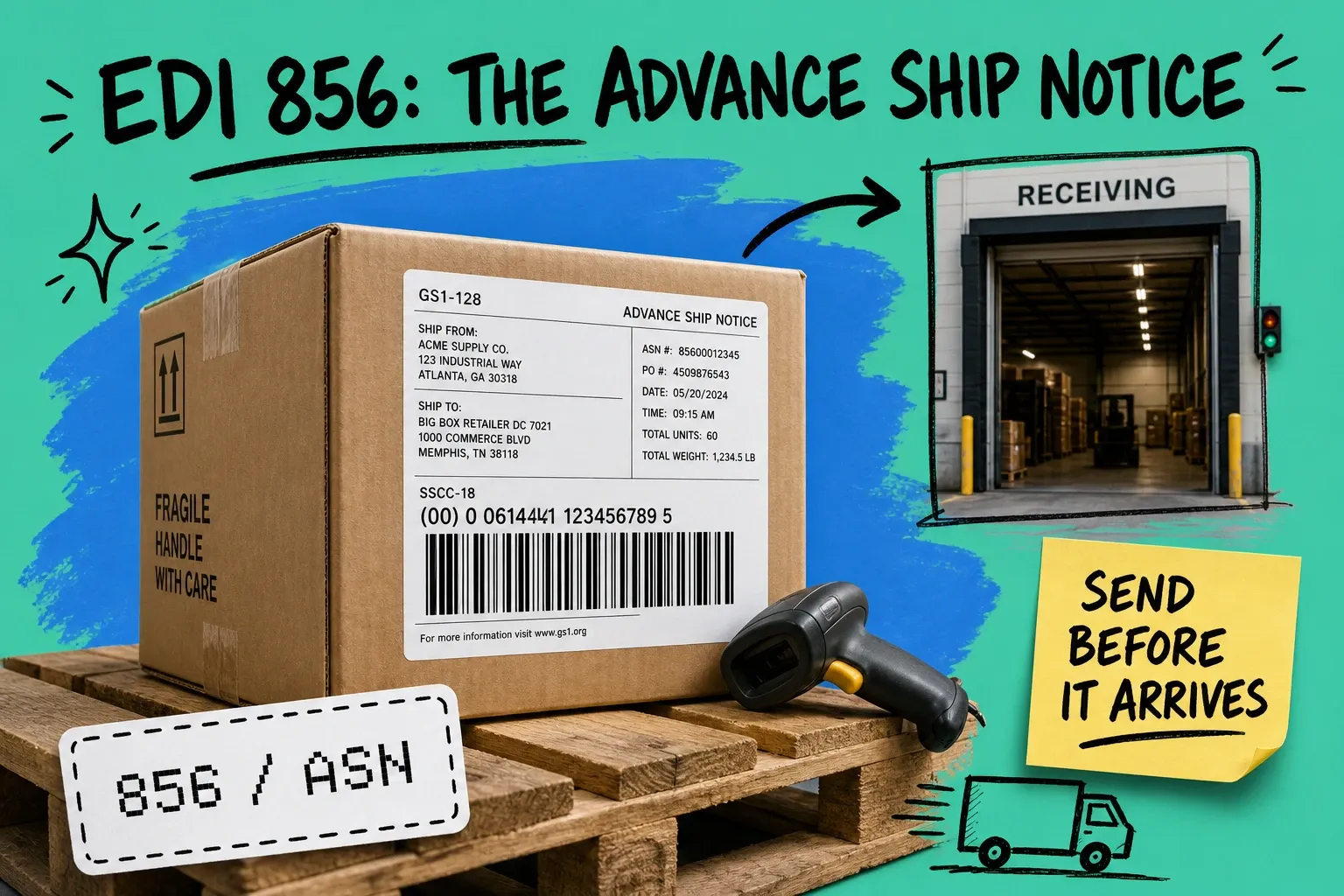
An EDI ASN is the 856 transaction, the electronic advance ship notice you send a retailer before your shipment reaches their dock. It tells the buyer exactly what is coming, how it is packed, and when it will land, so their receiving team can scan it in within minutes instead of unpacking blind. Get it right and your freight flows through. Get it late or wrong and you eat a chargeback.
An EDI 856 (ASN) is a standardized electronic document that describes the contents, packaging, carrier, and timing of a shipment before it physically arrives at the buyer. EDI stands for electronic data interchange, the computer-to-computer exchange of business documents in a common format, and ASN stands for advance ship notice. So "edi asn," "the 856," and "advance ship notice" all point at the same file.
This matters because retailers run their docks on that file. The EDI software market reached about $2.6 billion in 2025 and is on track to hit $4.54 billion by 2030, according to Mordor Intelligence, which tells you retail EDI is not a passing requirement you can wait out. If you sell into Walmart, Target, Home Depot, Amazon, or any big-box buyer, a clean 856 is table stakes.
What is an EDI ASN (856)?
An EDI ASN is a shipment-level notification. When a purchase order is ready to ship, you build an 856 that mirrors the physical load: which cartons sit on which pallets, which items sit in which cartons, and how the whole thing is traveling. You transmit it while the truck is en route, so the retailer knows the shipment before it hits the receiving door.
Retailers treat the 856 as the source of truth for inbound receiving. Their warehouse management system (WMS, the software that runs the warehouse floor) reads your ASN, expects those exact cartons, and scans each SSCC-18 barcode against it. SSCC stands for serial shipping container code, the unique 18-digit number on each carton or pallet label. If a scan matches the ASN, the carton receives in one beep. If it does not match, a person has to stop and investigate.
ASN and EDI 856 are the same document
Do not overthink the naming. "ASN" is the plain-English name for the document. "856" is its number in the ANSI X12 EDI standard used across North American retail. A routing guide might say "transmit your 856" on one page and "your ASN must be accurate" on the next. Both refer to the file you are reading about here.
What does an EDI 856 contain?
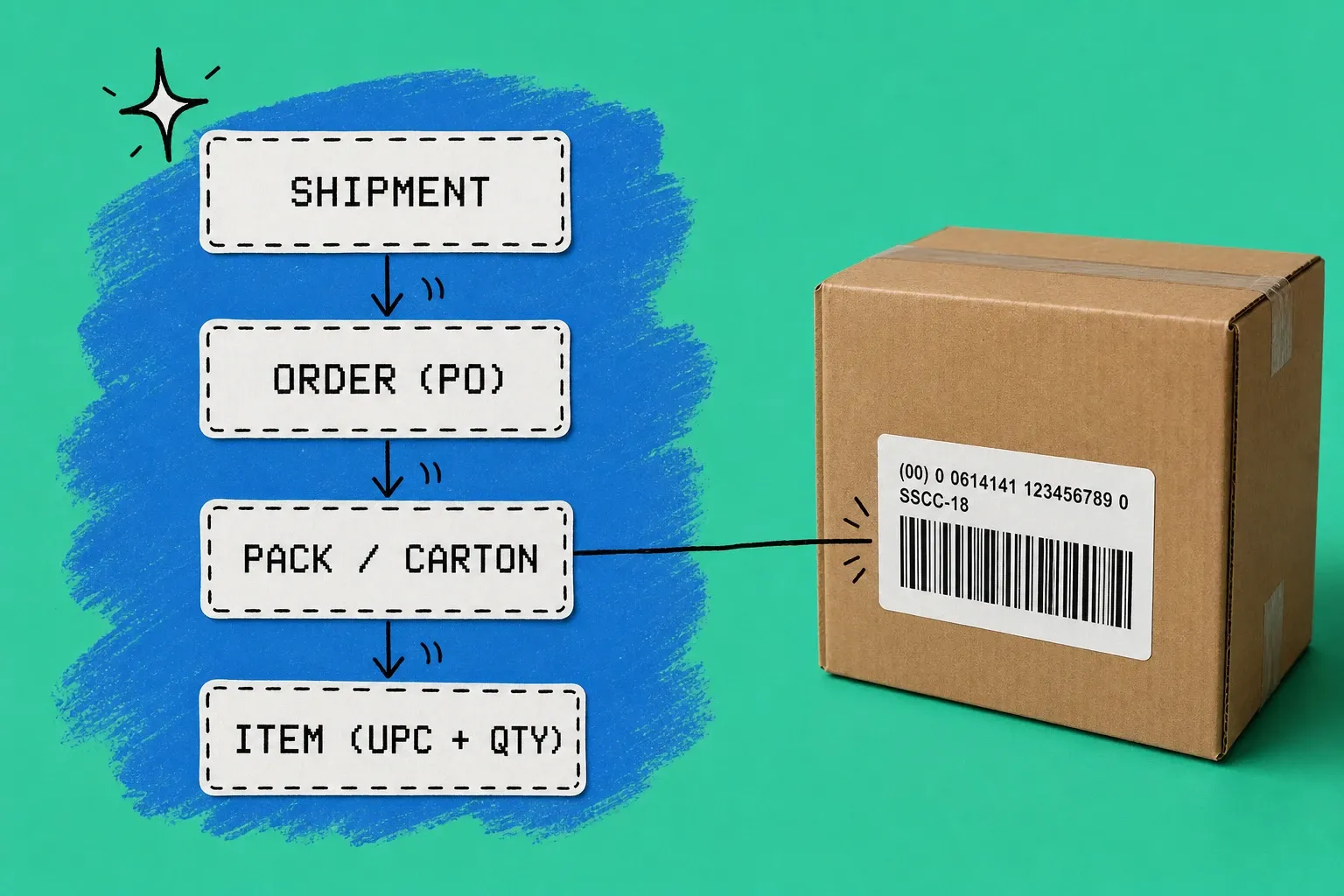
The 856 is built on a hierarchical loop, usually called the HL structure. It nests four levels so the receiver can walk from the whole truck down to a single unit: Shipment, then Order, then Pack (tare and pack), then Item. That nesting is what lets a scanner tie one carton back to one purchase order line.
Here is a simplified segment breakdown of a typical 856:
- ST and SE: open and close the transaction set.
- BSN: beginning segment, carries the shipment identifier and date/time.
- HL: hierarchical level segments that define Shipment, Order, Pack, and Item and how they relate.
- TD1 / TD5 / TD3: carrier detail, routing, and equipment (the how-it-ships data).
- REF: reference numbers such as the bill of lading (BOL) and the retailer's PO.
- DTM: date/time references, including estimated delivery.
- MAN: the marks-and-numbers segment that carries each SSCC-18 carton barcode.
- PRF / PO1 / SN1: purchase order reference and the item lines with quantities.
- CTT: transaction totals used to validate the whole document.
You do not need to hand-code these segments. Your EDI system or order platform maps your fulfillment data into them. But understanding the structure helps you spot why an ASN failed. A missing MAN segment means a carton label is not tied to the shipment. A quantity mismatch in SN1 means your pick did not match what you promised.
How the ASN fits into the EDI order flow
The 856 does not travel alone. It sits inside a chain of documents that make up a retail transaction, and each one has a job:
- EDI 850 (purchase order): the retailer sends you the order. If you want the full breakdown, see our guide to the EDI 850 purchase order.
- EDI 855 (PO acknowledgment): you confirm what you can fulfill.
- EDI 856 (ASN): you tell the retailer what is shipping and how, before it arrives.
- EDI 810 (invoice): you bill for the shipment.
Retailers run a three-way match across the 850, the 856, and the 810. The order has to line up with what you said you shipped and what you invoiced. When those three disagree, payment gets held or deducted. That is why an accurate ASN is not just a receiving convenience, it is the middle link that keeps your invoice from getting flagged.
How to send an EDI 856 the right way
Sending a compliant 856 is less about the EDI format and more about your warehouse workflow feeding it clean data. Here is the sequence that keeps ASNs accurate.
Pack first, then generate from real data
Build the ASN from what you actually packed, not from the original order. If you generate the 856 off the PO before picking, any short-ship or substitution makes your ASN wrong the moment the carton is sealed. Capture carton contents at pack time and let that feed the 856.
Apply and record SSCC-18 labels
Every carton and pallet needs a scannable GS1-128 label with an SSCC-18 code, and that exact code has to appear in the ASN's MAN segments. Illegible or missing carton labels are a top chargeback cause on their own.
Send inside the retailer's window
Timing is a hard rule. Some retailers want the 856 transmitted within an hour of the trailer closing and always before the truck reaches the dock. Build the send into your ship-confirm step so it fires automatically, not when someone remembers.
Confirm the 997 and reconcile
After you transmit, the retailer returns an EDI 997 functional acknowledgment confirming they received the file. If you get a rejection instead, fix it before the freight lands. Automating this loop is a core piece of EDI integration for ecommerce sellers, and it is where manual processes quietly break.
EDI ASN chargebacks: why retailers fine you
The 856 is the most penalized document in retail EDI. ASN errors generate more supplier penalties than any other EDI document type, with individual fines ranging from about $50 per purchase order at CVS to $1,000 per shipment at Home Depot, according to a supplier chargeback analysis by Inymbus. Amazon, meanwhile, charges roughly 1% to 6% of product cost for ASN accuracy failures, tiered by your compliance rate, based on compliance data compiled by Crstl.
Those fines add up fast because they are deducted straight from your payment, not billed separately. A late ASN, a carton count that does not match, or a missing SSCC label can each trigger a deduction, and a single non-compliant truck can carry several at once. This is also why order exception management belongs upstream of your ASN: catch the short-ship or mislabel before the 856 goes out, not after the chargeback lands.
The common triggers are predictable:
- Late transmission: the ASN arrives after the shipment does.
- Quantity mismatch: the 856 says 200 cartons, 195 show up.
- Label problems: missing or unreadable SSCC-18 barcodes.
- Missing data: no BOL, no PO reference, or an incomplete HL structure.
Every one of those is preventable with data captured at pack time and an automated send.
How OmniOrders keeps your ASNs compliant
Most ASN chargebacks are not an EDI problem, they are a data problem. The 856 was built from the order instead of the pack, or it went out late because a human had to trigger it. Both disappear when your order platform generates the ASN from real fulfillment data and transmits it on ship-confirm.
That is the job OmniOrders does. As a multichannel order and inventory platform, it captures what actually gets packed, applies and records SSCC-18 carton labels, and auto-builds a compliant 856 the moment a shipment confirms, then watches the 997 so a rejection never slips past you. You keep selling into big-box retail without turning ASN compliance into a full-time job.
If retailer EDI is on your roadmap, start by mapping the 850, 855, 856, and 810 chain for each partner, then automate the ASN first. It is the document that costs you the most when it breaks, and the one that pays back the fastest when you get it right.
Frequently asked questions
What is the difference between an ASN and an EDI 856?
They are the same thing. ASN stands for advance ship notice, and EDI 856 is the transaction code for that document in the ANSI X12 standard. When a retailer asks for your ASN, they mean the 856. You may also see it written as "the 856" or "the shipment notice" in a routing guide.
What is an advance ship notice?
An advance ship notice is an electronic message a supplier sends a buyer before a shipment arrives, describing exactly what is on the way. It covers carrier and tracking details, pallet and carton contents, SSCC-18 barcodes, item quantities, and an estimated arrival time so the receiving team can plan labor and scan goods in fast.
When do you send an EDI 856?
Send the 856 as soon as the shipment leaves your warehouse and before it reaches the retailer's dock. Many retailers require it inside a strict window, sometimes as little as 60 minutes after the trailer closes. A late ASN is one of the most common chargeback triggers, so timing matters as much as accuracy.
What information is required on an EDI 856?
A compliant 856 uses a nested structure that ties the shipment to its orders, packs, and items. Core data includes the shipment ID and date, the purchase order reference, carrier and bill of lading numbers, SSCC-18 carton labels, item UPCs with quantities, and an estimated delivery date. Exact fields vary by retailer, so always confirm against their routing guide.
What happens if your EDI 856 is late or wrong?
The retailer can deduct a chargeback from your payment or reject the shipment at the dock. Fines range from a few dollars per carton to $1,000 or more per shipment, and ASN errors trigger more penalties than any other EDI document. Accurate, on-time 856s protect both your margin and your standing with the buyer.
Start your 14-day free trial
See how OmniOrders connects your sales channels, 3PLs, and carriers into one operational layer — free for 14 days, no credit card.