









Demand Forecasting Methods: A Practical Guide for Ecommerce
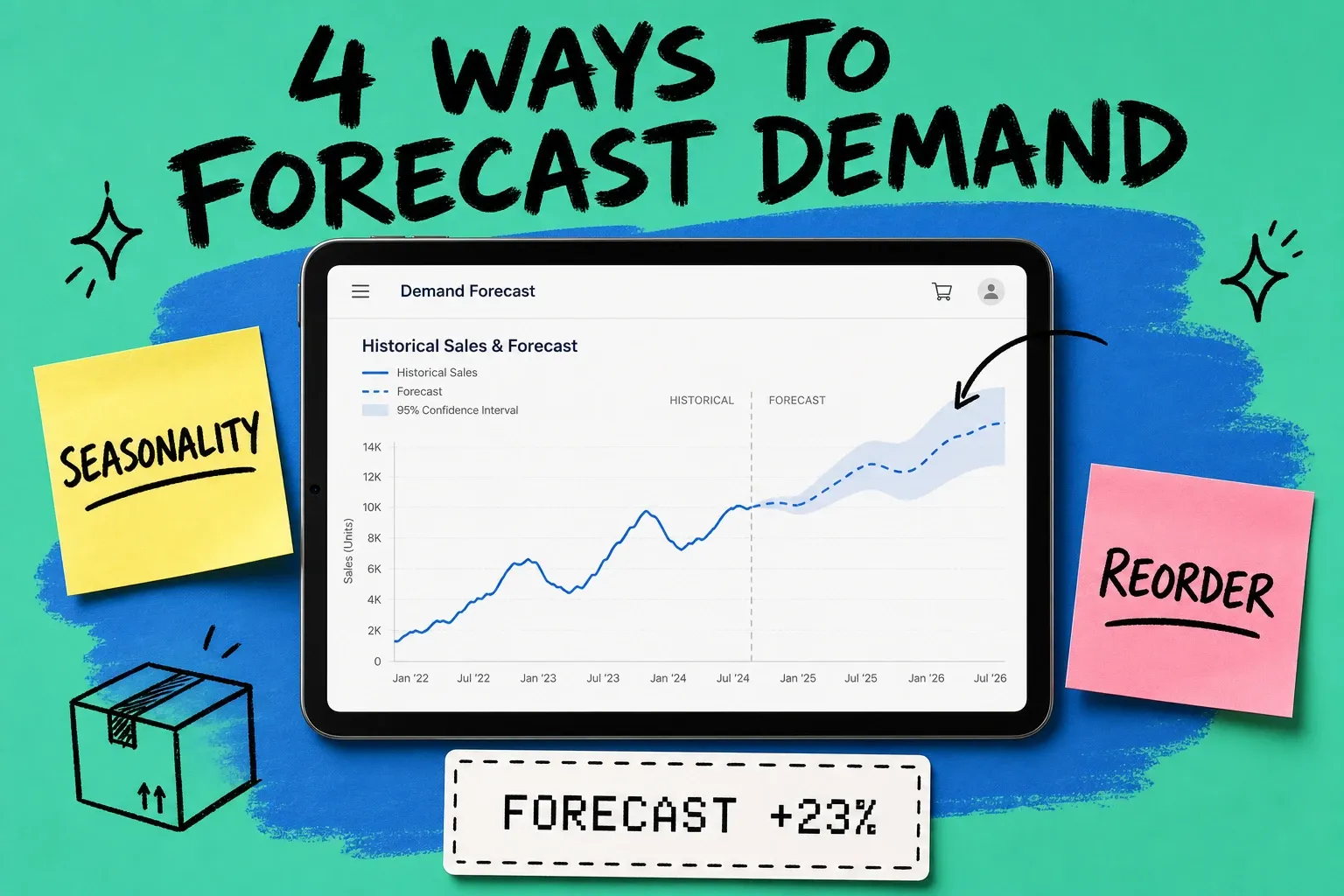
Demand forecasting methods are the techniques you use to predict how much you will sell in a future period. The four you actually need to know are qualitative forecasting, time-series forecasting, causal forecasting, and machine learning forecasting. Qualitative uses human judgment, time-series projects your past sales forward, causal links demand to drivers like price and promotions, and machine learning finds patterns across all of those signals at once.
Demand forecasting is the process of estimating future customer demand for a product using historical sales, market signals, and statistical or machine learning models, so you can buy and stock the right quantity at the right time.
You do not need every method. You need the right mix for your catalog size, your data, and how many channels you sell on. This guide walks through each method, when to use it, and how to get your forecasts more accurate as you grow.
Why does demand forecasting matter for ecommerce?
Get the forecast wrong and you feel it in two directions. Forecast too low and you stock out, losing the sale and often the customer. Forecast too high and cash gets trapped in inventory you eventually mark down.
The cost is not small. IHL Group estimates that retail inventory distortion, the combined damage from out-of-stocks and overstocks, costs the global industry roughly $1.73 trillion a year, or about 6.5 percent of retail sales. Poor demand forecasting sits near the root of both problems.
Better forecasting pays off directly. McKinsey research found that applying AI-driven forecasting to supply chain management can cut forecast errors by 20 to 50 percent and reduce lost sales from product unavailability by up to 65 percent. For a growing store, that is the difference between a smooth Q4 and a scramble.
If you want the full planning picture that sits on top of your forecast, our inventory planning guide covers how to turn a demand number into stock decisions.
What are the main demand forecasting methods?
There are four core methods. Each answers the same question from a different angle, and each fits a different stage of growth.
1. Qualitative forecasting
Qualitative forecasting uses informed human judgment instead of hard numbers. You draw on your sales team, supplier feedback, customer surveys, pre-order signups, and expert opinion to estimate demand.
This is your go-to when you have little or no sales data. Launching a new product, entering a new market, or testing a category with no track record all call for it. The Delphi method, where you gather structured input from several experts and refine it over rounds, is a common formal version.
The weakness is bias. People anchor on recent events and their own hopes. Use qualitative methods to get started, then replace gut feel with data as soon as sales come in.
2. Time-series forecasting
Time-series forecasting projects your historical sales forward. It assumes the future will rhyme with the past, then adjusts for two patterns: trend (are sales generally rising or falling) and seasonality (predictable peaks like the holidays or back-to-school).
Common techniques include moving averages, exponential smoothing, and ARIMA models. These are the workhorses of demand forecasting techniques for established products with steady sales history. If a SKU has sold consistently for a year or more, a time-series model is often accurate and cheap to run.
The catch is that time-series methods only see your own past. They do not know you are about to run a 30 percent promotion or that a competitor just went out of stock. For that, you need causal inputs.
3. Causal forecasting
Causal forecasting links demand to the factors that drive it. Instead of only asking "what did we sell," it asks "what makes us sell more or less." Those drivers might be price, promotions, ad spend, weather, holidays, or the wider economy.
The classic tool here is regression analysis, which measures how much each driver moves demand. Causal models shine when your sales swing with things you can measure and plan around. If a price drop reliably lifts units by a known amount, a causal model turns that relationship into a forecast.
Causal forecasting takes more data and more setup than time-series. You need clean records of both sales and the drivers you think matter. Done well, it captures the promotions and pricing moves that pure time-series models miss.
4. Machine learning forecasting
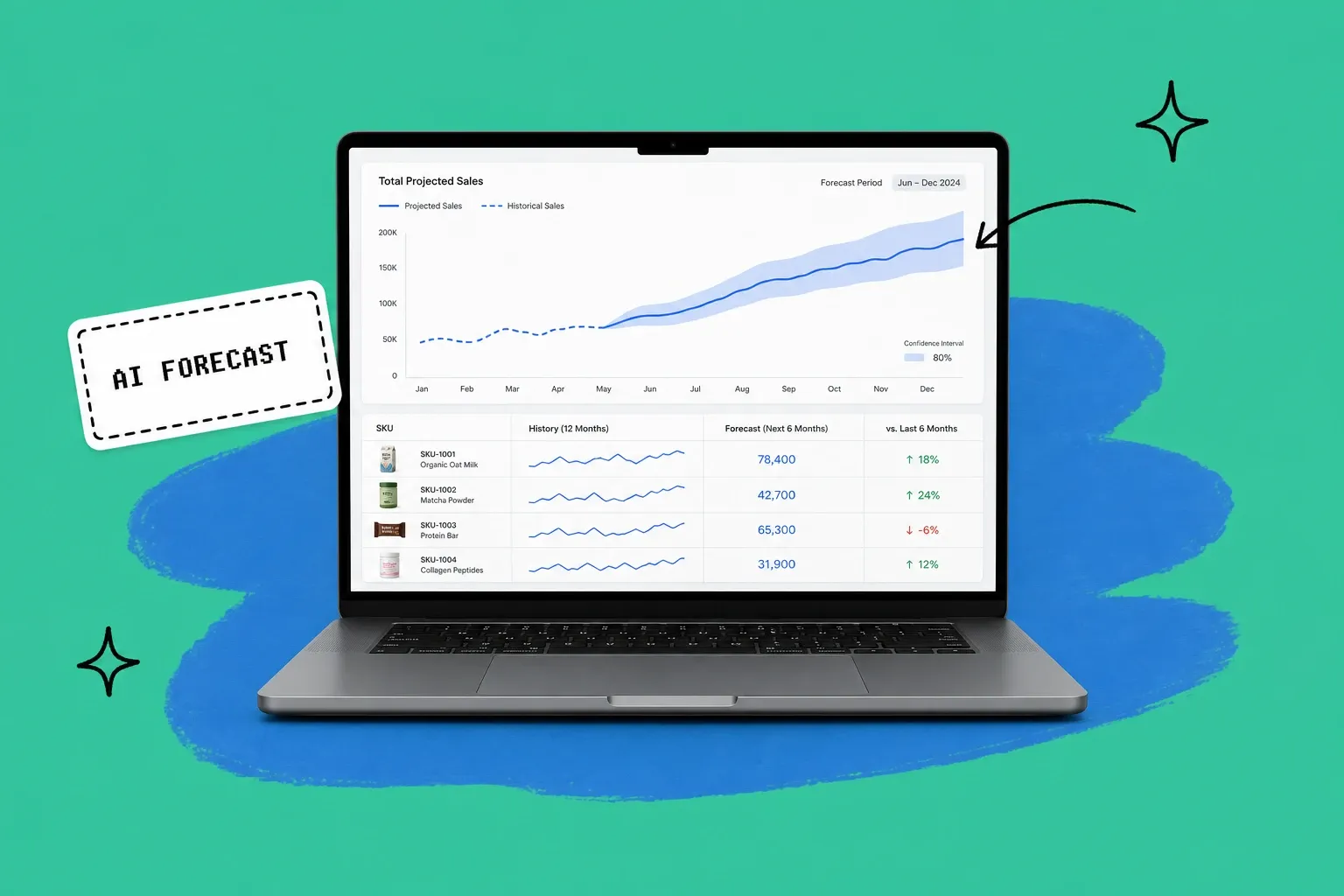
Machine learning forecasting uses models that learn from many signals at once: sales velocity, seasonality, price, channel mix, promotions, and more. Rather than you specifying the relationships, the model finds them and keeps updating as new data arrives.
This is where forecasting scales. Machine learning handles hundreds or thousands of SKUs across multiple channels without a human tuning each one. It also does better on the hard cases, the long-tail and irregular SKUs where simple statistical models fall apart.
The trade-off is data and tooling. Machine learning needs enough clean history to learn from, and it works best inside software that already has your order and inventory data. That is exactly where a modern order management system earns its keep.
Demand forecasting vs demand planning: what is the difference?
People use these terms interchangeably, but they are two steps in a chain.
Demand forecasting is the prediction. It is your best estimate of how many units you will sell in a given period.
Demand planning is what you do with that estimate. It turns the forecast into action: reorder points, safety stock, purchase orders, warehouse allocation, and production schedules. Forecasting answers "how much will we sell." Planning answers "so what do we buy, how much, and when."
You need both. A perfect forecast is useless if it never becomes a purchase order. To connect the two, our reorder point formula guide shows how to turn a demand estimate into a concrete buy signal with safety stock built in.
Which demand forecasting method should you use?
Match the method to your stage, not to what sounds most advanced.
- Brand new product, no history: qualitative forecasting, backed by analogous products and pre-orders.
- Established SKU, steady sales: time-series forecasting with a moving average or exponential smoothing.
- Promo-driven or price-sensitive products: causal forecasting so your models account for the levers you pull.
- Large multi-channel catalog: machine learning forecasting, because manual models cannot keep up.
Most brands run a blend. You might use time-series for your steady core, causal adjustments for promotions, and qualitative overrides for launches. The goal is not method purity. It is a number you trust enough to buy against.
How do you forecast demand for a new product?
New products are the hardest case because there is no history to project. Work through four steps.
First, find an analogous product, a SKU you already sell that behaves like the new one, and use its sales curve as a starting point. Second, pull in market signals: search volume, pre-orders, waitlist signups, and category benchmarks from your suppliers. Third, get structured input from your sales and buying team, and if you sell wholesale, from your accounts. Fourth, start conservative and plan to reforecast fast.
The first three to four weeks of real sales tell you more than any pre-launch estimate. Watch them closely, then switch the SKU onto a time-series or machine learning model once you have enough data to trust it.
How do you improve demand forecast accuracy?
Forecast accuracy is not one number you fix once. It is a habit. A few moves make the biggest difference.
Track accuracy per SKU, not as a single blended figure. One awful forecast on a long-tail item can hide behind great forecasts on your bestsellers. Measuring per SKU shows you where the money is leaking. Our guide to inventory KPIs that matter covers the metrics worth watching alongside forecast accuracy.
Then clean your data. Forecasts are only as good as the sales history behind them, so strip out one-off spikes (a viral moment, a stockout that flattened demand) before you model. Reforecast on a regular cadence rather than setting it and forgetting it, and feed known future events, promotions, launches, price changes, into the model instead of hoping it guesses.
Finally, unify your channels. If you sell on Shopify, Amazon, and a marketplace or two, a forecast built on one channel is blind to the others. Pooling demand across every channel is where accuracy jumps, and where most spreadsheet setups give up.
When does AI beat a spreadsheet?
A spreadsheet is fine until it is not. If you sell a few dozen SKUs on one channel, moving averages in a well-built sheet will serve you well. The tipping point comes with scale.
Once you are selling hundreds of SKUs across several channels, seasonality, promotions, and channel mix all move at the same time, and no analyst can retune every model by hand each week. That is the gap AI closes. Yet adoption is still early: McKinsey's 2025 supply chain survey found only 19 percent of companies deploy AI at scale, so getting this right is still a real edge rather than table stakes.
This is where your systems matter more than your math. AI forecasting works best when it sits on top of live order and inventory data across every channel, which is what a multichannel order management platform like OmniOrders is built to provide. When your sales velocity, seasonality, and channel mix all live in one place, machine learning has the clean, unified history it needs to outperform a manual model, and your forecast flows straight into reorder points and purchase orders instead of another spreadsheet tab.
Start with the method that fits your stage today. As your catalog and channels grow, let the data, and the tools that centralize it, carry more of the forecasting load.
Frequently asked questions
What are the four main methods of demand forecasting?
The four main methods are qualitative forecasting (expert judgment, sales team input, and customer surveys), time-series forecasting (projecting trend and seasonality from past sales), causal forecasting (linking demand to drivers like price, promotions, and weather), and machine learning forecasting (models that learn patterns across many signals at once). Most brands combine two or three rather than relying on a single method.
What is the difference between demand forecasting and demand planning?
Demand forecasting is the prediction itself, your best estimate of how many units you will sell. Demand planning is what you do with that prediction: setting reorder points, safety stock, purchase orders, and production schedules so the right stock is in the right place. Forecasting answers "how much will we sell," and planning answers "so what do we buy and when."
How do you forecast demand for a new product with no sales history?
Without history you lean on qualitative and causal methods. Use analogous products (a similar SKU you already sell), market research and pre-orders, supplier and category benchmarks, and expert judgment from your sales team. Start conservative, watch the first few weeks of real sales closely, and switch to time-series or machine learning methods once you have enough data.
What is a good demand forecast accuracy for ecommerce?
It depends on the SKU. Fast-moving core products can hit 80 to 90 percent accuracy, while new or seasonal items and long-tail SKUs are far harder to predict. Track forecast accuracy per SKU rather than one blended number, and focus improvement on the items where errors cost you the most in lost sales or dead stock.
Can you do demand forecasting in a spreadsheet?
Yes, and many brands start there. A spreadsheet with moving averages or exponential smoothing works fine for a few dozen SKUs on one channel. It breaks down once you sell hundreds of SKUs across multiple marketplaces, because manual models cannot keep up with seasonality, promotions, and channel mix changing at the same time.
Start your 14-day free trial
See how OmniOrders connects your sales channels, 3PLs, and carriers into one operational layer — free for 14 days, no credit card.