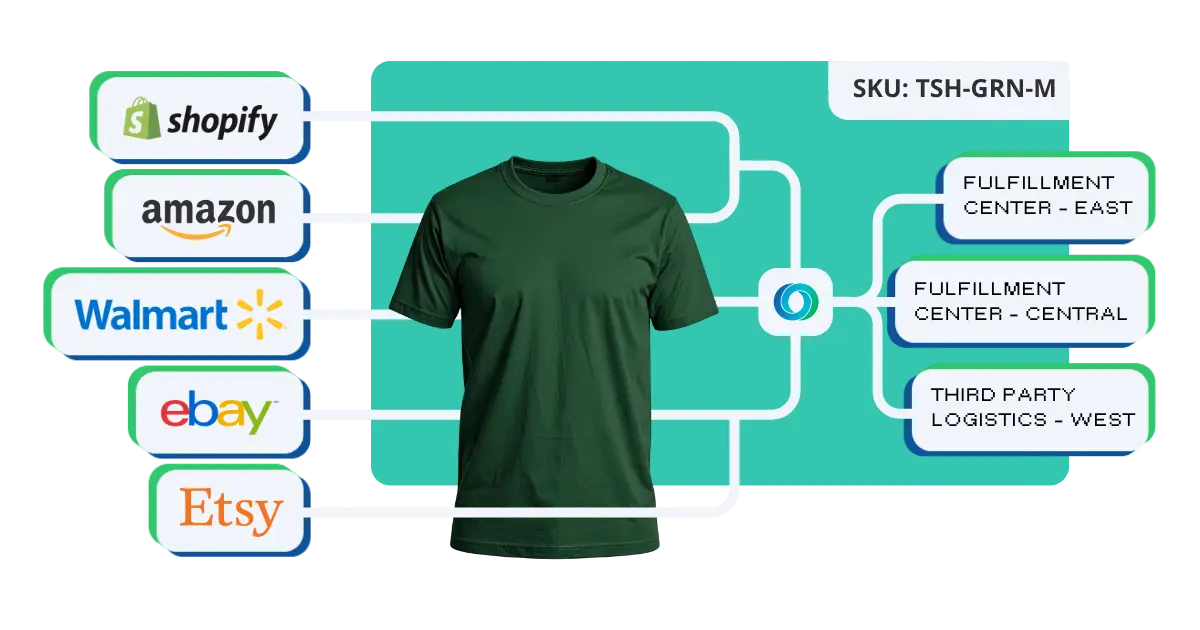
Inventory chaos costs more than you think.

63%

of consumers won't reorder after a stockout

IHL Group retail research

$1.1T

lost annually to inventory distortion worldwide

Overstock, understock, and shrinkage combined

4+ hrs

per week reconciling channel counts manually

Shopify vs. Seller Central vs. WMS portal

OmniOrders unified inventory ledger eliminating stockouts, overstocks, and manual reconciliation

OmniOrders eliminates all three on day one.

One authoritative stock ledger across Shopify, Amazon, Walmart, eBay, and Etsy — with live sync, per-channel safety buffers, and AI forecasting built in. Connect your warehouse, your 3PL, and every storefront you sell through, and watch oversells stop happening. Pair inventory control with order routing and shipping on a single platform, or extend it through our direct channel and carrier connectors to fit the stack you already run.

Start Free Trial

How it works

The inventory lifecycle, end to end.

01

Stock Intake & Receiving

Receive inbound POs, ASNs, and FBA shipments into the correct warehouse or bin location, with barcode scanning at the dock. Every unit is tagged to a canonical SKU, a lot or batch if you track them, and a physical location. The moment stock lands, your sellable quantity updates across every connected channel.

02

Availability Calculation

OmniOrders calculates true available-to-sell in real time by subtracting reserved, allocated, in-transit, and damaged units from on-hand counts across every location. You decide which warehouses and which 3PL nodes feed which channel, so Amazon FBA inventory never double-counts against Shopify and your retail floor stays protected from online demand spikes.

03

Sync & Low-Stock Alerts

Authoritative counts push to Shopify, Amazon, Walmart, eBay, and Etsy within seconds of any change, with per-channel safety buffers applied automatically. Threshold breaches fire Slack or email alerts to the right owner, and reorder-point rules trigger replenishment drafts long before a bestseller hits zero on your highest-margin channel.

04

Replenishment & Forecasting

The forecasting engine blends 90-day velocity, lead time by supplier, seasonality curves, and current in-transit quantities to recommend reorder quantities and timing. Approve a draft PO in one click, or let the automation engine cut POs directly to vendors when a SKU crosses its calculated reorder point.

How to set up inventory sync

Six steps from fragmented stock to one authoritative ledger.

A typical rollout moves a multi-channel brand off spreadsheets and onto OmniOrders in under three weeks. Each step below maps to a setup screen in the app.

  1. 1
    Connect

    Connect your sales channels

    Authenticate Shopify, Amazon Seller Central, Walmart Marketplace, eBay, and Etsy through the native connectors in OmniOrders. Each channel pulls its existing listings, SKUs, and current on-hand quantities so you have a starting baseline without manual CSV uploads.

    5 channels connected Live
    Shopify
    Amazon
    Walmart
    eBay
    Etsy
    + Add
  2. 2
    Catalog

    Consolidate your SKU catalog

    Map every per-channel SKU, FNSKU, and marketplace identifier back to a single canonical SKU in OmniOrders. The catalog tool flags duplicates and orphaned listings, and you resolve each one with a side-by-side merge view so your master catalog reflects one product, many storefronts.

    3 listings → 1 canonical SKU
    Shopify water-bottle-blk-16
    Amazon FNSKU B08YP4QZ9M
    Walmart WM-BWB-16OZ
    Canonical
    WTRBTL-BLK-16OZ
    Black Water Bottle · 16oz
  3. 3
    Thresholds

    Configure safety buffers and thresholds

    Set per-channel safety stock and low-stock thresholds on every SKU or at category level. You might hold a five-unit buffer on Amazon to protect against FBA settlement lag while running Shopify at zero buffer, and reorder alerts fire the moment available-to-sell crosses the line you defined.

    Safety buffer · WTRBTL-BLK-16OZ
    Amazon
    5 units
    Shopify
    0 units
    Walmart
    3 units
    eBay
    2 units
  4. 4
    Real-time sync

    Enable real-time sync and reservation logic

    Turn on bidirectional sync so every order, receipt, return, and transfer updates the master ledger immediately. Reservation logic holds stock the instant an order is placed, so a second shopper on a second channel cannot buy a unit that is already committed to someone else's cart.

    Master ledger · WTRBTL-BLK-16OZ
    Order −1
    Order −2
    Return +1
    On hand
    3,812
    reserved 214 · ATS 3,598
  5. 5
    Allocation

    Set multi-location allocation rules

    Define which warehouses, 3PL nodes, and retail locations feed which channels, and in what priority order. OmniOrders evaluates these rules on every order and on every sync cycle, routing allocation to the location that minimizes split shipments, honors carrier cutoffs, and protects reserve stock for your highest-margin channel.

    Route Shopify orders → priority order
    1 3PL · Reno, NV 52%
    2 Warehouse · Dallas, TX 28%
    3 Retail · Fresno, CA 12%
    4 Reserve · NY 8%
  6. 6
    AI forecasting

    Turn on AI forecasting

    Enable the forecasting engine and review the first set of reorder recommendations. The model blends 90-day sales velocity, supplier lead times, and seasonality curves to suggest order quantities and cut dates, and you can approve, edit, or fully automate PO generation depending on how much control you want to keep.

    90-day forecast · reorder 1,440 by Apr 28
    Velocity
    11.4/d
    Lead time
    21 days
    Reorder
    1,440
    Actual (90d) Forecast
Platform capabilities

Everything your inventory needs to stay honest.

Every capability below reads from and writes to the same ledger the IMS-vs-WMS table above describes — one truth, pushed to every channel and node.

Sync · 3s
12,840 SKUs
Stock health12,840
Healthy Watch Low
Live channels · 5
Shopify
Amazon
Walmart
eBay
Etsy
Channel sync

Live inventory across every channel you sell on.

OmniOrders holds one canonical count per SKU and pushes it to every connected storefront within seconds. Sales, receipts, transfers, and returns flow through the same pipeline, and reservation logic holds units the instant an order lands — so oversells stop happening even during peak traffic.

Syncs every 3 seconds
WTRBTL-BLK-16OZ PO suggested
1,440 units · Apr 28
90 d actual forecast →
AI forecasting

Know when to reorder before you run out.

The forecasting engine blends 90-day velocity, supplier lead time, seasonality, and in-transit quantities into concrete reorder quantities and cut dates. Approve a draft PO in one click, or let automation cut orders the moment a SKU crosses its calculated reorder point.

90-day velocity window
Master SKU WTRBTL-BLK-16OZ Stainless water bottle · 16oz · Matte black
UPC040232145 VariantBLK
Amazon
Amazon · FNSKU X001PMK4Z9
Shopify
Shopify · Variant wtr-blk-16
Walmart
Walmart · Item ID 8829140
Etsy
Etsy · Listing 142003-blk
SKU catalog

One canonical SKU, every channel's alias.

Every per-channel SKU, FNSKU, and marketplace identifier maps back to a single canonical SKU. A merge tool flags duplicates and orphans so your master catalog reflects one product across many storefronts.

FNSKU + barcode support
FC · RNO 3PL · DAL RTL · NYC FBA · ATL
Multi-location

One stock ledger across every node.

Track stock at the location level across in-house warehouses, 3PL nodes, retail backrooms, and Amazon FBA. Allocation rules decide which nodes feed which channels, and pairs naturally with order routing.

Warehouses · 3PLs · Stores
Editing 1,284 SKUs + price · safety
WTRBTL-BLK-16OZ+ $2.00
WTRBTL-NVY-16OZ+ $2.00
WTRBTL-FOR-22OZ+ $2.50
JAR-WT-8OZ
Apply to all
Bulk operations

Edit thousands of SKUs without breaking a sweat.

Update prices, reorder points, safety buffers, and channel assignments across hundreds or thousands of SKUs in one pass. Schedule promo-window price changes, stage seasonal buffers, or run warehouse transfers as reviewable batches with rollback on every change.

CSV import · batch rules
#ops-replen · 2 min ago WTRBTL-BLK-16OZ hit low stock on Amazon
Draft PO · ready to send 1,440 units · Acme Mfg · cut Apr 28
Low-stock alerts

Buffers, thresholds, and draft POs on autopilot.

Threshold breaches fire Slack or email alerts to the right owner, and reorder-point rules generate replenishment drafts long before a bestseller hits zero on your highest-margin channel.

Slack · email · draft PO
Who it's for

Built for the brands that live in inventory.

Four playbooks, one ledger.

DTC Apparel

The apparel brand running 1,400 SKUs across 4 channels.

Shopify is your source of truth, but Amazon needs its own SKU format and eBay counts never match. Seasonal curves spike demand on half your catalog at once while the rest sits. With OmniOrders, canonical SKUs carry per-channel aliases, variant-level forecasting weights recent velocity, and Shopify stays the master — everyone else reads from it.

Cut stockout incidents 73% in Q4.

FBA-First Seller

The Amazon seller with half their stock in FBA and half at a 3PL.

FNSKU mapping, settlement lag, and per-warehouse buffers make every reorder decision a coin flip, and FBA inbound slots add another deadline. OmniOrders maps FNSKUs back to canonical SKUs, splits on-hand visibility across FBA and your 3PL, and times replenishment against real inbound windows instead of last week's export.

Reclaimed 9 days of stale FBA buffer per quarter.

Multi-Warehouse Brand

The brand running US East, US West, and a European node.

Split shipments chew up margin, per-region safety stock decisions get made on gut feel, and a cross-border order can pull from the wrong node before anyone catches it. OmniOrders applies allocation rules per region, avoids splits intelligently, and keeps the stock ledger unified so finance and ops see the same numbers.

Dropped split-shipment rate from 34% to 8%.

3PL Customer

The brand whose 3PL runs the warehouse — but you own the inventory truth.

Your 3PL's WMS is great at bin-level picking and terrible at showing you what you can actually sell. Reconciliation lag means reorder decisions get made on stale data, and nobody trusts the Monday numbers. OmniOrders syncs with common 3PL WMS platforms, gives you live on-hand plus inbound visibility, and fires reorder triggers on real-time stock.

Cut reconciliation time from 4 hours/week to 0.

How it works in practice

The work that keeps your ledger honest.

Most multi-channel brands don't have an inventory problem — they have a truth problem. Your Shopify admin says one quantity, Seller Central says another, the 3PL portal shows a third. Every hour those systems disagree is an hour you either oversell or undersell. The fix is one authoritative ledger every channel, warehouse, and 3PL reads from and writes to. Pair it with automated order routing and you process orders against live availability.

Shopify: 132 units Seller Central: 97 units 3PL portal: 114 units One ledger: 114 units
Bulk Editor 1,284 SKUs selected
Field Change Apply all
SKUCurrentNewSafety
WTRBTL-BLK-16OZ $18.00 $20.00 20
WTRBTL-NVY-16OZ $18.00 $20.00 20
WTRBTL-FOR-22OZ $22.00 $24.50 15
JAR-WT-8OZ $14.00 30
BKPCK-GRY-MED $44.00 10
Batch applied · 1,284 SKUs · rollback available
Bulk Operations

Bulk edits across your whole catalog, reviewed as a batch.

The bulk editor updates prices, reorder points, safety buffers, and channel assignments across hundreds or thousands of SKUs in one pass, with CSV import and export for teams who already live in spreadsheets. Schedule a price change for a promo window, bump safety stock on your top fifty SKUs before cyber week, or transfer inventory between two warehouses with a single CSV. The platform applies the changes as a reviewable batch, with rollback if a rule looks wrong.

CSV import & export Reviewable batches Rollback on any change
Aurora Hydration Serum bottle representing a master SKU tracked across warehouse, 3PL, and FBA nodes
Live · 1.2s ago
RNO Warehouse
In-house · 4,210
DAL 3PL Node
ShipEdge · 1,822
Master SKU
AUR-HYD-50ML
Aurora · Hydration Serum
FBA East
Amazon · 602
Ledger synced · 3 locations · 6,634 units
Warehouse & 3PL

Physical stock and the master ledger — always in sync.

OmniOrders tracks stock at the location level — in-house warehouse, 3PL nodes, retail backrooms, Amazon FBA — and connects to leading WMS platforms, so bin locations, cycle counts, and receiving workflows stay under the WMS while the master ledger reflects every movement. A count correction in the 3PL app shows up as updated sellable quantity on Shopify within the same sync cycle.

Syncs every 3 seconds Warehouses · 3PLs · FBA WMS integration
Before & After

What changes when every channel reads from one ledger.

Before OmniOrders

With OmniOrders

Channel-level stock drift causes overselling on Amazon while warehouse pickers hunt for units already committed to Shopify orders.

Live sync pushes authoritative stock counts to every connected sales channel within seconds of a sale, receipt, or transfer.

Reconciliation relies on nightly CSV exports, manual pivot tables, and someone stitching together numbers that are stale by morning.

Reconciliation happens continuously in the background, so your operations dashboard always reflects the real, current sellable quantity.

In-transit units, open POs, and 3PL transfers live in separate spreadsheets that nobody trusts when it matters most.

In-transit stock, open POs, and warehouse transfers roll into a single availability view, tied directly to reorder recommendations.

Low-stock surprises only surface after a bestseller goes out of stock on your highest-traffic channel, usually during a promo window.

Per-channel thresholds and safety buffers notify the right owner before a SKU runs out, not after customer service gets the first complaint.

Replenishment decisions depend on whoever has time to open the supplier tab and eyeball last month's sales in the backend.

Reorder points calculated from velocity, lead time, and seasonality drive replenishment drafts automatically, with one-click approval.

Knowledge base · 8 answers

Everything to know about inventory management software.

Definitions, comparisons, and the operational details multi-channel brands ask first — pulled into one place so you (and the engines that summarize this page) don't have to hunt.

Definitions 3
Q01 Definition

What is inventory management software?

Inventory management software is the system of record for everything you sell — one authoritative ledger that tracks stock levels, locations, and movements across every channel and node in real time.

It tracks stock levels, locations, movements, and reorder points across every sales channel and fulfillment node you operate. For a multi-channel brand, inventory management software replaces the tangle of spreadsheets, channel backends, and WMS exports with one ledger that pushes accurate counts to Shopify, Amazon, Walmart, eBay, and Etsy in real time. It calculates available-to-sell, reserves units against live orders, triggers low-stock alerts, and feeds replenishment decisions with data on velocity, lead time, and in-transit quantities.

Q02 Definition

What is multi-channel inventory sync?

Multi-channel inventory sync holds one canonical stock figure per SKU in a central platform and pushes that figure to every connected channel within seconds of any movement.

When a customer buys a unit on Amazon, the platform decrements available-to-sell, applies any per-channel safety buffer, and updates the listing quantity on Shopify, Walmart, eBay, and Etsy within seconds. Receipts, transfers, returns, and adjustments flow through the same pipeline. Reservation logic holds stock the moment an order lands, so two channels cannot both commit the last unit of a SKU you only have one of.

Q03 Definition

What is the difference between inventory management software and a WMS?

Inventory management software owns the commercial picture across channels and nodes. A WMS owns the physical picture inside one building. They solve different problems and typically work together.

Inventory management software owns the commercial picture: what you can sell, where it lives at the facility level, what needs to be reordered, and how stock flows between channels and nodes. A warehouse management system owns the physical picture inside one building: bin-level locations, picker routes, packing stations, and receiving workflows. OmniOrders handles channel sync, allocation, and forecasting across your whole network, and integrates with WMS platforms at your 3PL or in-house warehouse so bin-level pick operations stay efficient while the master ledger stays accurate.

IMS vs. WMS at a glance

Inventory software WMS
Primary function Tracks sellable stock and syncs across every channel Manages bin-level pick, pack, and receiving
What it tracks Available-to-sell, reorder points, in-transit, forecasting Bin locations, cycle counts, picker routes
Who uses it Operations, merchandising, finance, founders Warehouse managers and floor staff
Where it connects Sales channels, 3PLs, suppliers, WMS platforms Scanners, WMS hardware, ERP systems
Operational 5
Q04 Operational

How do you prevent overselling across channels?

Treat one location as the authoritative ledger, reserve units the instant an order lands, and apply per-channel safety buffers — so the one-unit-left moment never turns into three accepted orders.

OmniOrders reserves units the instant an order is created, applies safety buffers to absorb settlement lag on marketplaces like Amazon and Walmart, and uses multi-location allocation rules so channel-specific inventory pools stay honest. When a SKU reaches its floor, listings automatically pause or throttle rather than continuing to accept orders your warehouse cannot fulfill, and the master ledger reflects every channel’s decremented count within the same sync cycle.

Q05 Operational

How does AI-powered inventory forecasting help ecommerce brands?

AI forecasting blends 90-day velocity, supplier lead time, seasonality, and in-transit quantities into concrete reorder quantities and cut dates per SKU.

The model weights recent velocity more heavily than stale data, layers in supplier lead time and seasonality, and flags SKUs that are trending up or down against last year. Instead of a flat reorder point that ignores context, you get a calculated order quantity and a cut date that account for how long your supplier actually takes to ship and how demand usually curves into Q4. For a brand running hundreds of SKUs across multiple channels, forecasting frees the operations manager from weekly spreadsheet work and pushes capital into the SKUs that will actually sell through.

Q06 Operational

How do bulk SKU operations work in OmniOrders?

Bulk SKU operations let you edit prices, reorder points, safety buffers, and channel assignments across thousands of SKUs in a single reviewable batch with rollback on every change.

The bulk editor updates prices, reorder points, safety buffers, and channel assignments across hundreds or thousands of SKUs in one pass, with CSV import and export for teams who already live in spreadsheets. Schedule a price change for a promo window, bump safety stock on your top fifty SKUs before cyber week, or transfer inventory between two warehouses with a single CSV. The platform applies the changes as a reviewable batch with rollback if a rule looks wrong, and bulk SKU creation, listing pauses, and variant edits close the catalog-hygiene loop.

Q07 Operational

How does OmniOrders integrate with my 3PL or WMS?

OmniOrders connects to leading WMS platforms and 3PL APIs so bin-level operations stay under the WMS while the master ledger reflects every movement within the same sync cycle.

The platform connects to leading WMS platforms — including ShipEdge and ShipHero — through native APIs that exchange receipts, adjustments, transfers, and shipped-quantity events. For 3PLs that operate their own portal, OmniOrders maps the 3PL’s product identifiers back to your canonical SKUs and reads on-hand plus inbound visibility on a live cycle. Bin-level pick, pack, and receiving stays under the WMS where it belongs; the master ledger reflects every movement within the same sync cycle, so a count correction in the 3PL app shows up as updated sellable quantity on Shopify within minutes.

Q08 Operational

How does multi-location inventory tracking work?

Multi-location tracking maintains real-time stock counts at every node — in-house warehouses, 3PL nodes, retail backrooms, Amazon FBA — with allocation rules that decide which nodes feed which channels.

Each node has its own real-time on-hand count, inbound queue, and allocation rules. When an order lands, the routing engine picks the cheapest node that can ship complete and decrements its sellable count. Cycle-count variances and adjustments at any node flow back to the master ledger, so finance, ops, and merchandising see the same numbers without weekly reconciliation cycles. Allocation rules let you reserve specific nodes for specific channels — DTC for the warehouse, FBA for Amazon Prime listings — without losing visibility of total network stock.


Ready to trade spreadsheet chaos for one authoritative ledger?

Hundreds of multi-channel brands run their stock, their POs, and their forecasts on OmniOrders — most are live in under three weeks. Start your free trial and see how OmniOrders fits with your existing channels and warehouses.

Start Free Trial

No credit card required · Most brands are live in under 3 weeks