










Amazon MCF: How to Ship Non-Amazon Orders with FBA Inventory
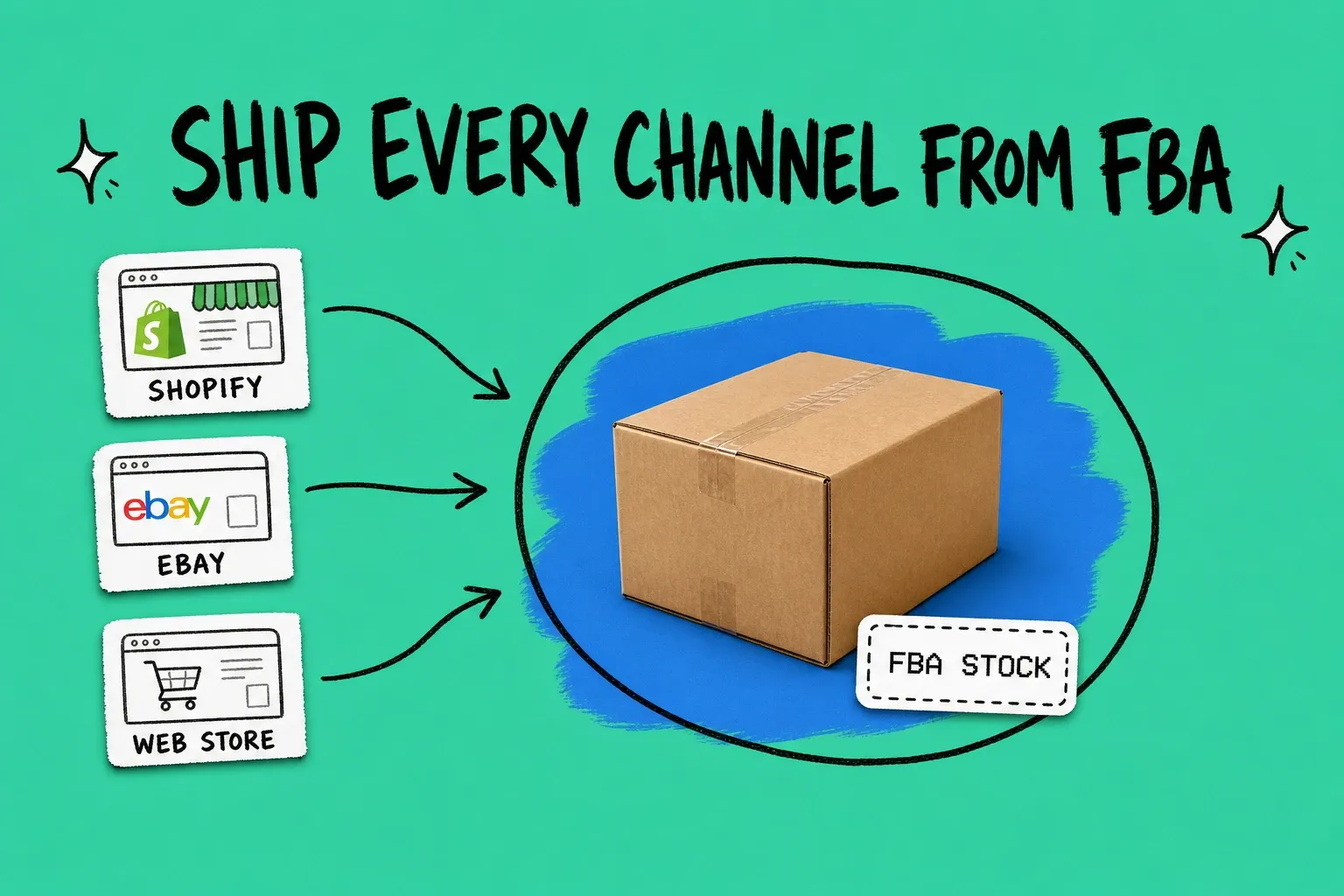
Amazon MCF lets you fulfill orders from your own website, Shopify, eBay, Walmart, and other channels using the same inventory you already store in Amazon's warehouses for FBA. You send Amazon the order, Amazon picks, packs, and ships it, and the box arrives with no Amazon branding on it.
Amazon MCF (Multi-Channel Fulfillment) is a service that uses your Fulfillment by Amazon (FBA) inventory to ship orders placed on non-Amazon sales channels. One stock pool, many storefronts, one warehouse doing the picking and packing.
That is the whole idea. If Amazon already holds your inventory, you can point orders from anywhere at it instead of running a second warehouse or signing with a separate third-party logistics provider (3PL) just to cover your Shopify store.
Whether that is smart depends on your margins, your delivery promises, and how many channels you sell on. This guide walks through how MCF works, what it actually costs in 2026, the packaging rules that changed recently, and when MCF beats a dedicated 3PL (and when it does not).
What is Amazon MCF?
Amazon MCF is Amazon's outsourced fulfillment service for orders that happen off Amazon. FBA fulfills orders placed on the Amazon marketplace. MCF fulfills everything else, using the exact same inventory sitting in the exact same fulfillment centers.
Here is the part that trips people up: your FBA units and your MCF units are the same units. There is no separate "MCF stock." A single tube of lip balm in an Amazon fulfillment center can ship to an Amazon buyer today and a Shopify buyer tomorrow. That shared pool is the reason MCF is attractive. You are not double-buying inventory or splitting it across two locations that each risk running dry.
This matters because marketplaces are where the demand is. Marketplaces now account for 67% of all global ecommerce sales, according to Digital Commerce 360 and eMarketer, and 43% of small and mid-sized online stores sell through at least one marketplace alongside their own site, per the Thuiswinkel.org SMB Monitor. If you already stock inventory at Amazon to chase that marketplace demand, MCF turns that same inventory into a fulfillment engine for your other channels.
MCF vs FBA: the quick distinction
- FBA: ships Amazon marketplace orders. Prime eligible. Referral fees apply.
- MCF: ships non-Amazon orders (Shopify, eBay, Walmart, your site). Not Prime eligible. No referral fee, but higher per-unit fulfillment fees.
If you want the full breakdown of Amazon's fulfillment programs and how MCF sits next to Seller Fulfilled Prime, see our guide on Amazon FBA vs FBM vs Seller Fulfilled Prime.
How does Amazon MCF work?
The flow is simple. A customer orders on a non-Amazon channel, that order reaches MCF, and Amazon fulfills it from your pooled inventory. The only real question is how the order gets to MCF. You have three routes.
1. Manual orders. You log into Seller Central, open the MCF order creation form, enter the customer address and items, and submit. Fine for a handful of orders a week. Painful at any real volume.
2. Prebuilt app or connector. Most ecommerce platforms and order tools have an MCF integration that pushes orders automatically and writes tracking back to the store. This is how most brands run it.
3. The MCF API. For custom stacks, Amazon exposes a fulfillment API so your system can create orders, request rates, and pull tracking programmatically.
Once the order lands, Amazon picks it, packs it in unbranded packaging, hands it to a carrier, and sends tracking. You get charged a per-unit fulfillment fee when the order ships.
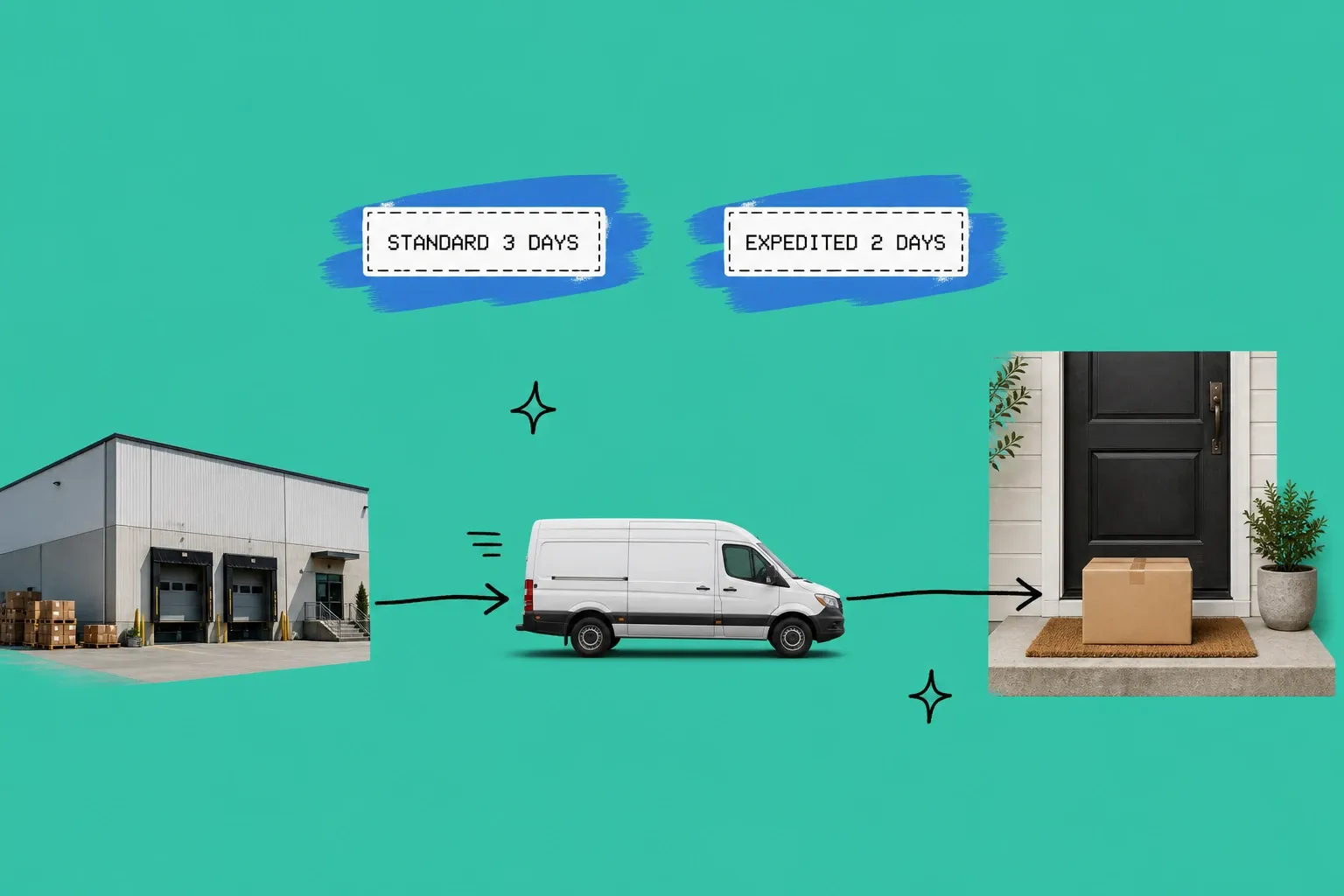
Delivery speeds you can promise
Amazon improved US MCF delivery speeds and simplified the options. As of 2026 there are two domestic speeds:
- Standard: 3 business days (down from the old 5).
- Expedited: 2 business days.
Priority delivery was discontinued; new priority orders now bill at the expedited rate. If you block Amazon Logistics as the carrier (required if you fulfill Walmart orders through MCF), add roughly two extra business days to those timelines.
How much does Amazon MCF cost?
MCF uses per-unit pricing with no monthly fee and no setup fee. You pay only for units you ship. Your fee per order is driven by four things:
- Product size tier (small standard, large standard, large bulky, extra large).
- Shipping weight.
- Units per order (multi-unit orders often cost less per unit).
- Delivery speed (expedited costs more than standard).
The catch is that MCF fulfillment fees run meaningfully higher than the FBA fulfillment fee for the same item, often in the range of 30% to 50% more, because you are paying for fulfillment without the referral-fee relationship that funds cheaper FBA rates. On top of the base fee, Amazon applies a 3.5% fuel and logistics surcharge to US MCF fees as of May 2026, plus a seasonal peak surcharge that runs mid-October to mid-January.
What this means in practice
A small standard item under a pound might cost around 7 dollars to fulfill on standard speed, before surcharges. A large bulky item can run into the high teens or more. Amazon updates the rate card annually and has started adding mid-year surcharges, so pull the current rate card for your exact size tier before you commit a product to MCF. Do not price your free-shipping threshold off last year's numbers.
If you are weighing MCF against running your own warehouse or hiring a logistics partner, our breakdown of 3PL vs in-house fulfillment covers the cost math in detail.
Does Amazon MCF ship in unbranded packaging?
Yes, and this changed in your favor. As of 2026, all eligible MCF orders ship in unbranded "blank box" packaging by default, at no extra cost. The box, tape, and mailers carry no Amazon branding, so your Shopify customer does not receive an Amazon-branded parcel and wonder why.
A few rules to know:
- Packing slips are off by default. Amazon stopped including them automatically in 2026 to cut packaging waste. Turn them back on in settings if you need them.
- Not everything qualifies. Non-sortable inventory, apparel, footwear, and any item over 56 inches on the longest side or heavier than 49.9 pounds are not eligible for unbranded packaging.
- Walmart has extra requirements. If you fulfill Walmart Marketplace orders through MCF, you must block Amazon Logistics as the carrier, or Walmart will reject the fulfillment.
What you do not get with MCF is your own branded box, custom inserts, or marketing collateral. The packaging is neutral, not yours. If unboxing is part of your brand, that is a real limit, and it is one of the clearest reasons brands pair MCF with a 3PL for their hero products.
Amazon MCF vs a dedicated 3PL: which should you use?
There is no universal winner. There is a fit for each order.
Amazon MCF is stronger when:
- You already use FBA and do not want to move or split inventory.
- You want fulfillment live in days, not weeks, with no new warehouse onboarding.
- Your channels sell standard-size, non-fragile goods.
- You need to cover spillover, a new channel launch, or a demand spike without a contract.
A dedicated 3PL is usually stronger when:
- You ship high volume and per-unit cost is the deciding factor.
- You need branded packaging, inserts, kitting, or bundling.
- You sell oversized, fragile, or specialty items MCF handles poorly.
- You want a single fulfillment partner instead of stock trapped inside Amazon.
The trap is treating this as an either-or. It is not. MCF and a 3PL both plug into the same order workflow, and the smart move is usually to run both and route each order to whichever node ships it cheapest and fastest. Amazon's fulfillment centers are close to most US buyers, which makes MCF a genuinely good regional node even if a 3PL carries your core volume.
When Amazon MCF makes sense (and when it does not)
Reach for MCF when speed to launch beats squeezing the last cent out of per-unit cost. New brands testing a Shopify store, sellers who just opened an eBay or Walmart channel, and anyone who needs overflow capacity during Q4 all get value fast because the inventory and the fulfillment muscle are already in place.
Think twice when your margins are thin on heavy or bulky items, when branded unboxing drives repeat purchases, or when a single channel has grown large enough to justify its own cheaper 3PL lane. At that point MCF becomes the backup, not the backbone.
The mistake to avoid is picking one fulfillment method for your whole catalog. Your fastest-moving standard SKUs, your oversized items, and your branded flagship products rarely want the same fulfillment path.
Using Amazon MCF as one node in your fulfillment network
The brands that get the most out of MCF stop thinking of it as "the Amazon option" and start thinking of it as one warehouse among several. FBA covers Amazon. MCF covers spillover and secondary channels. A 3PL or your own warehouse carries branded, oversized, or high-volume orders. Each order flows to the node that fits it.
Running that cleanly needs a layer above the warehouses that sees every channel and every stock location and routes each order automatically. That is where a multichannel order management platform like OmniOrders fits: it connects your Amazon inventory, your 3PL, and your storefronts, keeps stock synced so you do not oversell the shared pool, and applies routing rules that send each order to the cheapest, closest node, whether that is MCF or somewhere else. MCF becomes one lever you pull, not the whole system. For the wider picture, see how omnichannel fulfillment works when every location can ship.
Start by moving your standard, non-branded SKUs to MCF and measure the landed cost per order against your alternatives. Keep the products that need branding or cheaper bulk rates on a 3PL. Let the data, not the logo on the box, decide where each order ships.
Frequently asked questions
What is Amazon MCF and how does it work?
Amazon MCF (Multi-Channel Fulfillment) is a service that ships orders from your non-Amazon sales channels using the inventory you already store in Amazon fulfillment centers. When a customer buys on Shopify, eBay, or your own site, you send that order to MCF (manually, through an app, or through an API) and Amazon picks, packs, and ships it. You pay a per-unit fee and nothing monthly.
Can you use FBA inventory to ship non-Amazon orders?
Yes. That is exactly what MCF does. Your FBA and MCF inventory sit in the same pool inside Amazon's network, so a single unit can fulfill either an Amazon order or an off-Amazon order. You do not need to send Amazon a separate batch of stock for MCF.
How much does Amazon MCF cost?
MCF uses per-unit pricing based on size tier, shipping weight, units per order, and delivery speed, with no monthly or setup fee. Fees typically run higher than standard FBA fulfillment fees for the same item, and a 3.5% fuel and logistics surcharge applies to US MCF fees as of May 2026. Always check the current rate card before committing an ASIN.
Does Amazon MCF ship orders in Amazon-branded boxes?
No. As of 2026 all eligible MCF orders ship in unbranded (blank box) packaging by default at no extra cost, and packing slips are off by default. Non-sortable items, apparel, footwear, and anything over 56 inches or 49.9 pounds are not eligible for unbranded packaging.
Amazon MCF vs a 3PL: which is better?
MCF is faster to turn on and needs no new integrations if you already use FBA, which makes it strong for spillover and launch phases. A dedicated 3PL usually wins on per-unit cost at volume, custom branding and inserts, and kitting. Many brands use both and route each order to whichever node is cheapest and closest.
Start your 14-day free trial
See how OmniOrders connects your sales channels, 3PLs, and carriers into one operational layer — free for 14 days, no credit card.