










UPS API Explained: Direct Carrier Integration vs Your OMS
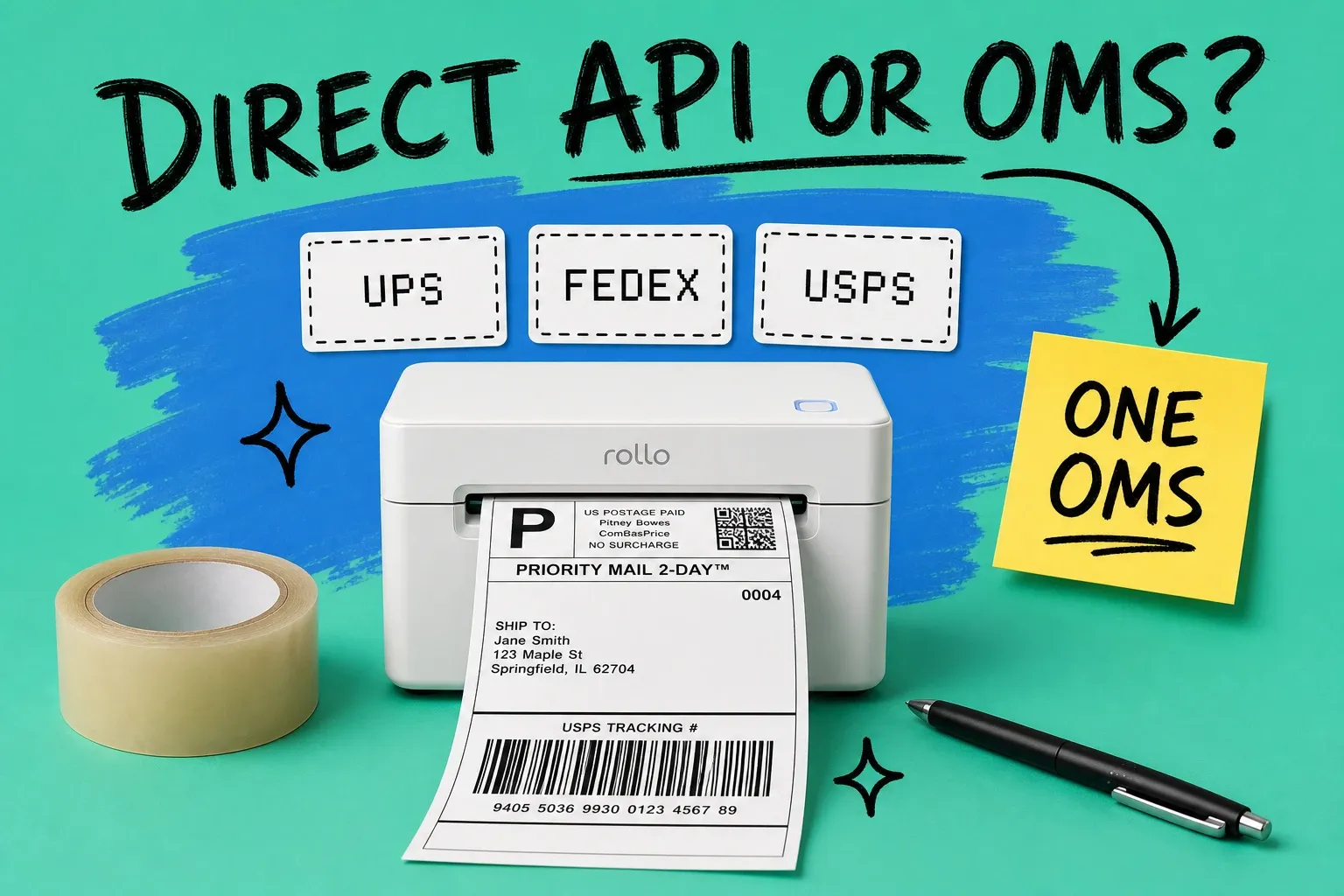
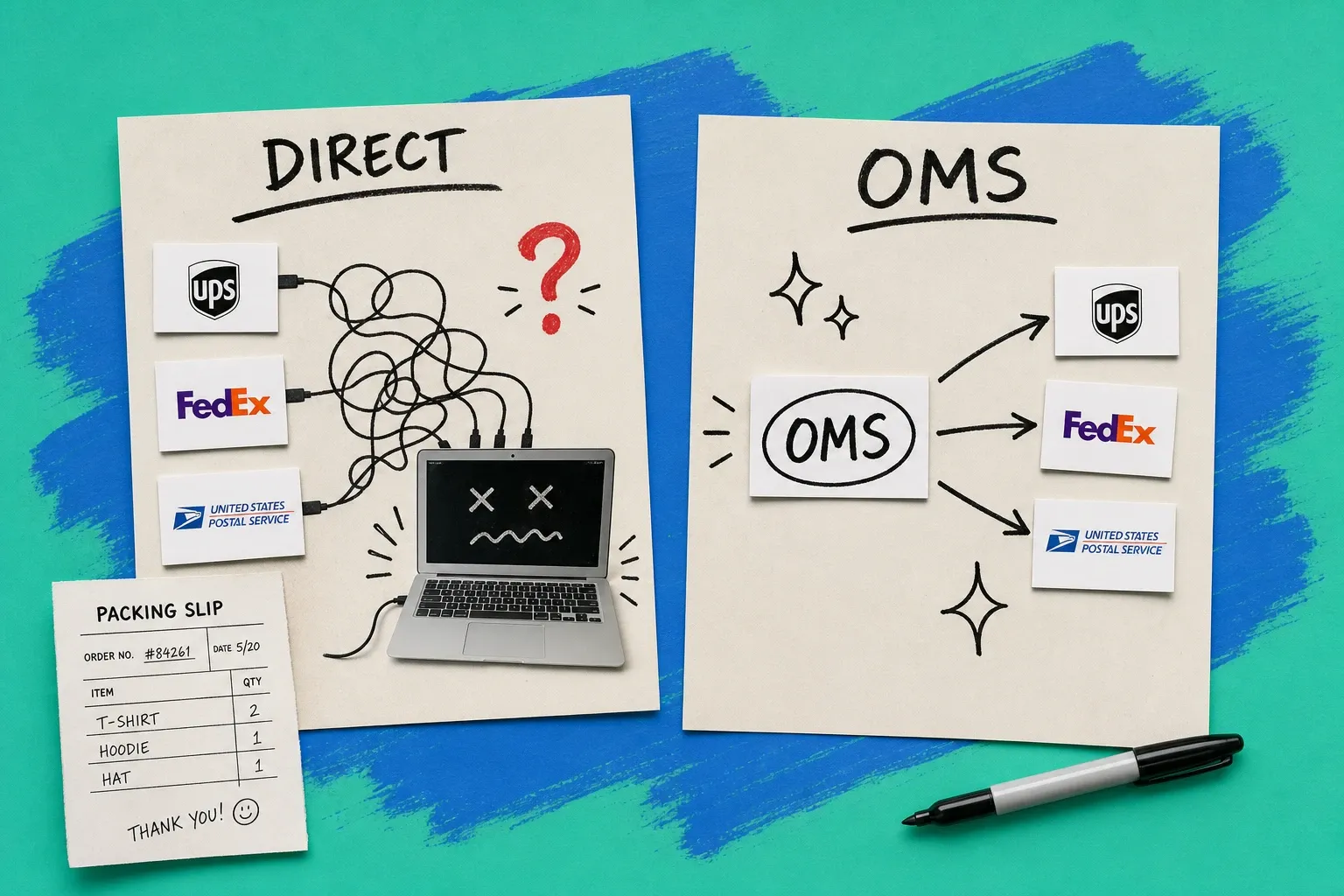
A UPS API is the programmatic interface that lets your software get live UPS rates, create shipping labels, validate addresses, and pull tracking events without clicking through the UPS website. FedEx and USPS publish the same kind of shipping APIs. The real decision for ecommerce operators is not whether those APIs exist. It is whether you should wire each carrier yourself or connect them through your order management system (OMS).
A UPS API is a carrier-owned web service that turns rates, labels, and tracking into machine-readable calls your store or warehouse tools can run automatically.
That distinction matters more in 2026 than it did a few years ago. UPS has already moved fully to OAuth-based REST APIs. USPS has retired older Web Tools versions. FedEx is finishing its SOAP-to-REST cutover. Every one of those migrations is free if someone else owns the connector, and expensive if you do.
What does a UPS API actually do?
Think of the UPS API as a set of jobs your ops stack can call on demand:
- Rating: return service options and prices for a package size, weight, and destination
- Shipping: create the shipment and generate a printable label
- Tracking: return scan events so you can update the customer and your OMS status
- Address validation: catch bad street data before the label is bought
- Time in transit: estimate delivery dates for checkout promises
- Pickup and void: schedule carrier pickups and cancel unused labels
FedEx shipping APIs and FedEx tracking APIs follow the same shape. USPS APIs cover rates, labels, and tracking for postal products. On paper, integrating all three looks straightforward. In practice, each carrier has different auth, payloads, error codes, surcharge logic, and release cadence.
If you only need one carrier forever, a direct UPS API build can be clean. Most brands do not stay on one carrier. They rate shop. They add USPS for light parcels, FedEx for certain zones, and regional carriers for density. That is when three "simple" APIs become a standing engineering project.
Why carrier APIs matter more as shipping costs climb
Shipping is no longer a background line item. According to BCG's 2025 Parcel Study, nine in ten shippers and carriers now rank cost reduction as their top challenge, ahead of speed and customer experience. The same study finds that last-mile delivery accounts for 50% to 60% of total parcel cost.
Industry summaries of 2026 ecommerce shipping economics put the average brand at roughly $8 to $15 per order to ship, with true all-in cost often 25% to 40% higher once fuel, residential, dimensional weight, peak, returns, and failed deliveries are included (GoBolt, 2026 shipping cost analysis).
Those numbers explain why operators obsess over rate shopping and carrier mix. A few dollars saved per package compounds fast. But savings only stick if your rate calls are live, your labels match the quote, and your team is not stuck rebuilding connectors every time a carrier sunsets an endpoint.
For a deeper look at how rate shopping works once carriers are connected, see carrier rate shopping.
How do FedEx and USPS APIs compare to UPS?
Carrier | What teams usually integrate | Auth model today | Operator gotcha |
|---|---|---|---|
UPS | Rating, Shipping, Tracking, Address Validation | OAuth 2.0 REST | Legacy access keys are gone; every new build must use the modern Developer Kit |
FedEx | Rates, Ship, Track, Address Validation | REST (SOAP retirement completing in 2026) | Rate logic and service codes differ from UPS even when the job looks identical |
USPS | Rates, Labels, Tracking | OAuth REST after Web Tools retirement | Older Web Tools versions are dead; postal products and packaging rules still need careful mapping |
A few practical differences operators feel day to day:
- Rate shape: UPS and FedEx quote negotiated account rates differently from retail. USPS pricing depends heavily on package type and commercial vs retail entry points.
- Label formats: ZPL, PNG, PDF, and thermal sizing vary. Your warehouse printers care.
- Tracking granularity: Event codes and delay reasons are not standardized across carriers, so a unified customer notification layer still needs mapping.
- Surcharges: Residential, DAS, AHS, fuel, and peak fees show up differently. If your quote path misses a surcharge that lands on the invoice, margin disappears quietly.
Vendor docs will teach you endpoints. They will not teach you how to keep three carriers consistent inside one pick-pack workflow. That is the OMS job.
Direct carrier integration: when it makes sense
Building straight against the UPS API (and then FedEx, then USPS) can be the right call when:
- You have dedicated engineering. Someone must own credentials, token refresh, retries, webhook handling, label QA, and version migrations.
- Volume justifies the build. At high ship counts, eliminating middleware markups and using exact contract rates can pay for the maintenance.
- You need carrier-specific features. Some account programs, billing arrangements, or branded tracking flows are easiest with first-party credentials.
- Shipping is a core product feature. Marketplaces, 3PLs, and custom platforms sometimes need deep API control that a dashboard OMS will not expose.
The hidden cost is not the first sprint. It is year two. UPS already forced a full auth migration. USPS Web Tools Version 3 shutoff hit in 2026. FedEx SOAP endpoints are on a 2026 retirement path. Each event means retesting rates, labels, voids, and tracking in production-like conditions before peak season. Miss a cutoff and labels stop printing.
Multi-carrier shipping APIs: EasyPost, Shippo, and friends
If you are building custom software but do not want three carrier SDKs, a multi-carrier shipping API is the middle path. EasyPost and Shippo are the names teams usually evaluate. Both expose one interface for rates, labels, address checks, and tracking across many carriers.
Strengths:
- One integration surface instead of three
- Faster expansion into regional or international carriers
- The vendor absorbs many schema and auth changes
Tradeoffs:
- Another vendor relationship and pricing model
- You still have to wire the shipping API into checkout, warehouse tools, inventory, and customer messaging
- Carrier-specific edge cases can still leak through
A shipping API is an excellent building block for engineers. It is not an order operating system. If your pain is "orders sit in five channel inboxes and nobody knows which warehouse should ship," an EasyPost key alone will not fix that.
OMS carrier connectors: the operator-first path
An OMS approach flips the question. Instead of asking "How do we call the UPS API?", you ask "How do we ship every order from the right place at the right cost without manual triage?"
A solid OMS carrier layer typically gives you:
- Account credentials for UPS, FedEx, and USPS stored once
- Live rate shopping at label time (and sometimes at checkout)
- Rules that pick the cheapest service that still hits the promised transit window
- Label printing tied to pick lists, batch waves, and warehouse assignment
- Tracking sync back to Shopify, Amazon, Walmart, and your customer emails
- Holds for address issues, payment risk, or missing SKUs before postage is spent
That is why brands often outgrow a standalone label tool. Shipping decisions sit next to inventory allocation, split shipments, and exception queues. When those systems are separate, you get rate quotes that ignore stock location, or labels printed for orders that should have been held.
If you are rebuilding how free shipping, zones, and margin interact, pair this with a clear ecommerce shipping strategy. After the package leaves, order tracking software is what turns scan events into retention instead of "where's my order?" tickets.
OmniOrders sits in that OMS lane: multichannel orders and inventory in one place, with carrier connections meant to serve the fulfillment workflow rather than force you to maintain three raw API clients.
Direct vs shipping API vs OMS: a quick decision matrix
Situation | Best default |
|---|---|
Custom marketplace or logistics product with a full eng team | Direct carrier APIs or a multi-carrier shipping API |
Shopify/Amazon/Walmart brand with a small ops team | OMS with built-in carrier connectors |
High volume, one dominant negotiated carrier, strong IT | Direct for that carrier, OMS or multi-carrier for the rest |
Need rate shopping across UPS, FedEx, USPS weekly | Multi-carrier API or OMS (not three hand-built clients) |
Peak season in under 90 days and no spare developers | Do not start a direct UPS API project. Use a maintained connector |
A useful rule of thumb: if your team talks about "OAuth scopes" and "webhook retries," a direct or shipping-API path can work. If your team talks about "which warehouse has stock" and "why is this order still awaiting fulfillment," start with the OMS path.
What breaks when you own the UPS API yourself
Operators who have lived through a direct build usually hit the same failure modes:
Credential and environment drift
Sandbox keys work. Production keys do not. Someone rotates a client secret and Friday labels fail. Account numbers, shipper numbers, and meter IDs get mixed across brands or warehouses.
Quote-to-invoice mismatch
Checkout showed $8.12 Ground. The invoice billed $11.40 after residential and DAS. Either your rating call omitted package attributes, or your checkout used a stale table. Live APIs only help if the payload mirrors the real carton.
Partial multi-carrier coverage
You finish UPS. FedEx is "next quarter." USPS stays on a browser workflow. Staff pick the familiar carrier even when it is not the cheapest. The engineering investment never reaches the rate-shopping ROI you modeled.
Migration surprise
A carrier announces a retirement date. Your backlog is full. Peak is eight weeks out. Now you are rewriting auth during the worst possible window. Platforms that already completed the migration remove that cliff.
Ops tooling gap
Even a perfect UPS API client does not assign pickers, sync marketplace tracking, or stop oversells. You still need inventory truth and order orchestration around the shipping calls.
A practical rollout plan (without painting yourself into a corner)
If you are choosing a path this quarter, use this sequence:
- List your real carrier mix. Pull the last 90 days of labels by carrier and service. If 90% of volume is one carrier, optimize that first. If volume is split, prioritize multi-carrier rate shopping.
- Decide who owns migrations. Write it down. If the answer is "our one full-stack hire," prefer an OMS or multi-carrier vendor that ships API updates for you.
- Connect credentials once. Whether through OmniOrders or another OMS, store UPS, FedEx, and USPS accounts in the system that prints labels and updates channels.
- Turn on rate shopping with guardrails. Cheapest eligible service that meets the SLA beats "always UPS Ground" for most catalogs. Start with domestic parcels before international edge cases.
- Measure quote vs invoice for two billing cycles. If variance is high, fix package dimensions and surcharge mapping before you chase another carrier.
- Only then consider a custom direct API. Build it when the OMS cannot express a required workflow, not because a developer portal demo looked easy.
Common misconceptions about carrier APIs
"The UPS API is free, so direct is cheaper." API access is often free or low cost. Engineering time, on-call, and migration work are not. Compare total cost of ownership, not just API fees.
"EasyPost replaces my OMS." It replaces carrier client libraries. You still need order intake, inventory, routing, and channel updates.
"We can hardcode rates and skip APIs." Static tables drift the moment fuel, peak, or contract changes hit. Live rating exists because published PDFs stop being true mid-month.
"Tracking is a nice-to-have." Tracking is how you close the loop with marketplaces and customers. If scan events never return to the channel, you create support load and risk performance metrics.
Bottom line
The UPS API, FedEx APIs, and USPS APIs are the pipes. Your OMS (or a carefully chosen multi-carrier layer) is the plumbing plan. Direct integration is powerful when shipping is a product capability and you have the engineers to keep three moving targets current. For most ecommerce operators, the winning move is simpler: connect UPS, FedEx, and USPS through the same system that already owns orders and inventory, rate shop with live data, and let the platform absorb the next carrier API retirement.
If you want that workflow without maintaining three carrier clients, start by centralizing orders and carrier accounts in one place, then let rate shopping and label rules do the daily optimization.
Frequently asked questions
What is a UPS API used for in ecommerce?
A UPS API lets your store or warehouse software request live shipping rates, create labels, validate addresses, schedule pickups, and pull tracking updates without logging into UPS.com for every order. The same pattern applies to FedEx and USPS APIs. You typically call rating first at checkout or label time, then shipping to print the label, then tracking to keep the customer updated.
Should I integrate UPS, FedEx, and USPS APIs directly?
Direct integrations make sense when you have in-house developers, negotiated contract rates you must surface exactly, and enough volume to justify ongoing maintenance. Most mid-market brands are better off connecting carriers through an OMS or multi-carrier layer so rate shopping, labels, and API migrations live in one place.
How is an OMS carrier connector different from EasyPost or Shippo?
EasyPost and Shippo are shipping APIs that normalize many carriers into one developer interface. An OMS goes further: it ties rate shopping and labels into order routing, inventory allocation, holds, and channel sync. Use a shipping API if you are building custom software. Use an OMS if you need shipping inside the full order workflow.
What happens when UPS, FedEx, or USPS retire a legacy API?
Carriers periodically shut down older auth models and SOAP or Web Tools endpoints in favor of OAuth REST APIs. If you own the direct integration, your team must migrate credentials, rewrite calls, retest labels, and redeploy before the cutoff. If carriers connect through your OMS, the platform usually absorbs that migration for you.
When does direct carrier API integration still win?
Direct wins when you need carrier-specific features your middleware does not expose, when you must eliminate aggregator markups at very high volume, or when compliance requires first-party credentials and branded tracking. Even then, many brands keep one primary carrier direct and route the rest through a multi-carrier or OMS connector.
Start your 14-day free trial
See how OmniOrders connects your sales channels, 3PLs, and carriers into one operational layer — free for 14 days, no credit card.