










Ecommerce Shipping Strategy: How to Offer Free Shipping Without Killing Your Margin
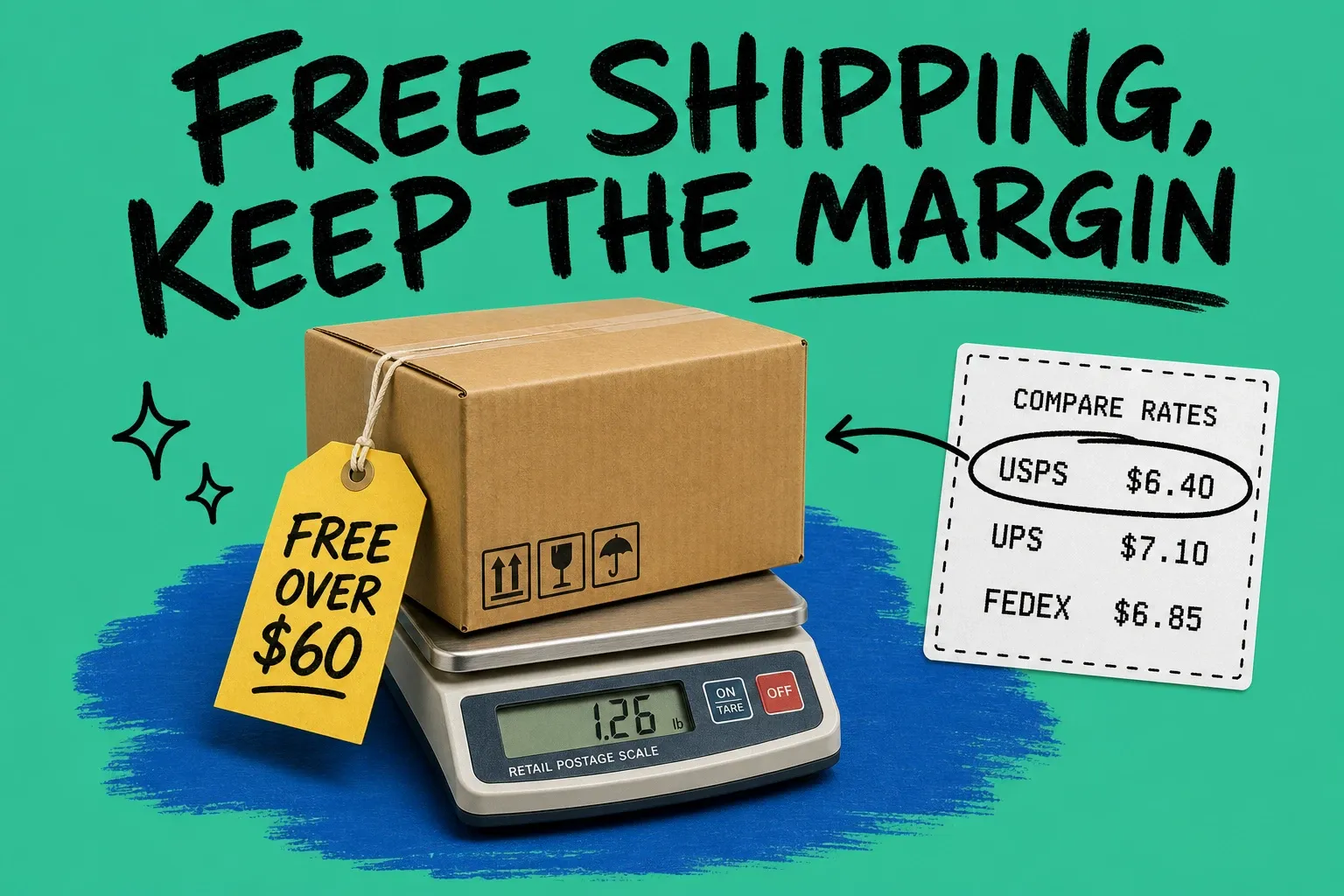
An ecommerce shipping strategy is the set of rules you use to price, route, and fulfill every delivery so orders arrive on time and still turn a profit. The single highest-impact move for most stores is a free shipping threshold set just above your most common order value, funded by cheaper labels and smarter routing rather than by absorbing the cost yourself.
An ecommerce shipping strategy is your playbook for how customers pay for delivery, which carriers and services you use, and where each order ships from, all tuned to protect margin while meeting buyer expectations.
Shipping is not a back-office detail. It decides whether a full cart becomes a sale. According to the Baymard Institute, which surveyed 1,012 US adults in February 2024, 48 percent of shoppers abandon their cart because extra costs like shipping, tax, and fees were too high. That has been the number one reason for abandonment for six straight years. Get shipping right and you fix the biggest leak in your funnel.
Should you offer free shipping on your ecommerce store?
For most stores, yes, but rarely on every order and never for free in the literal sense. Someone always pays for the label. Your job is to decide who, and to make the buyer feel like it is free while your margin stays intact.
The demand is real. In a November 2023 ShipStation survey reported by eMarketer, 34 percent of global shoppers named delivery cost the single most important factor when ordering online, ahead of the 23 percent who cared most about speed. Buyers do not just want fast, they want predictable and cheap.
You have three practical models:
- Threshold free shipping. Free once the cart passes a set dollar amount. This is the default for most brands because it raises average order value while covering cost.
- Baked-in shipping. Roll the shipping cost into product prices and advertise free shipping sitewide. Clean for customers, but it can make individual items look expensive next to competitors.
- Flat rate shipping. One predictable fee per order. Easy to understand and easy to forecast, though it over-charges small orders and under-charges heavy ones.
Skip blanket free shipping only when your margins are thin and your typical order is small, because then every order quietly loses money.
How do you set a free shipping threshold without losing money?
Start with the right number. Do not use your mean average order value, because a handful of large orders drags it upward and hands you a threshold nobody can reach. Use your most common order value, the basket size that shows up most often in your data.
Then set the threshold 15 to 25 percent above that figure. That gap is close enough that shoppers add one more item to qualify, which is exactly the behavior you want.
The economics work because a bigger basket brings more margin, and that extra margin pays for the label. There is a well-documented gap to exploit here. Capital One Shopping research puts the average US free shipping threshold at 64 dollars in 2023, up 23 percent from 2019, while shoppers say they will only spend about 43 dollars to earn it. The brands that win read their own numbers instead of copying that 64 dollar figure blindly.
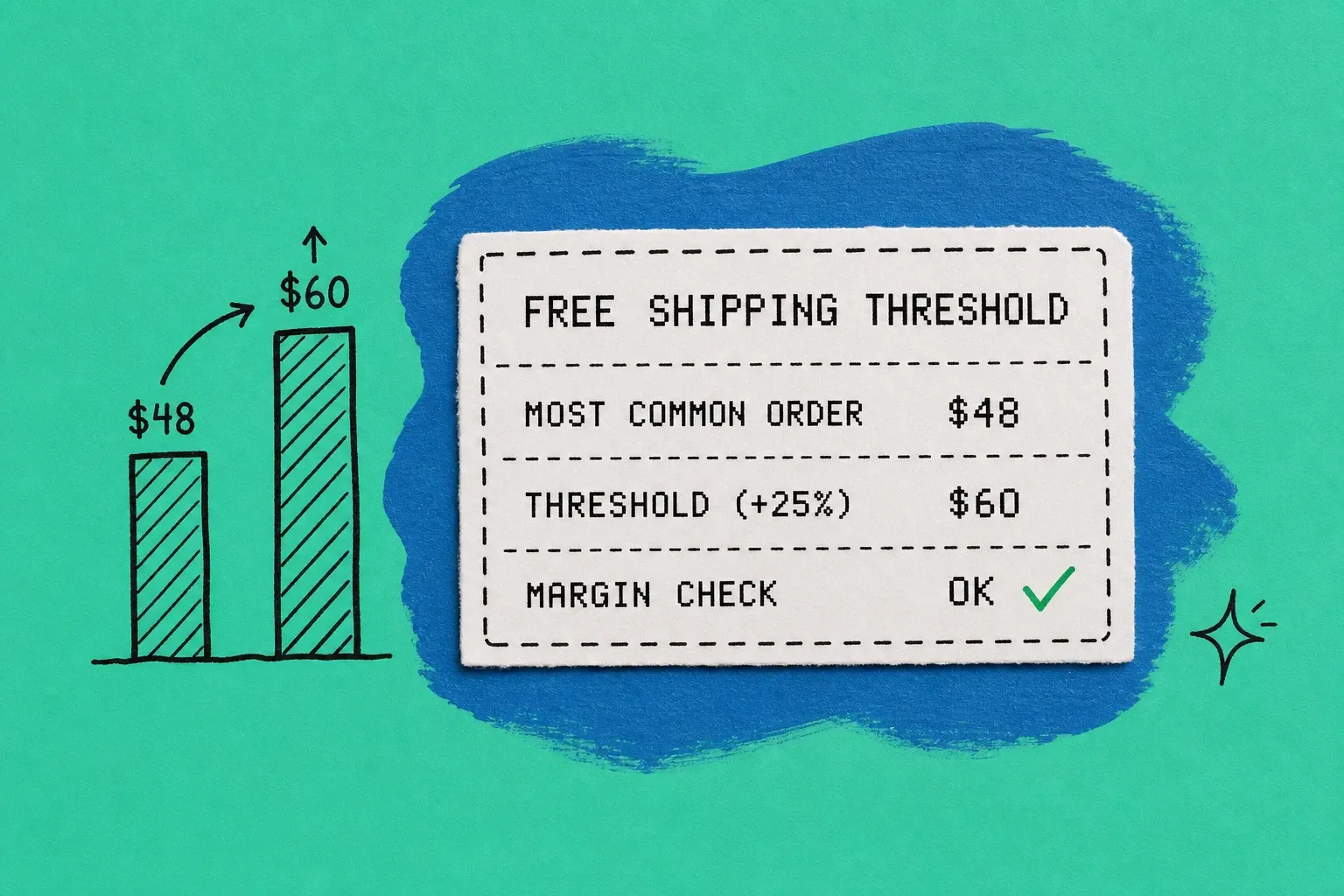
A quick sanity check before you publish a threshold:
- Pull your most common order value from the last 90 days.
- Add 15 to 25 percent to set the candidate threshold.
- Calculate the added gross margin a shopper delivers when they hit that threshold.
- Confirm that margin comfortably exceeds your average shipping cost per order.
If step four fails, raise the threshold or trim your shipping cost before you launch. Do not launch a threshold that loses money on every qualifying order.
How do you set up shipping rates for ecommerce?
You have two broad ways to charge, and most mature stores use both.
Flat and table rates
Flat rate shipping charges one fee regardless of the order, and table rates vary the fee by weight, price, or destination zone. These are simple to set up in Shopify, WooCommerce, or BigCommerce and give customers a number they can predict. The risk is that a fixed rate rarely matches your real cost, so you either overcharge and lose the sale or undercharge and eat the difference.
Real-time carrier rates
Real-time rates pull the live price from UPS, FedEx, USPS, and other carriers at checkout based on the actual cart and address. The customer pays close to true cost, which protects your margin on heavy or far-flung orders. The tradeoff is that a raw carrier rate can scare off a buyer, which is why most brands pair real-time rates with a free shipping threshold that hides the number for larger carts.
Whichever you choose, define a clear delivery promise. Buyers want a date, not a vague service name, so surface an estimated arrival window rather than only "ground" or "expedited."
What is dimensional weight and why does it inflate your shipping cost?
Dimensional weight, often called DIM weight, is a carrier pricing method based on how much space a package takes up rather than how heavy it is. The carrier multiplies length by width by height, divides by a DIM divisor, and bills you on whichever is larger, the actual weight or the dimensional weight.
This is why a pillow in an oversized box can cost as much to ship as a dumbbell. Light, bulky products are the most exposed. Two fixes cut the pain fast:
- Right-size your boxes. Every inch of empty space is space you pay to move. Match box size to product size and use fewer box types than you think you need.
- Audit your worst offenders. Sort your catalog by DIM weight versus actual weight and repackage the items where the gap is widest.
Getting packaging under control also feeds directly into your true cost of selling. If you want the full picture of what each order really costs to deliver, see our guide on landed cost.
How do you reduce ecommerce shipping costs?
Once your pricing model is set, the savings come from execution. Three levers move the needle most.
Rate shop every single order
Rate shopping means comparing live rates from every carrier and service the moment you buy a label, then picking the cheapest option that still hits the promised date. A parcel that ships USPS today and FedEx tomorrow, based on which is cheaper for that exact zone and weight, quietly trims a few percent off most labels. Across thousands of orders, that is real money. We go deep on the mechanics in our guide to carrier rate shopping.
Ship from the closest location
Every zone a package crosses adds cost. If you hold stock in more than one warehouse, store, or 3PL, route each order to the node nearest the customer so it travels fewer zones and arrives sooner. That single change lowers both cost and delivery time at once. This is the core idea behind omnichannel fulfillment.
Negotiate and consolidate
Once you have steady volume, carriers will talk. Bring your shipment data to the table and ask for zone-based discounts. Consolidating onto fewer carriers can also earn better tiers than spreading volume thin across many.
Putting your ecommerce shipping strategy together
A strong strategy is not one big decision, it is a handful of connected ones: a free shipping threshold set from your real order data, a pricing model that protects margin on outlier orders, packaging that beats dimensional weight, and execution that rate shops and routes every order automatically.
The hard part is doing all of that on every order without a human touching it. That is where a system that ships from the right location and rate shops carriers automatically earns its keep. OmniOrders connects your channels, warehouses, and carriers so each order picks the cheapest ship-from node and the cheapest compliant label on its own, which turns shipping from a margin drain into a lever you actually control.
Start with the threshold. Pull your most common order value this week, set a threshold above it, and confirm the math covers your cost. It is the fastest way to lift conversion and average order value at the same time.
Frequently asked questions
Should you offer free shipping on your ecommerce store?
For most stores, yes, but tie it to a minimum order value instead of giving it away on every order. Extra costs like shipping are the number one reason shoppers abandon carts, so hiding the fee inside a threshold usually lifts conversion and average order value. Only skip free shipping if your margins are thin and your average order is small.
How do you set a free shipping threshold without losing money?
Find your most common order value, not the mean, since a few large orders skew the average. Set the threshold 15 to 25 percent above that number so most shoppers add one more item to reach it. Then confirm the extra margin from the bigger basket covers your real shipping cost at that price point.
What is dimensional weight in shipping?
Dimensional weight, or DIM weight, is a price based on a package's size rather than its actual weight. Carriers divide length times width times height by a DIM divisor and bill you on whichever number is higher. Light but bulky items get hit hardest, so right-sizing boxes is one of the quickest ways to cut cost.
How do you reduce ecommerce shipping costs?
Rate shop every order across carriers so each label uses the cheapest service that meets the promised delivery date, right-size your packaging to beat dimensional weight fees, and ship from the location closest to the customer. Negotiating rates once you have volume and consolidating carriers also help.
What is rate shopping in shipping?
Rate shopping is comparing live rates from every connected carrier and service at the moment you buy a label, then picking the cheapest option that still hits the delivery window. Done automatically for every order, it trims a few percent off most labels, which adds up fast across thousands of shipments.
Start your 14-day free trial
See how OmniOrders connects your sales channels, 3PLs, and carriers into one operational layer — free for 14 days, no credit card.