










AI Inventory Management: How Machine Learning Cuts Stockouts and Overstock
AI inventory management uses machine learning algorithms to analyze sales history, demand signals, and supply chain variables to generate accurate stock forecasts, trigger automated reorder purchase orders, and continuously adjust safety stock levels without manual intervention. For multi-channel e-commerce brands, it means fewer stockouts on fast movers, less capital tied up in slow movers, and a replenishment loop that runs itself.
The traditional alternative is a spreadsheet model updated weekly by whoever has time. That model breaks down around the time you hit your third sales channel or fifth warehouse. AI does not replace your ops team; it gives them more control over problems that grow faster than headcount can.
What Is AI-Powered Inventory Forecasting?
Forecasting is where machine learning earns its keep first. A traditional forecast uses a rolling average of past sales and a manually set safety stock buffer. You pick 30 days of cover and hope it holds through a promotion or a supplier delay.
A machine learning forecast does something different. It trains on your actual transaction history, weighing recent trends more heavily than older data. It picks up seasonality patterns automatically, so it does not treat Q4 sales volume as the normal Q1 baseline. It can also ingest external signals, such as a product launch, a sales channel promotion, or a supplier lead-time change, and recalculate reorder quantities the same day.
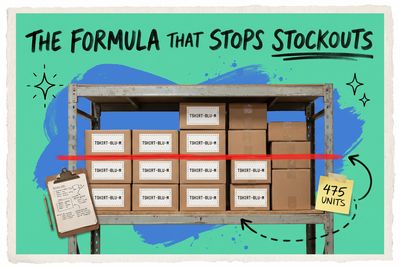
The result is not a number someone typed; it is a probability distribution. The system knows whether a particular SKU's demand is predictable or volatile, and it sets the safety stock accordingly. TSHIRT-BLU-M might run with 12 units of cover; a seasonal candle gift set might need 45. Both are calculated, not guessed.
How Machine Learning Reduces Stockouts
A stockout happens when demand outpaces the point at which you would have reordered. Three failure modes show up repeatedly.
The reorder point was too low. You set it based on average lead time, but your supplier ran late one month and you ran out before the replenishment arrived.
Demand spiked unexpectedly. A product got picked up by a newsletter, a TikTok video, or a retail buyer placing a larger order than usual. Your static safety stock was not sized for the spike.
You did not notice the lead time changed. Your supplier moved from 14 days to 21 days. You found out when the warehouse ran empty.
Machine learning addresses all three. It tracks rolling lead times per supplier and recalculates reorder points when those lead times shift. It weighs recent sales velocity more than historical averages, so a product gaining momentum triggers a reorder before the shelf goes empty. When demand spikes, it recalibrates safety stock upward instead of waiting for the next quarterly review.
Connected to a proper order management system, the AI can also factor in open purchase orders and incoming stock, so it does not reorder stock already in transit.
How Machine Learning Reduces Overstock
Overstock is the problem people talk about less, but it is usually where the money is. Carrying excess inventory locks up working capital, takes up warehouse space, and eventually ends in markdowns.
Overstock usually comes from the same root cause as stockouts: static reorder rules that do not adapt. A product that sold well in Q4 gets the same reorder trigger in Q1, when demand has dropped by 60%. The warehouse fills with units that will not move until summer.
AI inventory management fixes this by applying the same recalibration to slow movers that it applies to fast movers. If a SKU's 90-day velocity is declining, the forecast downgrades the reorder quantity before you place the purchase order. If demand has flattened entirely, the system can flag the product for manual review rather than auto-reordering.
OmniOrders' AI-powered inventory management runs this loop continuously, not on a weekly schedule, so adjustments happen while there is still time to act.
The Closed-Loop Advantage: Forecast to PO Without Leaving the Platform
Here is where most standalone demand-forecasting tools fall short. They give you a great forecast, then hand you a CSV or a dashboard, and someone on your team has to manually create purchase orders, send them to suppliers, and track what is in transit.
That handoff is where accuracy breaks down. The forecast was made on Tuesday. The PO was created on Friday. Between those two events, you sold 40 more units. By the time the stock arrives, your safety stock calculation is already wrong.
OmniOrders closes that loop. The AI generates a reorder recommendation, which can trigger the creation of a draft purchase order automatically, sent directly to your supplier. When stock arrives and is received against that purchase order, the inventory count updates. The AI re-forecasts using the new on-hand quantity as the baseline. No spreadsheet. No manual reconciliation. No gap between the forecast and what actually happened.
You can manage stock levels across multiple locations within the same loop, so a warehouse in New Jersey and a store in Austin stay synchronized in real time. The AI knows the total on-hand quantity, what is allocated to open orders, and what is in transit per location.
Setting Reorder Rules vs. Letting AI Set Them
If you are new to AI inventory software, the most common question is: do I still set reorder points manually, or does the AI handle it?
The answer is both, depending on the SKU.
For your core, high-velocity SKUs, the AI does best when you give it latitude. It has enough transaction history to forecast accurately, and manual overrides tend to introduce more error than they prevent. Set a minimum order quantity for supplier economics, and let the algorithm handle the trigger.
For new products with less than 60 days of sales history, seasonal items, or products where a supplier has a hard lead time or minimum order quantity constraint, a human-set rule often works better as a starting point. The AI can take over as it accumulates data.
OmniOrders automation rules let you define both models on the same platform, routing different SKU categories through different logic without maintaining two separate systems.
AI Inventory Management for E-commerce Multi-Channel Brands
Multi-channel is where AI earns its full return. When you sell on Shopify, Amazon, and Walmart simultaneously, every sale on any channel depletes the same pool of inventory. Without real-time synchronization and AI allocation, you oversell, you carry excess safety stock to compensate for overselling risk, or both.
With AI, the system tracks sell-through rate per channel and adjusts channel allocations dynamically. If Amazon is outselling Shopify 3:1 this week, the allocation logic reflects that. If you run a promotion on one channel, the forecast accounts for the lift before it hits.
This is also where par levels matter. The AI sets par levels per channel and per location based on demand rate, not guesswork. Par level fundamentals are worth understanding if you are setting baseline thresholds before enabling AI-driven reordering, because the AI inherits whatever starting floor you give it.
For brands tracking performance across channels, inventory reporting in e-commerce gives you the visibility layer that makes AI recommendations auditable. You can see what the system forecasted, what actually sold, and where the gaps were.
Getting the Closed Loop Right
The difference between AI inventory management that works and AI that produces a report no one acts on is integration. The forecast needs to connect directly to reorder creation, receiving, and channel sync, all inside the same system.
OmniOrders brings orders, inventory, and fulfillment into one platform, so the AI loop has access to everything it needs: real-time channel demand, supplier lead times, open purchase order status, and multi-location stock counts. The result is a replenishment cycle that runs continuously in the background while your team focuses on the work that cannot be automated.
Start your free OmniOrders trial and see how the AI inventory engine performs against your current stockout and overstock rates.
Frequently asked questions
What is AI inventory management?
AI inventory management uses machine learning algorithms to forecast demand, set reorder points, and trigger replenishment based on sales history, lead times, and external signals. It replaces static, manually maintained stock rules with a system that recalibrates continuously. The goal is fewer stockouts, less overstock, and a replenishment cycle that requires less manual intervention.
What is AI-powered inventory forecasting?
AI-powered inventory forecasting applies machine learning to your sales transaction data to predict future demand at the SKU level. Unlike a simple rolling average, a machine learning model weights recent trends more heavily, detects seasonality automatically, and can adjust for supplier lead time changes. The output is a forecast with a confidence range, which the system uses to calculate safety stock and reorder quantities.
How does machine learning reduce stockouts?
Machine learning reduces stockouts by tracking rolling lead times per supplier, detecting changes in sales velocity before they trigger an out-of-stock, and recalibrating safety stock in response to demand spikes. Because the model recalculates continuously rather than on a weekly or monthly schedule, reorder points stay current even when supplier timelines shift or a product starts trending unexpectedly.
What are the benefits of AI inventory management?
The main benefits are more accurate reorder points, which reduce both stockouts and overstock; less manual work for inventory planning; better capital allocation across SKUs; and faster response to demand shifts. For multi-channel brands specifically, AI also enables smarter channel allocation, so the same pool of inventory is distributed across Shopify, Amazon, and Walmart based on actual sell-through rates rather than static splits.
Is AI inventory management suitable for small e-commerce brands?
AI inventory management is most effective once you have 90 or more days of consistent sales history per SKU and are managing at least a few hundred active SKUs. Smaller catalogs with short histories may not give the model enough data to outperform a well-maintained spreadsheet. Multi-channel brands typically benefit earlier, because the complexity of syncing stock across channels quickly exceeds what manual rules can handle reliably.
Start your 14-day free trial
See how OmniOrders connects your sales channels, 3PLs, and carriers into one operational layer — free for 14 days, no credit card.