










Work in Process Inventory: How to Track WIP Across Fulfillment
Work in process inventory is the value of goods that have started production but are not yet finished and ready to sell. Work in process inventory (WIP) is the money tied up in partly built units, counting the raw materials pulled for them plus the labor and overhead already spent, sitting on your balance sheet between raw materials and finished goods.
If you kit bundles, assemble made-to-order products, or customize items before they ship, some of your stock is never fully "raw" or fully "finished." It is stuck in the middle. That middle is WIP, and if you cannot see it, you cannot promise it to a customer, forecast the components it needs, or close your books accurately.
This is not a niche accounting term. The US Census Bureau put manufacturers' work in process inventories at roughly 275.9 billion dollars at the end of April 2026, up from 259.9 billion dollars in December 2025. That is a large, growing pool of value sitting between materials and finished goods across the economy, and a slice of it belongs to ecommerce brands that build, bundle, or personalize what they sell.
What is work in process inventory?
WIP is the second of the three inventory stages. Raw materials come in, work in process is everything mid build, and finished goods are ready to ship. The term "WIP" simply stands for work in process, and you will also see it written as "work in progress." For ecommerce operations the two phrasings mean the same thing.
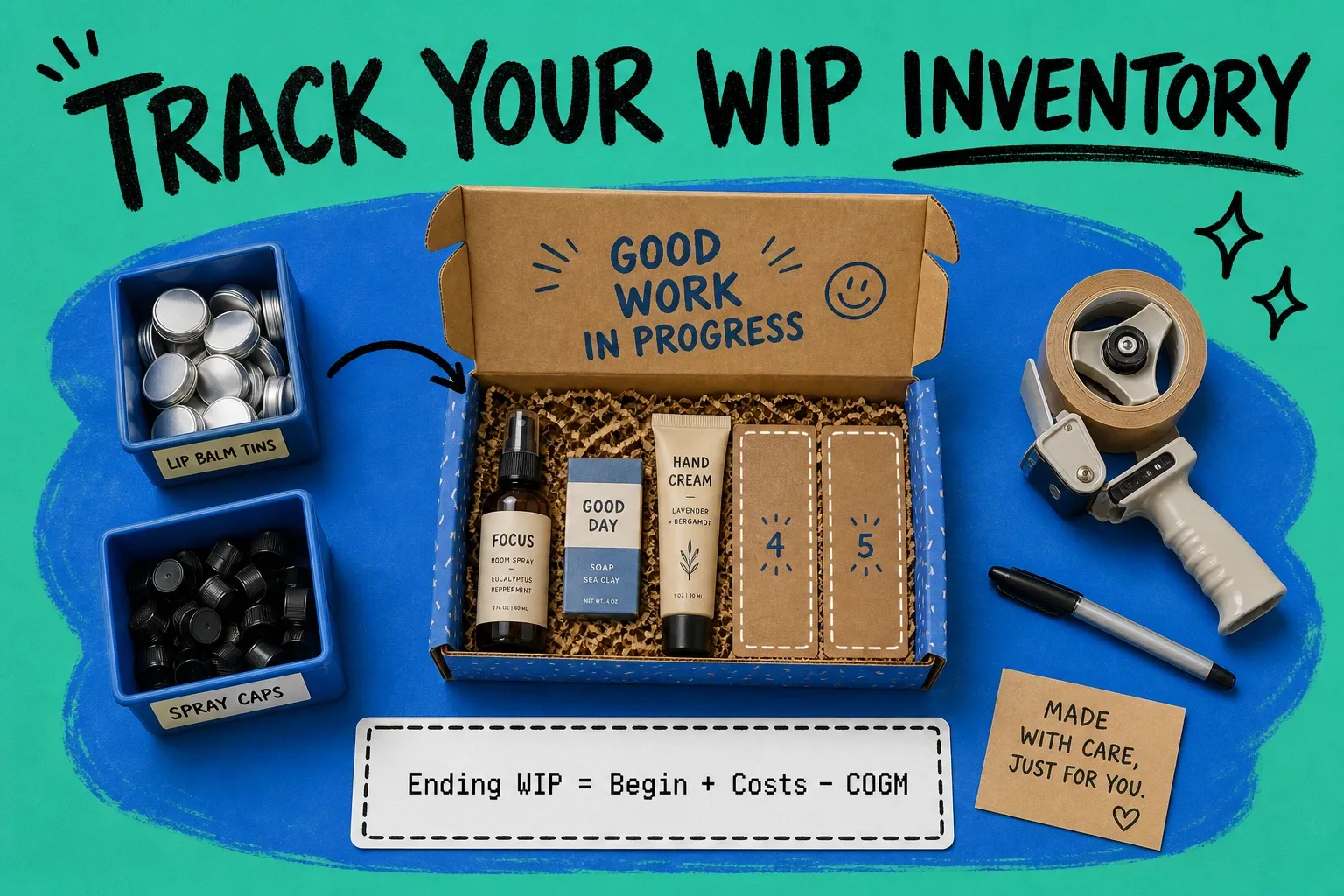
A unit counts as WIP the moment production starts and stops counting the moment it is complete. Picture a subscription box brand. The empty boxes, loose products, and printed inserts are raw materials. A box that has three of its five items packed, waiting on a delayed component, is work in process. A sealed, labeled box ready to ship is a finished good.
WIP matters for two reasons. First, it is real money. Every partly built unit has absorbed materials, labor, and overhead that you have already paid for. Second, it is a promise you may not be able to keep. A half-assembled order is not sellable stock, so counting it as available is how you oversell and disappoint a customer.
Where WIP shows up in ecommerce
You do not need a factory to carry work in process inventory. You carry WIP any time an order passes through a step between "components in the bin" and "packed and ready." Common cases include:
- Kitting and bundles. You combine several SKUs into one sellable unit. Learn more in our guide to bundle SKUs and kit SKUs.
- Made to order and build to order. You assemble the product only after the order lands.
- Personalization. Engraving, embroidery, or custom printing adds a step before the item is finished.
- Light manufacturing. You buy parts and build the final product in house.
What is the work in process inventory formula?
The work in process formula tracks how value flows into and out of the WIP stage over an accounting period:
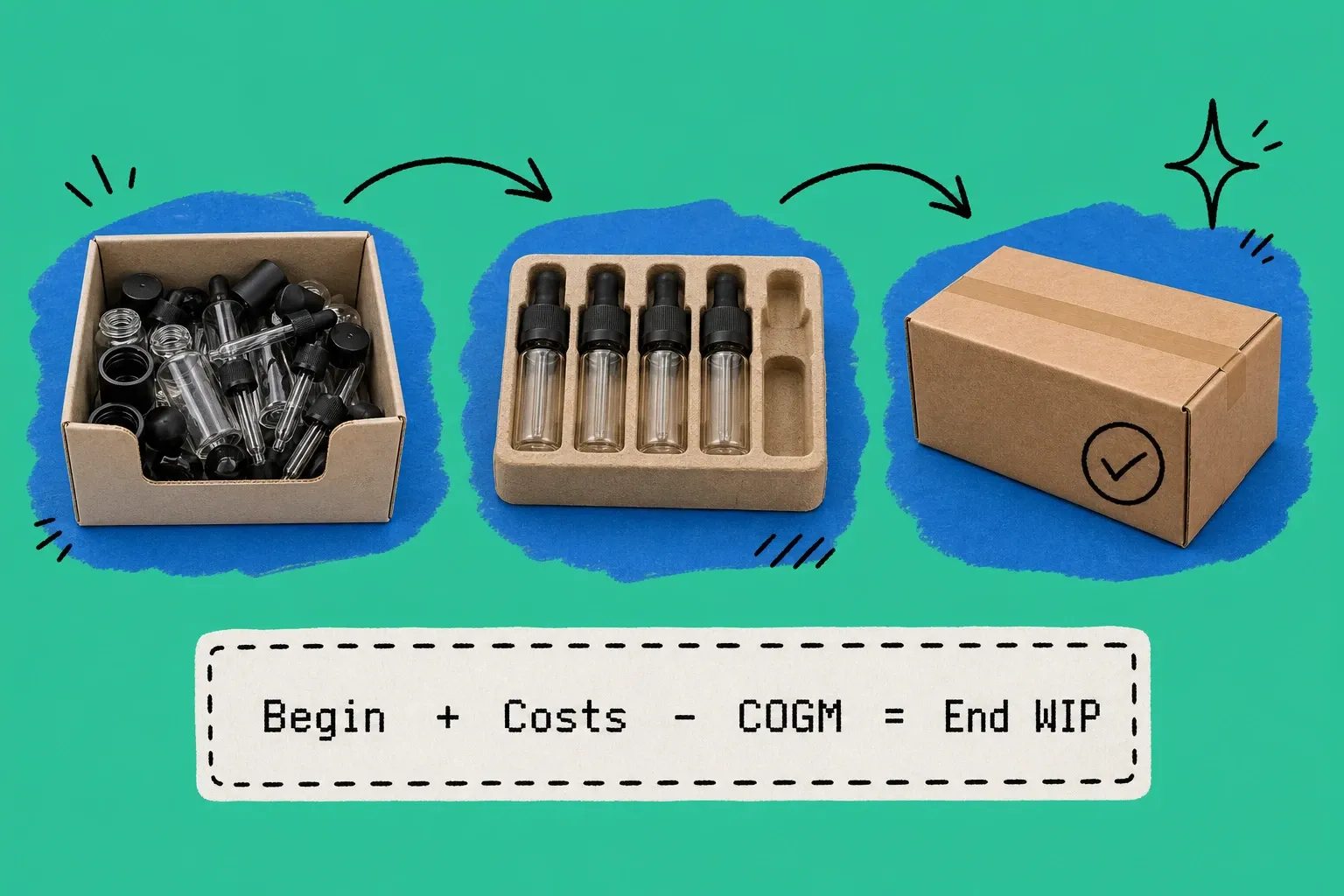
Ending WIP = Beginning WIP + Manufacturing Costs - Cost of Goods Manufactured
Here is what each part means:
- Beginning WIP is the value of unfinished units you carried in from the last period.
- Manufacturing costs are what you added this period: direct materials, direct labor, and manufacturing overhead.
- Cost of goods manufactured (COGM) is the value of units that finished production and moved into finished goods.
Say you start a month with 8,000 dollars of unfinished bundles. During the month you add 20,000 dollars in components, assembly labor, and overhead. You finish and move 22,000 dollars of completed bundles to finished goods. Your ending WIP is 8,000 plus 20,000 minus 22,000, which equals 6,000 dollars still on the floor.
That 6,000 dollars is your beginning WIP for next month. This is why finding beginning work in process inventory is usually easy: it is just last period's ending balance carried forward.
Beginning and ending WIP without a clean history
If you have never tracked WIP before, you will not have a tidy prior balance to roll forward. Start with a physical count. Walk the floor, list every partly built unit, and total the materials, labor, and overhead already applied to each. That total is your opening beginning WIP. From then on, each period's ending WIP becomes the next period's beginning WIP, and the formula does the rest.
How does WIP work in accounting?
In accounting, WIP is a current asset. It sits in its own account on the balance sheet, between raw materials and finished goods. As units move through production, their value flows from raw materials into the WIP account, then out to finished goods when they are complete, and finally to cost of goods sold when they sell.
Most operators keep WIP low on purpose. A large or growing WIP balance can signal a bottleneck: components are getting pulled and started, but units are not finishing and shipping fast enough. That ties up cash and floor space. WIP accounting gives you an early warning that your build process is backing up.
Two methods decide how often that WIP account updates. Under a periodic system you recalculate at the end of the period with a count. Under a perpetual system your software updates the balance continuously as materials are consumed and units are completed. For ecommerce brands shipping every day, perpetual tracking is the only realistic option, because a number that is only right once a month is wrong most of the month.
Why WIP visibility breaks across multiple warehouses
WIP is hard enough to track in one location. It gets genuinely painful when your build steps and your stock live in different places.
Say components sit in a 3PL warehouse, kitting happens at a second location, and finished bundles ship from a third. A single order can be "in process" in more than one building at once. If each site runs its own spreadsheet, nobody has a true picture of what is actually available to promise. You either hold back sellable stock to be safe, or you oversell and scramble.
The cost of getting this wrong is not small. IHL Group's 2025 research pegged global retail inventory distortion, the combined cost of out-of-stocks and overstocks, at about 1.77 trillion dollars a year, with overstocks alone accounting for 572 billion dollars. Stranded and miscounted WIP feeds both sides of that number: components you cannot see get reordered and pile up, while half-built orders you cannot finish turn into stockouts.
Two habits keep component demand under control so WIP does not stall:
- Forecast the parts, not just the finished SKU. If a bundle sells, every component inside it just sold too. Good demand forecasting methods work at the component level so you never start a build you cannot finish.
- Set reorder points on components, not only finished goods. A missing five dollar part can freeze a fifty dollar bundle in WIP. Our reorder point formula guide shows how to size safety stock so a single component never becomes the bottleneck.
How to track work in process inventory across your operation
You do not need a full manufacturing ERP to get WIP under control. You need a system that treats assembly as a real inventory stage and updates in real time. Here is a practical setup.
1. Define your assemblies and their components
List every bundle, kit, or built product and the exact components each one consumes. This is your bill of materials. When a finished unit sells, the system should know precisely which parts to deduct.
2. Track components and finished goods separately
Do not lump loose parts and finished bundles into one number. Keep raw materials, WIP, and finished goods as distinct stages so you always know what is buildable, what is mid build, and what is ready to ship.
3. Update WIP in real time as builds happen
The moment a build starts, components should move into WIP. The moment it finishes, value should move to finished goods and available stock. This is where a central order and inventory system earns its keep. A platform like OmniOrders syncs stock across every warehouse and channel and lets you automate assembly steps without custom code, so a bundle built in one location is counted correctly everywhere else. That single source of truth is what keeps you from overselling a bundle whose components are already spoken for.
4. Reconcile with periodic counts
Even with perpetual tracking, count your WIP on a regular cadence. Cycle counts catch the small errors, shrinkage, and damaged components that quietly throw your balance off before they become a real problem at month end.
Turning WIP from a blind spot into an advantage
Work in process inventory is the stock that lives between "not started" and "ready to ship," and for any brand that kits, builds, or personalizes, it is where cash and promises quietly get stuck. Track it with the WIP formula, keep the three inventory stages separate, and update the balance in real time instead of once a month.
Get that right and WIP stops being a mystery line on a spreadsheet. You know exactly what you can promise, you reorder components before they run dry, and your books reflect what is actually on the floor. That is the difference between guessing at your available stock and knowing it. If your builds and your stock are spread across channels and warehouses, a unified order and inventory platform is what turns that scattered picture into one number you can trust.
Frequently asked questions
What is work in process inventory?
Work in process inventory is the value of partly finished goods that have left raw materials but are not yet ready to sell. It includes the direct materials, direct labor, and manufacturing overhead already absorbed by those unfinished units. On the balance sheet it sits between raw materials and finished goods as a current asset.
What is the work in process inventory formula?
The formula is Ending WIP = Beginning WIP + Manufacturing Costs - Cost of Goods Manufactured. Manufacturing costs are your direct materials, direct labor, and overhead added during the period. Cost of goods manufactured is the value of units that finished production and moved to finished goods.
How do you find beginning work in process inventory?
Beginning work in process inventory is simply the ending WIP balance from the prior period, so it carries straight over from your last close. If you are starting fresh with no history, you count the value of every partly built unit on the floor and total the materials, labor, and overhead already spent on them.
What is included in work in process inventory?
WIP includes any unit that has started production but is not finished: kitted bundles waiting on a missing component, made-to-order items mid-assembly, and customized products awaiting a final step. It captures the direct materials pulled for those units plus the labor and overhead applied so far.
What is the difference between work in process and work in progress inventory?
They mean the same thing in day to day use. Accounting standards and manufacturers tend to use "work in process" for goods that move through production quickly, while "work in progress" often describes longer projects like construction. For ecommerce inventory, treat the two terms as interchangeable.
Start your 14-day free trial
See how OmniOrders connects your sales channels, 3PLs, and carriers into one operational layer — free for 14 days, no credit card.