










ERP Inventory Management: Do You Actually Need an ERP?
Most growing ecommerce brands do not need a full ERP for inventory management, at least not yet. If your problem is keeping stock accurate across Shopify, Amazon, and a warehouse or two, an order management system or dedicated inventory tool will solve it faster and for far less money. You need an ERP once your finance, manufacturing, and multi-entity accounting outgrow everything bolted around them. This guide shows you where that line sits, so you can spend on the right tool instead of the biggest one.
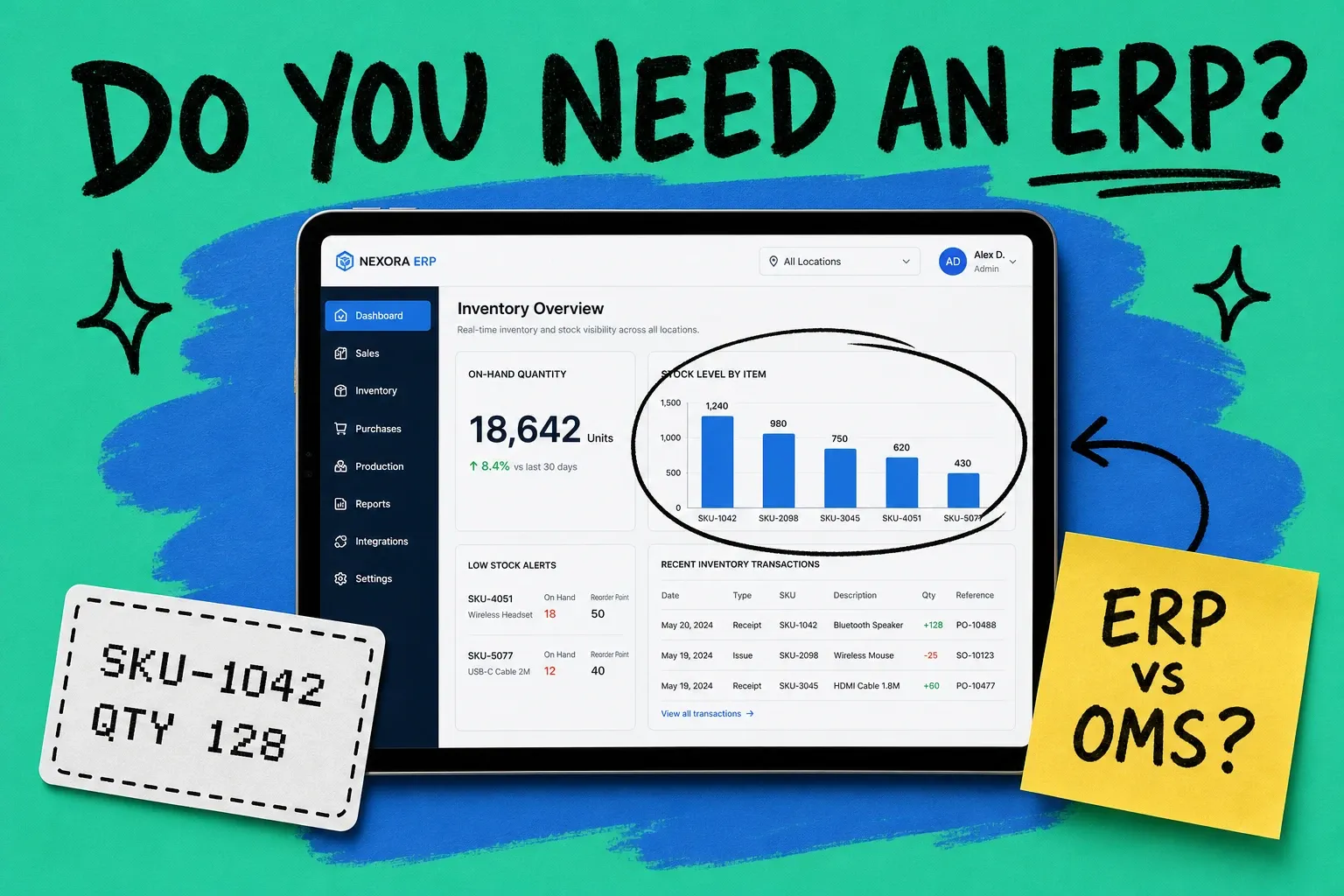
ERP inventory management is the stock-control function built into an enterprise resource planning (ERP) system, where inventory data lives in the same database as finance, purchasing, and accounting. Instead of a separate app for stock, the inventory module shares one record of truth with the general ledger, so a received purchase order, a sold unit, and a write-off all update your books automatically.
That single-database promise is real. It is also why ERP is heavy, slow to deploy, and easy to buy before you need it.
What is ERP inventory management, exactly?
An ERP is the operational backbone that ties together the money side of a business: accounting, procurement, order processing, HR, and inventory. The inventory module is one piece of that suite.
Inside a modern ERP, the inventory function typically handles:
- Stock quantities and locations. On-hand, allocated, and available counts by warehouse, bin, or store.
- Inventory valuation. Costing methods like FIFO, LIFO, or weighted average that feed the balance sheet.
- Movements and adjustments. Receipts, transfers, cycle counts, and write-offs, each with an accounting entry behind it.
- Purchasing and replenishment. Reorder points, supplier records, and purchase orders tied to inventory levels.
The advantage is that finance and operations read from the same numbers. When you sell a unit, cost of goods sold updates without anyone rekeying it. That is the core reason enterprises with heavy accounting needs run ERP-based inventory.
Why "one system" sounds better than it works for many brands
Here is the catch. An ERP is optimized for financial accuracy and control, not for the speed and channel breadth ecommerce runs on. Its inventory module was designed for a controller, not for the person who needs Amazon and Shopify stock to match at 2 a.m. during a flash sale. So the "everything in one place" pitch is genuinely valuable, but only when the finance complexity justifies the weight.
Do you actually need an ERP for inventory management?
Ask a sharper question than "should we get an ERP?" Ask "what specifically is breaking that only an ERP fixes?" For pure inventory and order problems, the answer is usually no. For deep financial and manufacturing problems, the answer starts turning to yes.
Signs you are ready for an ERP
Look for these thresholds. The more that apply, the stronger the ERP case:
- You manufacture or assemble at scale. You need a bill of materials, work orders, and production costing, not just stock counts. Simple kitting does not count here; multi-stage production does.
- You run multiple legal entities or currencies. Consolidated financials across subsidiaries push you toward an ERP's accounting core.
- Your accounting is drowning in manual entry. Finance rekeys orders, inventory, and costs between disconnected systems every month and reconciliation takes days.
- You have serious compliance or audit requirements. Regulated industries, investor reporting, and strict inventory valuation controls favor an ERP's audit trail.
- Your headcount and processes are outgrowing spreadsheets everywhere, not just in the warehouse.
Signs an OMS or inventory tool is still enough
If your pain is operational rather than financial, you probably do not need an ERP yet:
- You sell across several channels and just need stock to stay in sync.
- You want smart order routing, backorders, and fulfillment that does not oversell.
- Your accounting fits comfortably in QuickBooks or Xero.
- You need to launch in weeks, not next year.
An order management system (OMS) covers all of that. It is worth understanding exactly what that category does before you shop for something ten times larger; our guide on what an order management system is breaks it down.
ERP vs OMS: where should inventory data live?
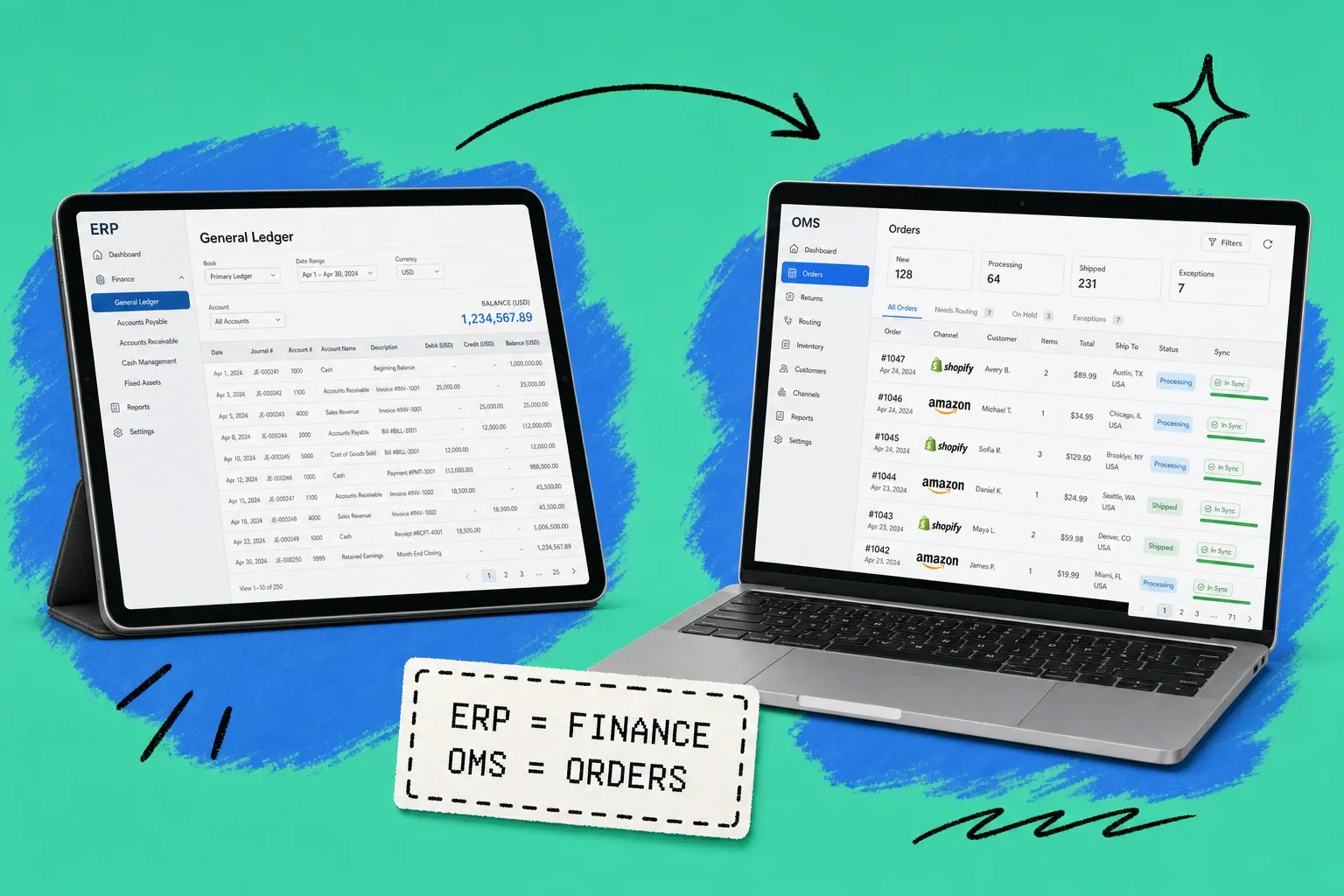
This is the decision most brands actually face. An OMS and an ERP overlap on inventory, but they are built for different jobs.
An order management system is focused on the order lifecycle: capturing orders from every channel, keeping inventory synced in real time, routing each order to the best location, and pushing it to fulfillment. It speaks ecommerce natively, so channel connectors for Shopify, Amazon, Walmart, and 3PLs (third-party logistics providers) tend to ship in the box.
An ERP is focused on the financial and operational record. Its inventory module is accurate and tightly coupled to accounting, but it is slower to change and usually needs middleware to talk to sales channels in real time.
For most mid-market brands, the practical answer is: run inventory and orders in an OMS for daily speed, and let the ERP own finance if and when you adopt one. The two can share data through an integration. You do not have to force every stock update through a heavyweight system just to keep your books tidy.
That split is where OmniOrders fits. It gives you real-time multichannel inventory, smart order routing, and pre-built channel and EDI (electronic data interchange) connectors without an ERP-scale rollout, so many brands find they can defer or skip a dedicated ERP entirely for inventory purposes.
The accuracy problem no software brand talks about
Whatever system holds your stock, the number on the screen is only as good as the number on the shelf. The average retailer has only about 63% inventory record accuracy, according to research from the Auburn University RFID Lab. That gap between recorded and actual stock is what causes overselling, missed reorders, and phantom availability.
An ERP does not automatically fix that. Accuracy comes from good processes, real-time updates, and disciplined cycle counting, not from the price tag on the software. If your stock data is messy today, a cheaper OMS with tight sync and solid inventory planning will move the accuracy needle more than an expensive ledger integration.
What does an ERP inventory module actually do well?
To be fair to ERP, there are jobs it does better than almost anything else:
- Inventory as a financial asset. If you need inventory valuation to flow cleanly into audited statements, an ERP's tight ledger coupling is hard to beat.
- Manufacturing and BOM costing. Multi-level bills of materials, work-in-process tracking, and production costing are ERP strengths.
- Procurement at scale. Complex supplier terms, approvals, and landed cost tracking sit naturally in an ERP.
- One source of truth across departments. Finance, ops, and procurement genuinely working from the same data reduces reconciliation pain.
If those describe your business, ERP inventory management earns its cost. If they do not, you are buying a manufacturing-grade accounting engine to solve a stock-sync problem.
The real cost of ERP inventory management
Budget is where the ERP decision gets honest. The median ERP implementation costs around 450,000 dollars and takes roughly nine months, according to the Panorama Consulting Group 2025 ERP Report. Mid-market projects commonly land between 150,000 and 750,000 dollars, and enterprise deployments routinely cross a million.
It is not just the sticker price. More than a quarter of organizations reported going over budget, and the most common reason was the unexpected need for additional technology, per that same Panorama report. In other words, you often discover mid-project that the ERP cannot do something on its own and you have to bolt on more tools.
Compare that to standing up an ecommerce OMS, which is usually a subscription with a rollout measured in weeks. The total cost of ownership (TCO) gap is enormous. That does not make ERP wrong. It makes buying one early, for a problem an OMS already solves, an expensive mistake.
How to decide: a practical checklist
Run your situation through this quick filter:
- Is the pain financial or operational? Financial complexity leans ERP. Operational speed and channel sync lean OMS.
- Do you manufacture or run multiple entities? If yes, weigh ERP seriously. If no, an OMS likely covers you.
- How fast do you need it live? If the answer is this quarter, an ERP is not realistic.
- What is your accounting stack? If QuickBooks or Xero still fits, you are not at the ERP threshold yet.
- Can an OMS plus your accounting tool share data? Usually yes, which lets you defer ERP without losing clean books.
If most answers point to "operational" and "soon," start with an order management system and keep your channels synced across Shopify and Amazon. You can graduate to an ERP later, when finance complexity, not stock chaos, is the thing forcing your hand.
The bottom line
ERP inventory management is powerful, and for manufacturers and multi-entity businesses it is often the right call. For most growing ecommerce brands, though, the honest answer is that you do not need an ERP to keep stock accurate and orders flowing. You need real-time inventory sync, smart routing, and channel connectors, and you need them without a six-figure, nine-month project.
Match the tool to the problem you actually have. If that problem is inventory and orders across channels, start there, prove out clean data, and let the bigger system wait until your finances, not your fulfillment, are the reason you outgrow it.
Frequently asked questions
What is ERP inventory management?
ERP inventory management is the stock-control function built into an enterprise resource planning system, so inventory data sits in the same database as finance, purchasing, and accounting. It tracks quantities, valuations, and movements across locations, and updates the general ledger automatically as stock changes.
Do you need an ERP for inventory management?
Not usually, at least not at first. Most ecommerce brands get accurate multichannel stock control from an order management system or dedicated inventory software. You typically need an ERP once you run manufacturing, multiple legal entities, or complex financial consolidation that a standalone inventory tool cannot handle.
What is the difference between an ERP and an OMS?
An ERP is a broad financial and operational backbone that covers accounting, HR, procurement, and inventory. An order management system (OMS) is focused on the order lifecycle: routing, inventory sync, and fulfillment across sales channels. Many brands run an OMS for daily operations and add an ERP only when finance complexity demands it.
How much does an ERP cost to implement?
The median ERP implementation costs about 450,000 dollars and takes roughly nine months, according to the Panorama Consulting Group 2025 ERP Report. Mid-market projects commonly run from 150,000 to 750,000 dollars, and more than a quarter of organizations go over budget.
Can ERP inventory management sync with Shopify and Amazon?
Yes, but rarely out of the box. Most ERPs need a connector, middleware, or an integration platform to sync stock and orders with Shopify, Amazon, and other channels in real time. An OMS built for ecommerce usually ships those channel connectors natively.
Start your 14-day free trial
See how OmniOrders connects your sales channels, 3PLs, and carriers into one operational layer — free for 14 days, no credit card.