










Pick and Pack: Wave, Batch, and Zone Picking Compared
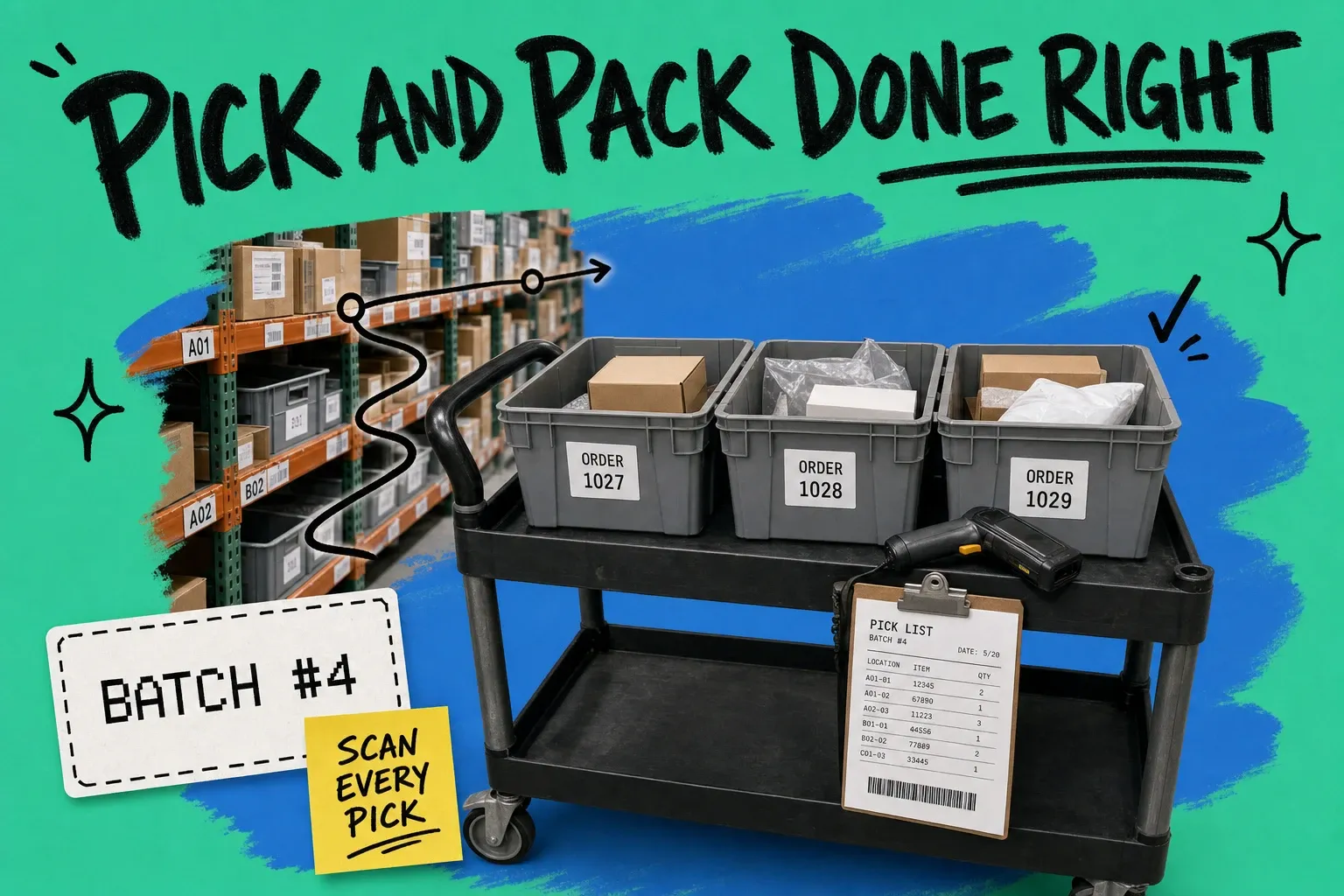
Pick and pack is the warehouse process of pulling the items on a customer order from their storage locations, then packing those items with the right box, filler, and shipping label so the order can go out the door. In short, picking is selecting the products, and packing is preparing them for shipment. Get this loop right and orders leave fast and correct. Get it wrong and you pay for it in returns, refunds, and labor.
If you fulfill your own orders, pick and pack is probably where most of your warehouse time and money already goes. So the real question is not "what is pick and pack," it is "which picking method should you run, and when." This guide compares single-order, batch, wave, and zone picking, shows you how to match a method to your order profile, and covers how to keep accuracy high as volume climbs.
Why pick and pack decides your fulfillment cost
Picking is the most expensive thing happening in your warehouse, and it is not close. Order picking accounts for as much as 55 percent of total warehouse operating costs, which is why every serious efficiency project starts here.
The reason is walking. According to research from the Georgia Tech Supply Chain and Logistics Institute, travel eats roughly 55 percent of a picker's time, followed by paperwork and admin at about 20 percent, searching at 15 percent, and the actual extracting of items at only 10 percent. Read that again: your pickers spend more time walking than doing anything else. That is the number every picking method below is trying to attack.
Packing carries its own hidden cost, and it shows up as errors. An Intermec survey of 250 supply chain and distribution managers found that a single mispick costs an average of 22 dollars once you count the return, the replacement, and the labor to sort it out, and that 35 percent of facilities run mispick rates of 1 percent or higher. On a few thousand orders a month, a 1 percent error rate quietly drains real money and burns the customer goodwill you paid to acquire.
So the goal of pick and pack optimization is simple to state: cut the walking, and stop the wrong item before it gets in the box.
What are the main order picking methods?
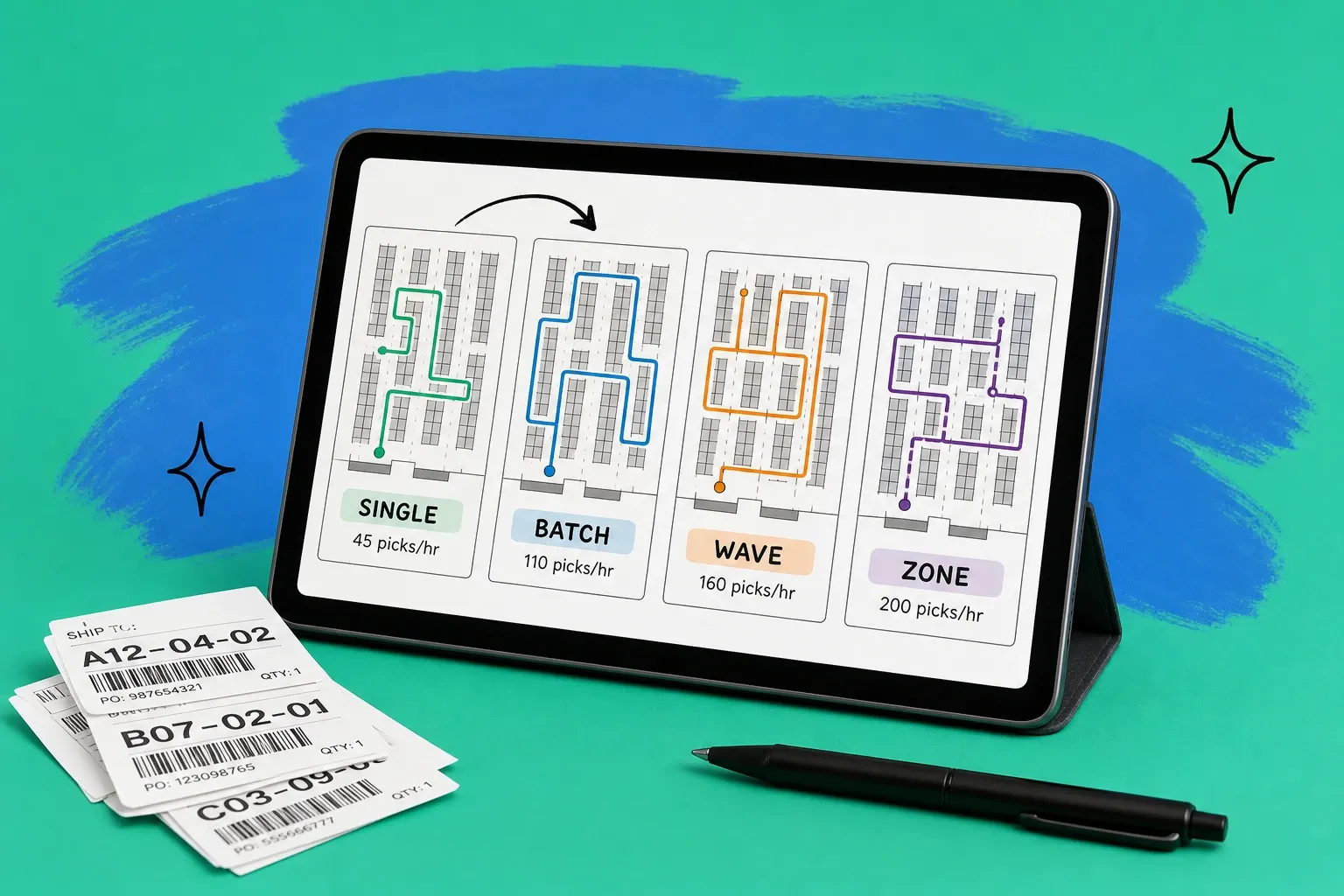
There are four picking methods you will actually use in ecommerce. Each one trades travel time against complexity in a different way.
Single-order (discrete) picking
One picker takes one order and walks the warehouse collecting every line on it, then hands it off to pack. It is the simplest method to run and the easiest to train, and it keeps orders cleanly separated so mistakes are easy to trace.
The downside is travel. If a picker walks the whole building for a two-item order, then does it again for the next order, you are paying for the most expensive part of picking over and over. Single-order picking works when your volume is low, your orders have many lines each, or your catalog is small enough that walking is not a real cost yet.
Batch picking
Batch picking groups multiple orders that share items so one picker collects the total quantity of each SKU in a single trip, then splits it across the individual orders. Instead of walking to the same shelf ten times for ten orders, the picker goes once and grabs ten units.
This is usually the highest-impact change for a growing ecommerce brand, especially if you ship lots of small orders that repeat the same best-sellers. Batch picking directly cuts the travel time that dominates your labor cost. The tradeoff is a sorting step at the end, where batched items get allocated back to each order, so it needs either a tidy putwall or software keeping track of what belongs where.
Wave picking
Wave picking releases orders in scheduled groups, or waves, timed around your operation instead of picked the instant they arrive. You might run a wave for every carrier cutoff, or one wave per hour, or a dedicated wave for expedited orders.
Waves matter most when you have to coordinate picking with something downstream, like a UPS pickup at 4pm or a packing team that can only process so many boxes an hour. It smooths out the day so you are not slammed at the cutoff and idle before it. Wave picking pairs naturally with batch and zone methods rather than replacing them.
Zone picking
Zone picking splits the warehouse into areas and assigns each picker to one zone. An order that spans several zones gets passed along, either physically in a tote moving down a conveyor (pick and pass) or by each zone contributing its lines to a consolidation point (pick and sort).
Zone picking shines when you carry a large, varied catalog across a big footprint. Pickers become fast experts in their own area and never walk the entire building for a single multi-line order. The cost is coordination: you need a way to merge the zones back into one complete order before it ships, and unbalanced zones can create bottlenecks where one busy area holds up everything.
Which picking method should you use?
Match the method to your order profile, not to what the biggest warehouse in your city runs. Ask three questions about your orders.
How many lines per order? Mostly one or two items per order points you toward batch picking, because you can combine many orders into one efficient trip. Lots of lines per order leans back toward single-order or zone picking so a complete order gets assembled cleanly.
How big and varied is your catalog? A tight catalog of fast movers is easy to batch. A sprawling catalog spread across a large space is where zone picking earns its keep.
How spiky is your volume? Steady daily flow can run batch picking all day. Sharp peaks around promotions, drops, or carrier cutoffs are where wave picking keeps the operation from choking. If you want a full peak-season playbook, our Black Friday fulfillment checklist walks through surviving Q4 without a meltdown.
Most scaling brands do not pick one method forever. They combine them. A common setup is zone picking to keep pickers local, batch picking within each zone to cut trips, and wave picking to line everything up with shipping cutoffs. Start with the single change that attacks your biggest cost, prove it, then layer on the next.
How do you keep pick and pack accurate?
Speed is worthless if the wrong item ships. The fix is verification at two points: at the pick and at the pack.
At the pick, replace paper lists with a digital pick list and scan a barcode to confirm each item as it is pulled. Scanning catches the wrong SKU at the shelf, before it ever reaches a box. Warehouses running system-directed, scan-verified picking reach 99.5 percent order accuracy or higher, while warehouses without a system average around 92 percent, according to Extensiv. That gap is the difference between a clean operation and a steady stream of returns.
At the pack station, verify the count and the contents against the order one last time, then generate the label from the same system so the right box gets the right address. If you are still building out your scanning setup, our guide to a barcode inventory system covers scanner choices and how real-time stock sync fits in.
A quick way to know where you stand: time-study ten pick trips and measure what percentage is travel versus actual picking. If travel is over 40 percent, a batching or routing change will pay off immediately. Then check your mispick rate. If it is 1 percent or higher, scanning validation is your next move.
How to optimize pick and pack as you scale
The manual version of all of this, deciding which orders to batch, drawing pick paths, balancing zones, breaks down fast once you are shipping hundreds of orders a day. This is where an order management system earns its place.
A good system reads every order from every channel into one queue, groups orders into smart batches automatically, and generates an optimized pick path so the walking stays short. It routes each order to the right warehouse or zone, confirms picks by scan, and prints the carrier label at pack. That is exactly the layer OmniOrders sits in: it batches and routes orders across your locations and builds the pick lists for you, so you scale throughput without adding a picker for every extra hundred orders.
If you are earlier in the journey and still deciding what to systematize first, our post on fulfillment automation covers which steps to automate before others so you get the biggest return.
The takeaway is straightforward. Pick and pack is the most expensive, most error-prone part of fulfillment, and both of those problems have known fixes. Cut the travel with the right picking method for your orders, verify every pick with a scan, and let software handle the batching and routing math once volume outgrows a whiteboard. Do that, and pick and pack stops being the bottleneck and starts being the thing you quietly do well while you grow.
Frequently asked questions
What is pick and pack?
Pick and pack is the two-part warehouse process of selecting the items on a customer order from storage locations (the pick) and boxing them with the right packaging and label for shipment (the pack). It is the core of ecommerce fulfillment and usually the most labor-intensive step in the whole operation.
What is the difference between wave, batch, and zone picking?
Batch picking groups several orders that share SKUs so one picker collects them in a single trip. Zone picking assigns each picker a fixed area of the warehouse and passes the order between zones. Wave picking releases groups of orders on a timed schedule so picking lines up with carrier cutoffs and packing capacity. Many warehouses combine them, such as zone plus batch.
How do you pick and pack orders accurately?
Use a digital pick list instead of paper, scan a barcode at the point of pick to confirm the right SKU, and verify quantities at the pack station before the box is sealed. Scanning validation is the single biggest lever on accuracy, since it catches the wrong item before it ships rather than after a customer complains.
When should you use batch picking instead of zone picking?
Batch picking wins when you have many small orders that repeat the same SKUs, because one trip fills several orders at once. Zone picking wins when you carry a large, varied catalog spread across a big footprint, because pickers stay expert in their own area and avoid walking the entire warehouse for one multi-line order.
Does pick and pack require a warehouse management system?
You can run pick and pack with paper lists at low volume, but accuracy and speed both suffer as you grow. Warehouses without a warehouse management system average around 92 percent order accuracy, while system-directed picking reaches 99.5 percent or higher, according to Extensiv. Software that batches orders and generates optimized pick paths pays for itself quickly at scale.
Start your 14-day free trial
See how OmniOrders connects your sales channels, 3PLs, and carriers into one operational layer — free for 14 days, no credit card.