










Black Friday Fulfillment Checklist: How to Survive Q4 Without a Meltdown
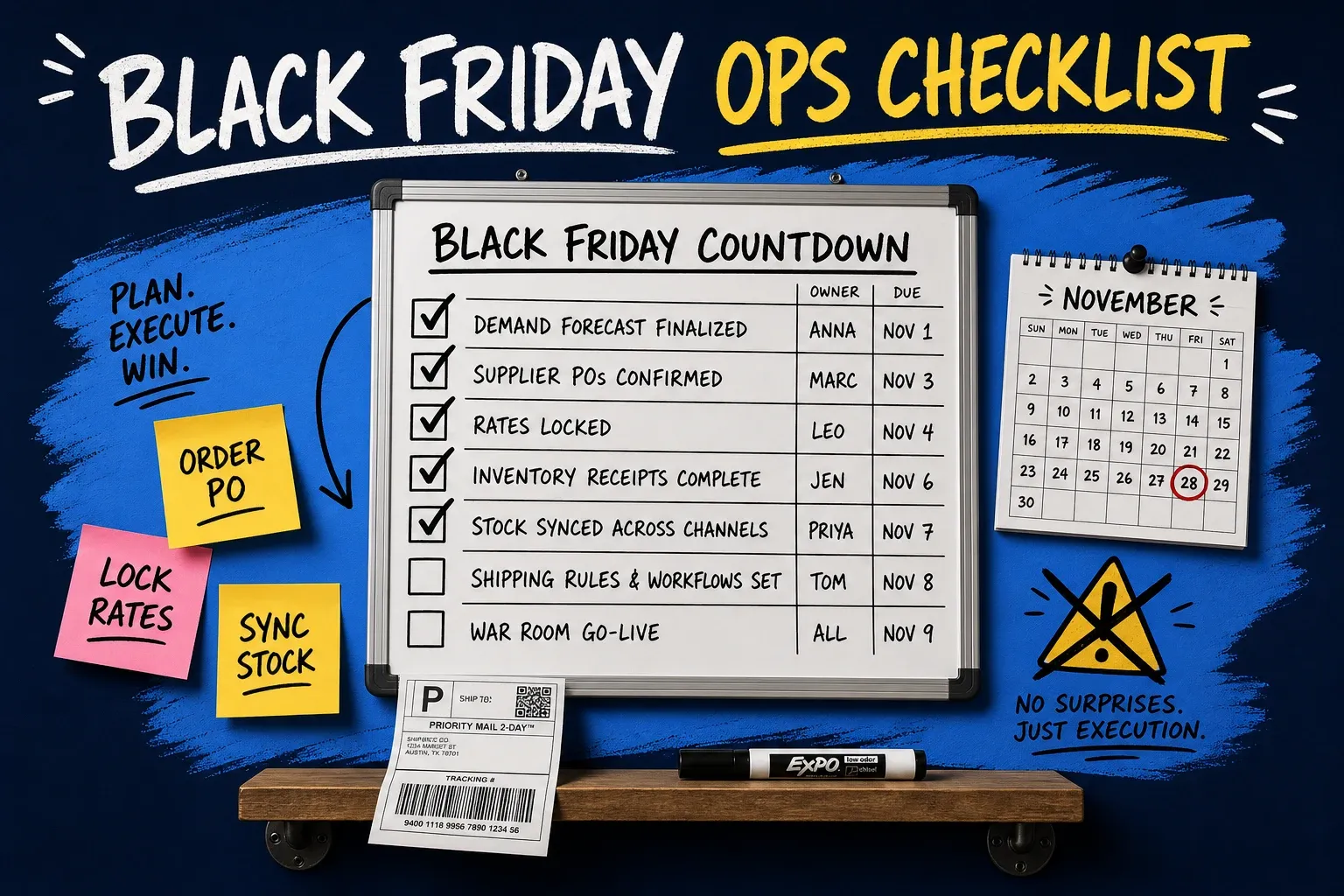
A Black Friday fulfillment checklist is a phased operations plan you start running 10 to 12 weeks before peak, not the week of. It works across five fronts in sequence: forecast and position inventory, lock carrier rates before peak season surcharges hit, audit your order management settings, prep your warehouse and support team, then run disciplined live ops through Cyber Week and the returns wave that follows. Get the early phases right and the busy weekend takes care of itself. Skip them and you spend BFCM firefighting instead of shipping.
The stakes are real. U.S. shoppers spent a record $257.8 billion online during the 2025 holiday season, up 6.8 percent year over year, according to Adobe Analytics, and the five-day Cyber Week stretch alone drove $44.2 billion. That demand lands on your fulfillment operation in a compressed window. The brands that come out clean are the ones that treated Q4 readiness as a countdown, not a scramble.
Here is the checklist, phase by phase, with the dates and the math.
When should you start your Black Friday fulfillment prep?
Start in early September, roughly 10 to 12 weeks out. That timing is not arbitrary. It is the last point where you can still influence the three things that break under pressure: inventory you do not have time to reorder, carrier rates you locked too late, and systems you never load-tested.
Each phase below maps to a window before peak. If you are reading this later than September, do not panic. Run the phases you can still run and compress the rest. Late prep beats no prep, but early prep beats both.
Phase 1: Forecast demand and position inventory (10 to 12 weeks out)
You cannot ship what you did not order. The first job is a demand forecast that is honest about how lopsided peak is.
Pull last year's BFCM sales by SKU and by channel. Look at your top sellers, because peak demand concentrates hard on a handful of products. Then size a holiday buffer off forecasted peak velocity, not your average week.
A buffer formula you can actually use
For each fast-moving SKU, work it out like this:
- Take your expected daily sell-through during the BFCM window.
- Multiply by your replenishment lead time in days. This is your cycle stock.
- Add a safety stock layer for the SKUs and channels most likely to spike.
That gives you a target on-hand number per SKU. Place purchase orders against it now, before your suppliers and freight forwarders hit their own capacity ceilings. If you want a deeper walkthrough of buffer sizing and reorder timing, our reorder point formula guide breaks down the safety stock math in detail so you forecast demand without over-ordering into dead stock.
Position inventory close to demand, too. If you run multiple warehouses or use a 3PL with several nodes, split stock so your fastest-moving SKUs sit near your biggest customer regions. Shipping a package one or two carrier zones instead of five is the cheapest speed upgrade you can buy.
Phase 2: Lock carrier rates before peak surcharges hit (8 to 6 weeks out)
Carriers raise prices for the holidays, and they do it on a schedule you can plan around. A peak season surcharge is an extra per-package fee added on top of your normal rates during the busy window.
The 2025 season shows how much this stings. UPS raised its Additional Handling fee from $8.25 to $10.80 per package during the November 23 to December 27 peak, and pushed Large Package surcharges above $100, according to UPS's published 2025 demand surcharge schedule. FedEx moved in step, taking its Oversize charge to $108.50 and its Additional Handling fee to $10.90 over a nearly identical window, as reported by Supply Chain Dive. High-volume shippers can also trigger volume-based demand fees when weekly volume jumps above a June baseline.
Here is what to do about it before October:
- Map the surcharge calendar. Note the exact dates each fee turns on and off. The peak window is shorter than the full surcharge period, so timing matters.
- Decide where you lock rates and where you rate shop. For predictable lanes, a negotiated rate lock protects your margin. For everything else, compare carriers per order. Our carrier rate shopping guide explains how to pick the cheapest compliant service on every shipment instead of defaulting to one carrier.
- Diversify carriers. Regional carriers and USPS often dodge the steepest peak fees. Spreading volume keeps one network from becoming a single point of failure when capacity tightens.
- Audit your packaging. Additional Handling and Oversize fees trigger on dimensions and weight. Trimming box sizes before peak can quietly remove dollars from every order.
Phase 3: Audit your OMS settings (6 to 4 weeks out)
This is the phase most checklists skip, and it is the one that saves your weekend. Your order management system is the brain that decides where each order ships from, which carrier service it uses, and how fast your channels learn that stock just sold. An order management system, or OMS, is the software layer that takes orders from every sales channel and routes them to the right fulfillment location with the right shipping method. If you are still deciding whether you need one, see what an order management system is.
Walk through these settings while you still have time to change them:
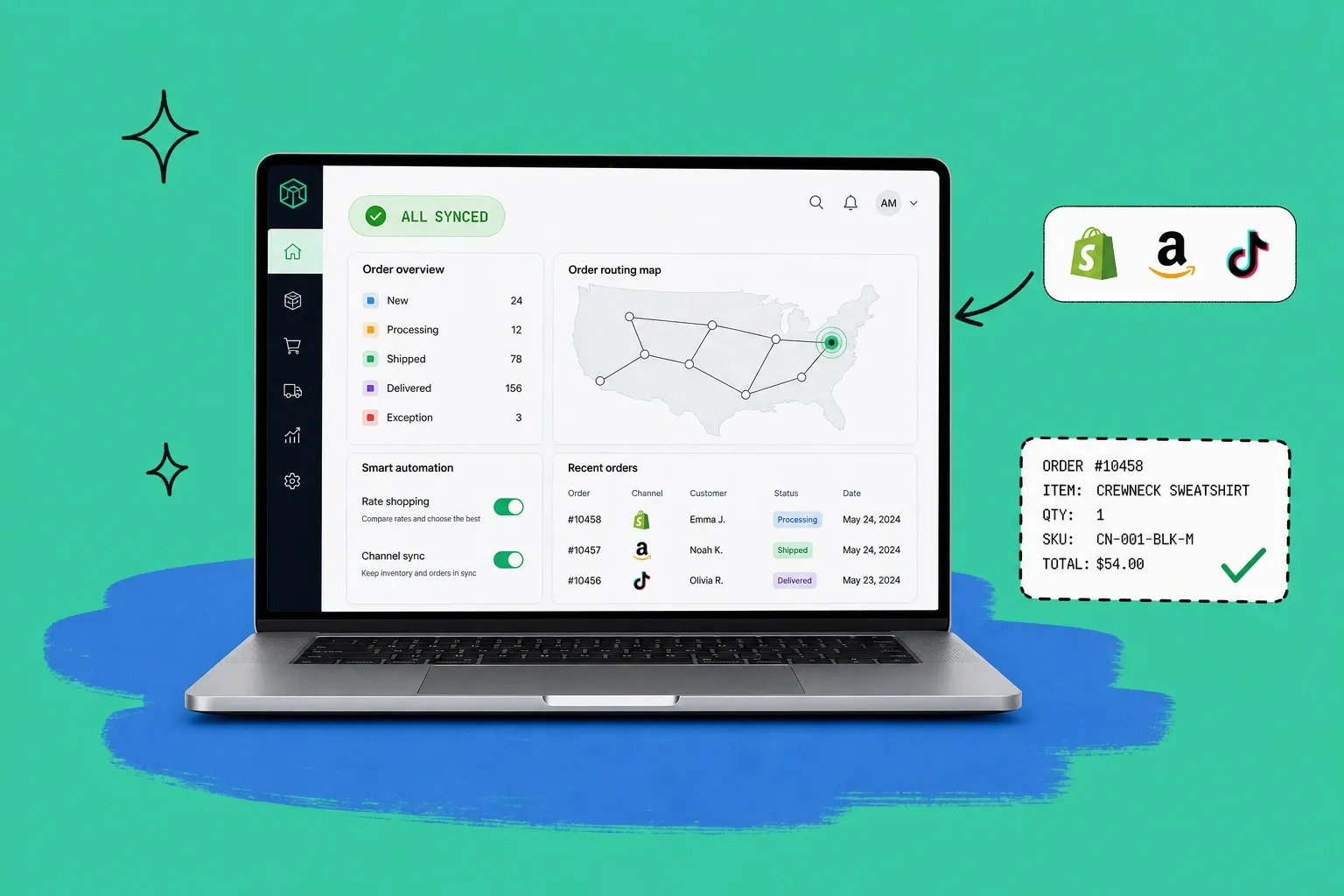
- Channel sync intervals. How often does available stock update across Shopify, Amazon, and your other channels? Under peak velocity, a slow sync is how you oversell. Tighten the interval and route every channel against one source of truth for available-to-promise stock.
- Routing rules. Confirm orders route to the closest node that has stock, fall back cleanly when a location stocks out, and avoid unnecessary split shipments. A bad rule quietly inflates shipping cost on every order.
- Rate-shopping rules. Make sure your automation picks the cheapest service that still meets the promised delivery date, and that it accounts for the new surcharges.
- Automation triggers. Auto-tagging, hold rules for fraud review, and address validation should all be on before the volume arrives, not bolted on mid-rush.
- Load test it. Push a burst of test orders through and watch where the pipeline slows. Find the bottleneck in October, not at 9 pm on Cyber Monday.
Phase 4: Prep the warehouse and your team (4 to 2 weeks out)
Now the work moves to the floor. Inventory is in, rates are locked, the system is tuned. The question becomes throughput.
- Staff for the peak day, not the average. Hire and train seasonal pickers and packers early enough that they are productive before BFCM, not learning on it.
- Set up batch and wave picking. Grouping orders by zone or carrier cuts walking time and speeds up the pack bench.
- Stage packing stations and supplies. Run out of the right box size mid-rush and your whole line stalls. Over-order consumables.
- Cycle count your top SKUs. Inaccurate counts undo all of Phase 1. A focused count on your bestsellers right before peak keeps your available-to-promise numbers honest.
If you outsource fulfillment, this is when you confirm your 3PL's peak staffing plan, cutoff dates, and capacity in writing.
Phase 5: Run live ops during Cyber Week
During the BFCM window your job shifts from building to monitoring. The plan is set. Now you watch the dashboards and triage exceptions fast.
- Watch one operations dashboard. Order intake, unfulfilled aging, stock levels on top SKUs, and any sync errors should be visible in one place.
- Have an escalation chain. Everyone should know who handles a stockout, a carrier delay, or a payment hold, and how to reach them. Decisions made fast on Saturday morning prevent a backlog by Monday.
- Triage exceptions, do not let them pile. Address-correction holds, oversold items, and failed label prints are normal at volume. Clear them in batches throughout the day so they never become a wall.
- Communicate cutoffs clearly. Post your last-order-by dates for guaranteed delivery on product pages and in checkout, and brief your support team on the script for delays.
Phase 6: Plan for the returns wave
Peak does not end when the orders stop. It ends when the returns finish. Holiday returns are large and predictable: retailers expect 17 percent of holiday sales to be returned, and roughly 19.3 percent of all online sales will come back in 2025, according to the National Retail Federation and Happy Returns.
Plan for it before the wave arrives:
- Decide your holiday return policy early and publish it. Extended windows reduce checkout friction but pull returns into January, so staff for it.
- Set up restocking rules so good returns flow back into available stock quickly instead of sitting on a receiving dock.
- Watch for return fraud, which spikes during the holidays. Require tags and receipts on high-value items where it makes sense.
A clean returns process protects both your January inventory accuracy and the customer relationship you spent peak acquiring.
What it costs to skip the checklist
Skipping the early phases does not save time. It moves the work to your worst possible week and adds a premium. The reorder you delayed becomes an air-freight emergency. The carrier rate you never locked gets charged at peak surcharge. The sync interval you never tightened oversells your bestseller, and now you are issuing refunds and apologies during the busiest sales window of the year.
The fix is boring and it works: treat Q4 as a countdown and run the phases in order. A connected order management platform like OmniOrders pulls the inventory, routing, channel sync, and rate-shopping pieces into one system, so the OMS audit in Phase 3 is a settings review rather than a software project. That is the difference between watching dashboards on Cyber Monday and chasing fires.
Start the checklist in September. Your future self, somewhere around 9 pm on the busiest night of the year, will thank you.
Frequently asked questions
When should you start preparing for Black Friday fulfillment?
Start your Black Friday fulfillment prep 10 to 12 weeks out, around early September. That gives you time to forecast demand and place purchase orders before factory and freight lead times stretch, lock carrier rates before peak season surcharges take effect in late September, and load-test your systems before traffic spikes. Last-minute prep in November is where most meltdowns start.
What is a peak season surcharge?
A peak season surcharge is an extra per-package fee carriers add during the holidays on top of your normal rates. For the 2025 season, UPS raised its Additional Handling fee from $8.25 to $10.80 per package during the November 23 to December 27 peak window, and FedEx pushed its Oversize charge to $108.50. These fees apply automatically, so you need to budget for them and route around them where you can.
How much extra inventory should you hold for Black Friday?
Size your holiday buffer off forecasted peak demand, not your average week. A simple approach is to take your expected daily sell-through for each fast-moving SKU during BFCM, multiply by your replenishment lead time in days, then add a safety stock layer for the channels most likely to spike. Hold more on your top sellers and accept tighter coverage on slow movers so you do not tie up cash in dead stock.
How do you prevent overselling during Black Friday?
Sync inventory across every channel in near real time and hold a small safety buffer on shared stock. Overselling happens when one channel sells units another channel already claimed because the counts updated too slowly. Tightening your sync interval and routing orders against a single source of truth for available stock is what keeps Shopify, Amazon, and your other channels from promising the same unit twice.
What carrier problems should you expect during peak season?
Expect higher per-package surcharges, tighter pickup capacity, and later delivery commitments than your off-season norm. High-volume shippers can also trigger volume-based demand fees when weekly volume jumps above a June baseline. Build slack into your promised delivery dates, diversify carriers so one network does not become a single point of failure, and confirm holiday pickup cutoffs in writing.
Start your 14-day free trial
See how OmniOrders connects your sales channels, 3PLs, and carriers into one operational layer — free for 14 days, no credit card.