










Minimum Order Quantity (MOQ): How to Negotiate Lower Minimums and Plan Around Them
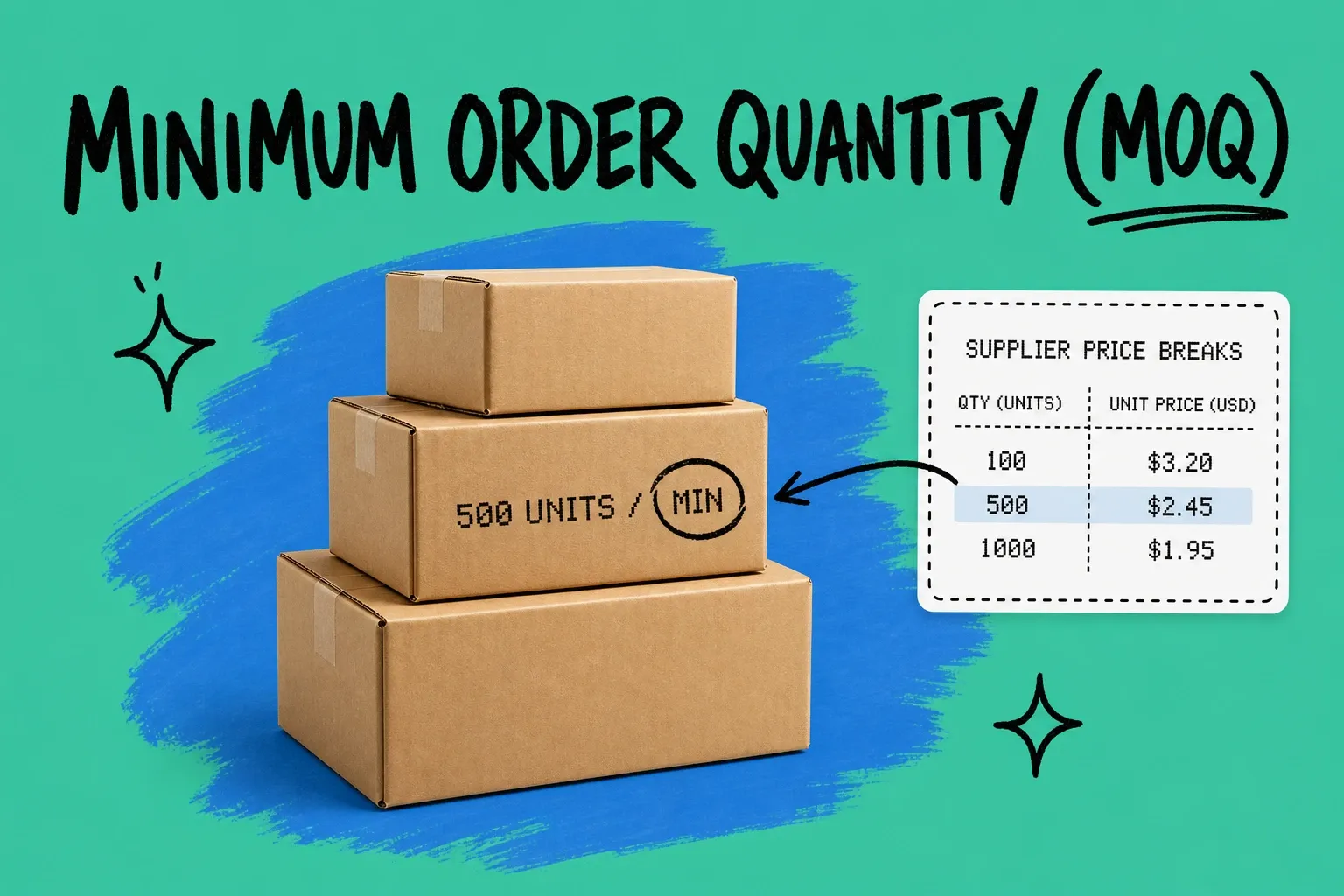
A minimum order quantity (MOQ) is the smallest number of units, or the smallest total order value, a supplier will accept in a single purchase order. If a factory sets a MOQ of 500 units, you cannot buy 300. You either commit to 500 or find another supplier. That one number shapes your cash flow, your storage, and how much dead stock you risk carrying.
A minimum order quantity is the lowest amount a supplier is willing to sell per order, set to keep each production or fulfillment run profitable for them.
MOQs are not arbitrary, and they are more negotiable than most sellers assume. Below you will learn what drives a MOQ, how to calculate whether one works for you, how to negotiate it down, and how to plan inventory so a forced minimum does not turn into a warehouse full of stock you cannot move.
What is a minimum order quantity (MOQ)?
A MOQ is the floor on a single order. It is usually expressed in one of two ways:
- Unit MOQ: a count of physical items, like "1,000 pieces per style" or "250 units per color."
- Value MOQ: a dollar threshold, like "$2,500 minimum per order," common with wholesale distributors and B2B catalogs.
Some suppliers layer both on top of each other. You might see a 500-unit minimum per SKU and a $5,000 minimum per shipment, so a single-SKU order has to clear both bars at once.
MOQ is different from an order multiple. A MOQ sets the starting point; an order multiple (sometimes called an incremental order quantity) forces you to buy in fixed steps after that. A supplier with a MOQ of 500 and a multiple of 100 will sell you 500, 600, or 700 units, but never 550.
MOQ vs EOQ: two different questions
People mix up MOQ and EOQ, but they answer different questions. MOQ is the supplier's rule for the smallest order they will accept. Economic order quantity (EOQ) is your math for the order size that minimizes your total cost of ordering plus holding stock. The supplier controls the MOQ. You control the EOQ. When your EOQ lands below the supplier's MOQ, the minimum wins, and that gap is exactly where over-ordering and dead stock creep in.
Why do suppliers set minimum order quantities?
Suppliers set MOQs because the cost of starting an order does not scale down. A factory pays roughly the same to set up a machine, source raw materials, and configure a production line whether the run is 200 units or 2,000. Spread across too few units, those fixed costs wipe out the profit on the order.
Here are the usual drivers behind a MOQ:
- Setup and tooling costs. Machine calibration, dyes, molds, and print screens cost the same regardless of run size.
- Raw material minimums. The factory's own suppliers impose minimums on fabric, components, and packaging, which roll downstream to you.
- Labor efficiency. Short runs mean more changeovers and idle time per unit produced.
- Handling and admin. Every order carries invoicing, QC, and shipping overhead that a tiny order cannot justify.
- Shelf and channel economics. Wholesale distributors set value MOQs so the picking, packing, and account servicing on a small order does not run at a loss.
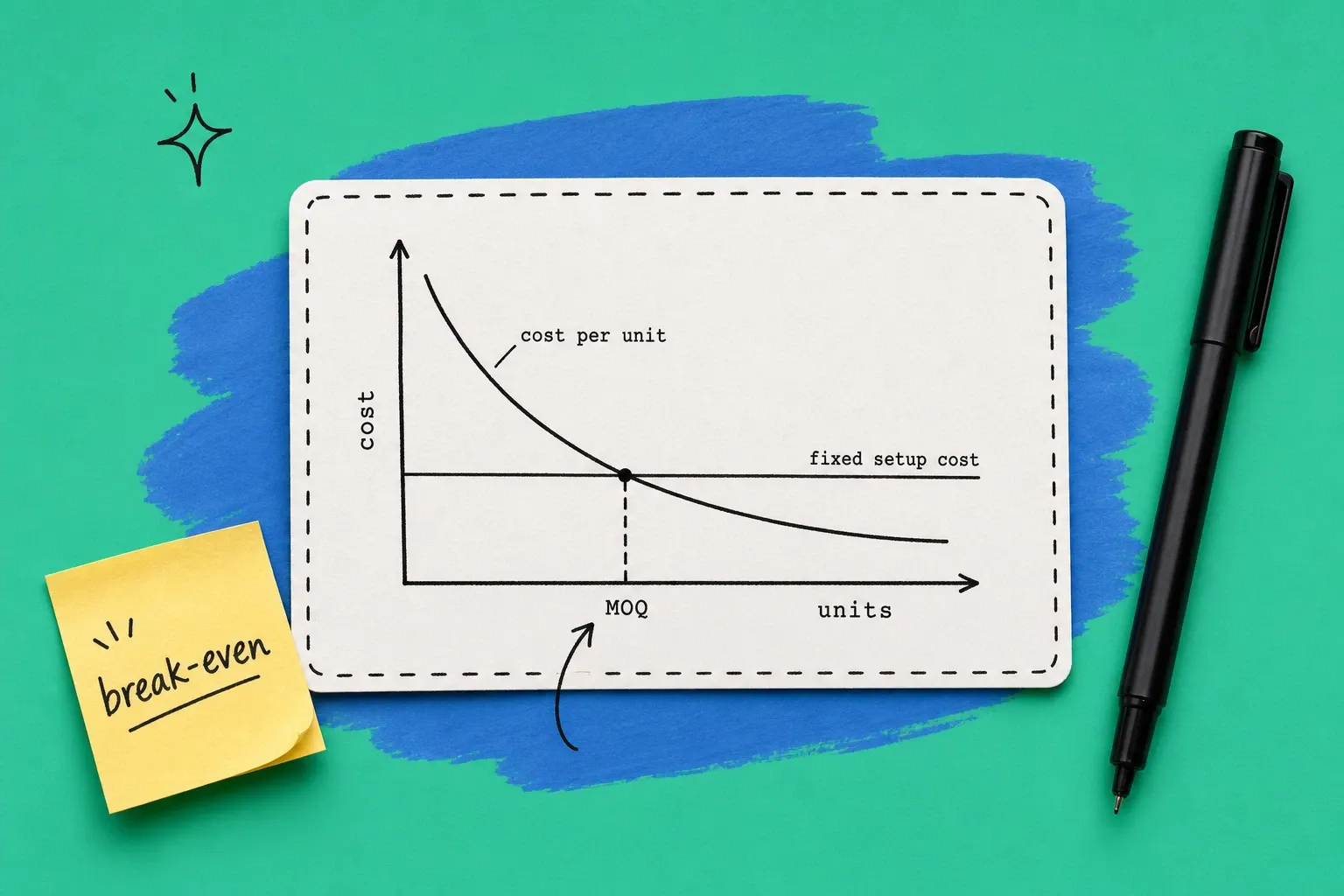
Once you see a MOQ as the supplier protecting a margin, negotiation stops feeling like a favor and starts feeling like a problem you can solve together.
How do you calculate MOQ?
There are two sides to the MOQ math, and knowing both makes you a sharper negotiator.
The supplier's break-even MOQ
A supplier sets a MOQ so the order clears its fixed cost. The simple version:
MOQ = Fixed cost per run ÷ Profit per unit
If a factory spends $4,000 to set up and run a batch and makes $10 of profit per unit at your price, it needs to sell at least 400 units to break even on that run. That is why the quoted MOQ often sits right around a round number like 500. When you understand the fixed cost driving it, you can propose ways to shrink it, like accepting standard packaging or a stock colorway that skips a custom setup.
Your sell-through check
As a buyer, the number that matters is not the supplier's break-even. It is whether you can sell the MOQ before it costs you money to hold. Run this quick check:
Months of stock = MOQ ÷ average units sold per month
If a MOQ of 500 units equals four months of sales, that is usually healthy. If it equals two years of sales, you are financing the supplier's efficiency with your cash and your shelf space. Pair this with a solid reorder point formula so you know your true monthly demand and safety stock before you sign off on a minimum.
How to negotiate a lower MOQ with suppliers
You negotiate a MOQ by taking risk off the supplier's plate. Every tactic below does that in a different way.
Lead with order history and forecasts. A supplier's biggest fear is producing stock that never sells. Show real sell-through data and a credible forecast for repeat orders, and the MOQ becomes a smaller bet for them.
Commit to a repeat schedule. Offering to place four orders over a year is far more attractive than one small order. Suppliers will often cut a first-order MOQ in exchange for a blanket purchase order across future runs.
Consolidate SKUs into one run. If a supplier needs 1,000 units to justify a run, ask whether five colorways of 200 each can share the same production setup. You hit their minimum while keeping each individual SKU small.
Put money down. A larger deposit, or faster payment terms, reduces the supplier's exposure. Many factories will trade a lower MOQ for a 50% deposit instead of 30%.
Accept a higher unit price on the first order. A supplier's MOQ exists to protect margin. Offer to pay a per-unit premium on a smaller trial order and you give them the margin without the volume.
Ask about stock or standard options. Custom colors, prints, and packaging drive setup costs and MOQs up. A stock item with standard packaging often carries a far lower minimum.
On marketplaces like Alibaba, treat the listed MOQ as an opening position, not a rule. A large share of listed minimums move for a sample or trial order, especially when you signal that a bigger relationship could follow.
How to plan inventory when a MOQ forces you to over-order
Sometimes you cannot negotiate the MOQ down far enough, and you have to buy more than you would like. That is where planning protects your margin, because sitting inventory is expensive in ways that are easy to underestimate.
The Association for Supply Chain Management and APQC benchmarking data put the annual cost of carrying inventory at roughly 20% to 30% of the inventory's value once you add capital, storage, insurance, shrinkage, and obsolescence. So $50,000 of stock forced by a MOQ can quietly cost $10,000 to $15,000 a year just to hold.
The bigger picture is worse. IHL Group's 2024 research pegged the global cost of retail inventory distortion at about $1.77 trillion, with overstocks alone accounting for roughly $554 billion of that through markdowns and spoilage. Over-ordering to clear a MOQ is one of the quiet contributors to that overstock pile.
Here is how to keep a forced minimum from becoming dead stock:
- Forecast before you commit. Base the order on real demand, not gut feel. Sound demand forecasting methods tell you whether a MOQ is three months of cover or three years.
- Time the order to your reorder window. Buy the minimum when your stock actually needs replenishing, not early, so you are not paying to hold it longer than necessary.
- Plan the sell-down. If a MOQ leaves you long, build a promotion or bundle plan up front to move the extra units before carrying cost erodes the savings.
- Watch it at the SKU level. Track sell-through per SKU so a MOQ you accepted six months ago does not turn into a slow-mover you forgot about.
A full inventory planning process turns MOQs from a guess into a calculated decision. This is also where a connected order and inventory platform earns its keep. When your real-time sales velocity across every channel lives in one system, you can see exactly how long a MOQ will take to sell through before you place the order. OmniOrders forecasts demand across all your sales channels so you can size each purchase against the next viable reorder window, instead of over-buying to satisfy a supplier and hoping it clears.
What MOQ means across manufacturing, wholesale, and marketplaces
The term shifts slightly depending on where you meet it.
In manufacturing, a MOQ is the smallest production run a factory will make. It exists because setup and tooling cost the same regardless of run size, so the minimum keeps each run economical. Custom work almost always carries a higher MOQ than stock items.
In wholesale, MOQs are often expressed as a dollar value, an opening-order minimum, or a per-case pack. Wholesale marketplaces use them to keep account servicing profitable, and first-order minimums are frequently different from reorder minimums.
On marketplaces like Alibaba, the MOQ sits on the product page and is widely negotiable. Suppliers list a comfortable number but will often flex it for a trial order or a buyer who looks like a long-term account.
Turn MOQs from a constraint into a plan
A minimum order quantity is not a wall. It is a supplier protecting a margin, and once you understand the cost driving it, you have room to negotiate and a way to plan around what you cannot move. Lead with data, consolidate where you can, and never commit to a minimum without knowing how long it will take to sell through.
Do that, and MOQs stop dictating your cash flow. You buy the right quantity at the right time, keep carrying costs down, and free up the capital that would otherwise sit on a shelf. The suppliers still set the floor. You just stop letting it decide your inventory for you.
Frequently asked questions
What does MOQ stand for?
MOQ stands for minimum order quantity. It is the smallest number of units, or the smallest total order value, a supplier or manufacturer will accept for a single order. Below that threshold the supplier will not process the order.
How do you calculate MOQ?
Suppliers calculate a MOQ by dividing their fixed setup and handling cost per run by the profit they make on each unit, so the order still clears a margin. As a buyer, you calculate whether a MOQ works by checking how many units you can realistically sell before your carrying cost eats the savings. Divide the MOQ by your monthly sales rate to see how many months of stock it represents.
Can you negotiate a lower minimum order quantity?
Yes. Suppliers set MOQs to stay profitable, so you negotiate by removing their risk. Share real sales history, commit to repeat orders, combine several SKUs into one production run, offer a larger deposit, or accept a slightly higher unit price in exchange for a smaller first order.
What is MOQ on Alibaba?
On Alibaba, MOQ is the minimum quantity a listed supplier requires per order, shown on each product page. Many Alibaba MOQs are negotiable, especially for a first trial order or a sample run, so treat the listed number as a starting point rather than a fixed rule.
What does MOQ mean in manufacturing?
In manufacturing, a MOQ is the smallest production run a factory will make. It exists because machine setup, tooling, and material sourcing cost the same whether the factory makes 100 units or 1,000, so a minimum keeps each run economical.
Start your 14-day free trial
See how OmniOrders connects your sales channels, 3PLs, and carriers into one operational layer — free for 14 days, no credit card.