










Merchandise Inventory: What It Is and How to Account for It

Merchandise inventory is the stock of finished goods you buy from a supplier and hold to resell to your customers. If you run a retail store or an ecommerce brand and you purchase products ready to sell rather than making them yourself, almost everything in your warehouse is merchandise inventory.
Merchandise inventory is a current asset on your balance sheet that records the cost of unsold goods held for resale, and it becomes cost of goods sold the moment an item ships.
That one distinction, asset until sold, then expense, is the whole reason merchandise inventory matters. Get the number wrong and your gross profit, your taxes, and your reorder decisions all drift out of sync with reality. This guide covers what counts as merchandise inventory, where it lives in your books, how to calculate it, and why keeping it accurate is harder for multichannel sellers than most accounting textbooks admit.
What is merchandise inventory?
Merchandise inventory is the value of all the goods a merchandising business has bought and not yet sold. A merchandising business is any company that buys finished products and resells them without changing their form: think apparel shops, electronics resellers, and Shopify or Amazon brands sourcing from manufacturers.
The key word is finished. You did not build these products. You bought them ready to sell, and your job is to move them to a customer at a markup. The cost you paid to acquire and receive those goods is what sits in the merchandise inventory account until the sale happens.
Merchandise inventory vs raw materials and work in process
This is where a lot of operators get tripped up, so it is worth being precise. A manufacturer carries three kinds of inventory: raw materials waiting to be used, work in process inventory that is partway through production, and finished goods ready to ship. A merchandising business skips the first two entirely.
You have one bucket. Merchandise inventory is your finished goods, and there is nothing upstream of it because you never touched a production line. If you kit or lightly assemble products, you edge toward manufacturing accounting, but for most resellers the single merchandise inventory account is the whole story.
What type of account is merchandise inventory?
Merchandise inventory is an asset account, and more specifically a current asset. Current means you expect to convert it to cash within one operating cycle, usually a year. That is a safe assumption for resale goods, which is exactly why they land in the current section of your balance sheet right alongside cash and accounts receivable.
Here is the flow that trips people up. While goods sit unsold, their cost is an asset. It is money you have parked in stock, not an expense. The instant an item sells, its cost leaves the merchandise inventory account and becomes cost of goods sold (COGS) on your income statement. COGS is the direct cost of the products you actually sold in a period.
So merchandise inventory never shows up as an expense directly. It converts into the COGS expense one sale at a time. Your ending balance, the goods still on the shelf, stays on the balance sheet as an asset and rolls forward as next period's beginning inventory.
What costs are included in merchandise inventory?
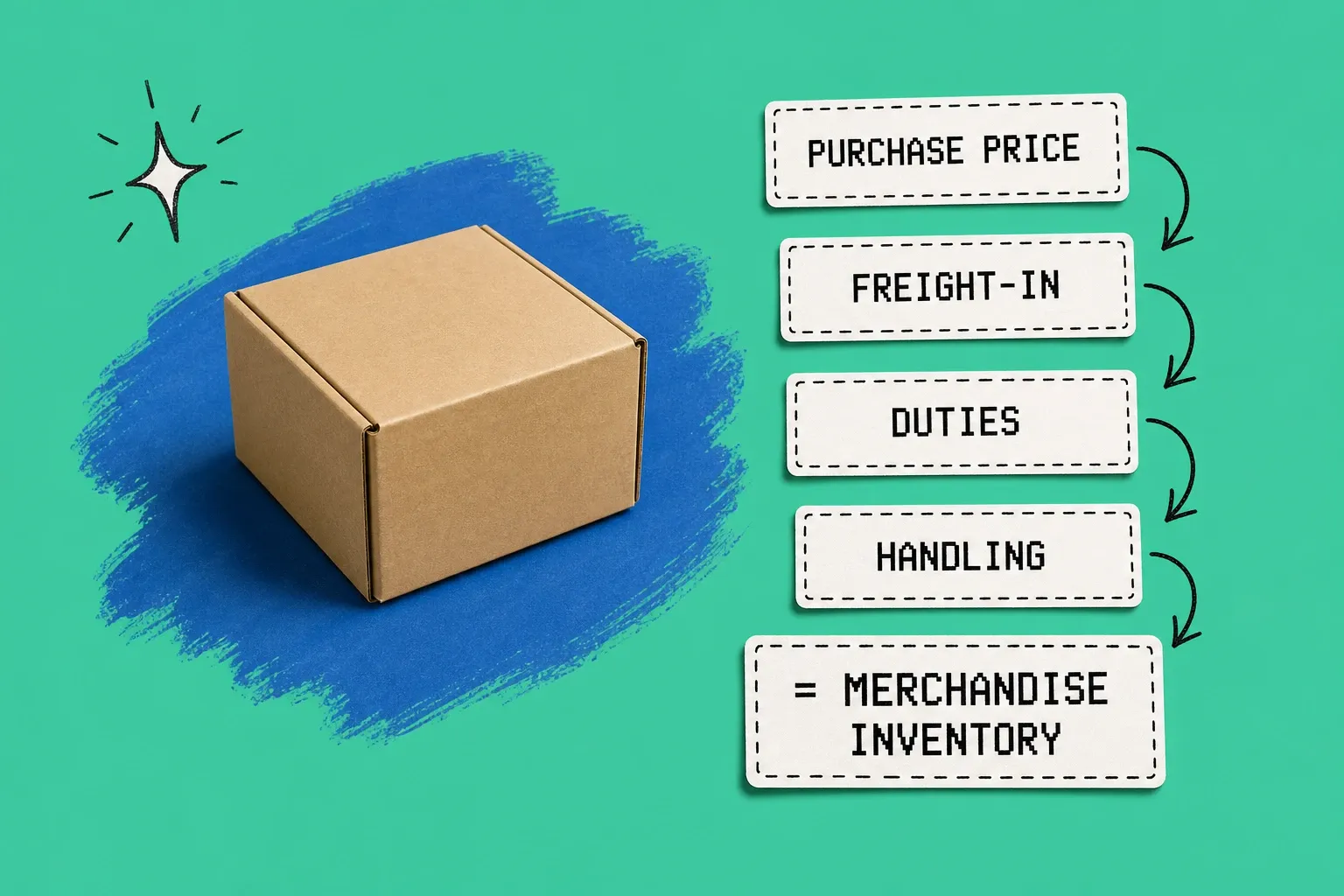
Merchandise inventory includes far more than the sticker price you paid your supplier. It captures every cost required to get the goods into your warehouse and ready to sell. In practice that means:
- The purchase price of the goods, minus any trade or volume discounts
- Freight-in, the cost of shipping the goods to you (not the cost of shipping to your customer)
- Import duties and customs fees
- Insurance while the goods are in transit
- Handling and receiving costs directly tied to getting stock shelf-ready
Added together, these are your landed cost, and landed cost is what belongs in merchandise inventory. What does not belong: marketing spend, sales commissions, office rent, or outbound shipping to customers. Those are period expenses, not part of the product's cost.
Getting this boundary right protects your margin. If you leave freight-in and duties out of inventory cost, you understate what each unit really cost you and overstate your gross profit, which quietly leads to underpricing.
How do you calculate merchandise inventory?
The core relationship is a single equation that ties your stock levels to your cost of goods sold. Master this and every other merchandise inventory calculation falls out of it.
The cost of goods sold formula
The foundational formula is:
Beginning inventory plus Net purchases minus Ending inventory equals Cost of goods sold.
Beginning inventory is the value of stock you carried in from last period. Net purchases are the new goods you bought, at landed cost, minus returns and discounts. Ending inventory is the value of what is still unsold when the period closes, usually confirmed by a physical or cycle count.
Rearrange the same equation and you can solve for the piece you do not know. If you counted your ending stock and know your purchases, you can back into COGS. If you know COGS from your point-of-sale data, you can estimate ending inventory.
How to calculate ending merchandise inventory
To find ending merchandise inventory directly, flip the formula:
Beginning inventory plus Net purchases minus Cost of goods sold equals Ending inventory.
Say you started the quarter with $40,000 in stock, bought $60,000 more at landed cost, and your COGS for the quarter was $70,000. Your ending merchandise inventory is 40,000 plus 60,000 minus 70,000, which equals $30,000. That $30,000 is the asset you carry on the balance sheet and the number you hand to your accountant.
How to calculate average merchandise inventory
Average merchandise inventory smooths out the swings between a slow January and a frantic Q4. Add beginning and ending inventory and divide by two:
(Beginning inventory plus Ending inventory) divided by 2.
Using the numbers above, average inventory is (40,000 plus 30,000) divided by 2, which is $35,000. This figure feeds your inventory turnover ratio, which is COGS divided by average inventory, and it is the denominator behind most inventory health metrics like sell-through and GMROI.
Why accurate merchandise inventory matters for ecommerce
On paper, merchandise inventory looks like a tidy accounting exercise. In a real multichannel operation, it is one of the hardest numbers to keep honest, and the cost of getting it wrong is enormous.
Start with the accuracy problem. The average retail store's inventory is only about 65 percent accurate, according to the Auburn University RFID Lab. That means roughly one in three stock records does not match what is physically on the shelf. When your recorded merchandise inventory drifts from reality, you oversell items you do not have, sit on dead stock you think already sold, and file financial statements built on a guess.
The scale of that gap is staggering. IHL Group estimates that inventory distortion, the combined cost of out-of-stocks and overstocks, cost retailers $1.77 trillion worldwide in 2025, roughly 6.5 percent of global retail sales. A large share of that traces back to merchandise inventory records that no one could trust.
For a single-store retailer, keeping the number accurate is manageable. For an ecommerce brand selling on Shopify, Amazon, Walmart, and a wholesale channel at once, every sale on every channel should decrement one shared inventory count in real time. When each channel tracks stock in its own silo, your merchandise inventory value is stale the moment you calculate it.
This is where a unified system earns its keep. Platforms like OmniOrders keep one live inventory count across every sales channel, so when an order ships anywhere, your merchandise inventory value updates everywhere at once. That is the difference between a balance sheet number you calculate once a quarter and one you can actually trust on any given day. If you sell across marketplaces, our guide to multichannel inventory management for Shopify and Amazon covers how to wire the channels together.
Turn merchandise inventory from a chore into a signal
Merchandise inventory is not just a line on a financial statement. It is a running measure of how much cash you have tied up in stock and how efficiently you turn that stock into sales. When the number is accurate and updates in real time, it tells you when to reorder, which products are dragging, and exactly how much gross profit each sale earned.
Nail the fundamentals first: know what counts as merchandise inventory, capture full landed cost, and reconcile with regular counts. Then give yourself one source of truth across every channel so the number stays honest between counts. That is when merchandise inventory stops being a quarterly headache and starts driving better buying decisions.
Frequently asked questions
What type of account is merchandise inventory?
Merchandise inventory is an asset account, specifically a current asset, because you expect to sell the goods and convert them to cash within a year. It appears on the balance sheet, not the income statement. When an item sells, its cost moves out of merchandise inventory and into cost of goods sold.
How do you calculate ending merchandise inventory?
Use the formula: Beginning inventory plus Net purchases minus Cost of goods sold equals Ending inventory. Beginning inventory is last period's ending balance, net purchases are new goods bought (including freight-in) minus returns and discounts, and cost of goods sold is the cost of everything you sold during the period.
What costs are included in merchandise inventory?
Merchandise inventory includes the purchase price of the goods plus every cost to get them ready to sell: freight-in, import duties, insurance in transit, and handling. That total is often called landed cost. It does not include selling costs like marketing, sales commissions, or the salary of your warehouse staff.
How do you calculate average merchandise inventory?
Add beginning inventory and ending inventory, then divide by two. Average merchandise inventory smooths out seasonal swings and is the denominator in your inventory turnover ratio, which is cost of goods sold divided by average merchandise inventory.
What is the difference between merchandise inventory and manufacturing inventory?
Merchandise inventory is a single category: finished goods you bought ready to resell. A manufacturer instead holds three inventory types, raw materials, work in process, and finished goods, because it builds products rather than buying them for resale. Retailers and most ecommerce brands only carry merchandise inventory.
Start your 14-day free trial
See how OmniOrders connects your sales channels, 3PLs, and carriers into one operational layer — free for 14 days, no credit card.