










Ecommerce Integration Platforms: Connecting Channels, 3PLs, and Back Office Without the Middleware Chaos
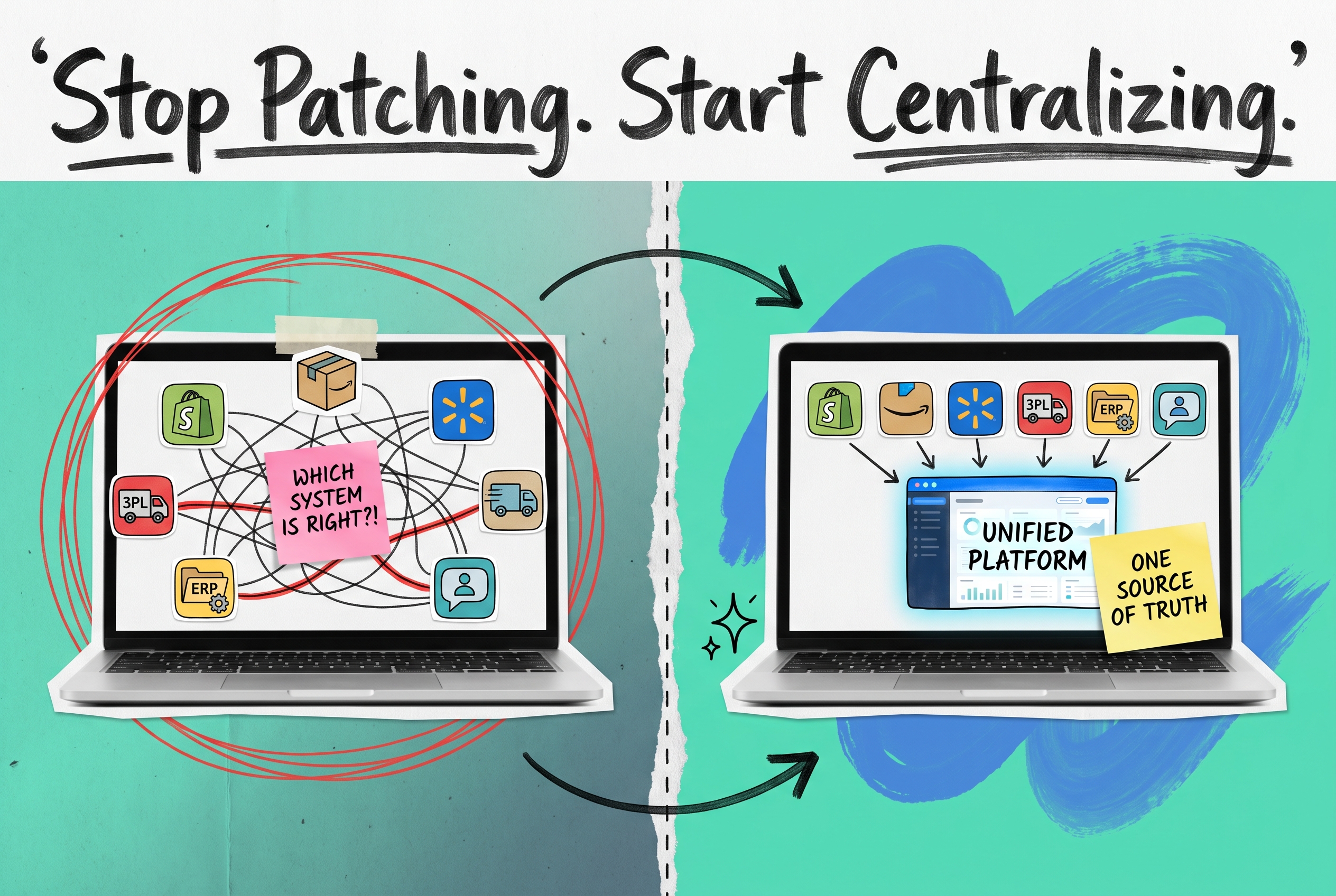
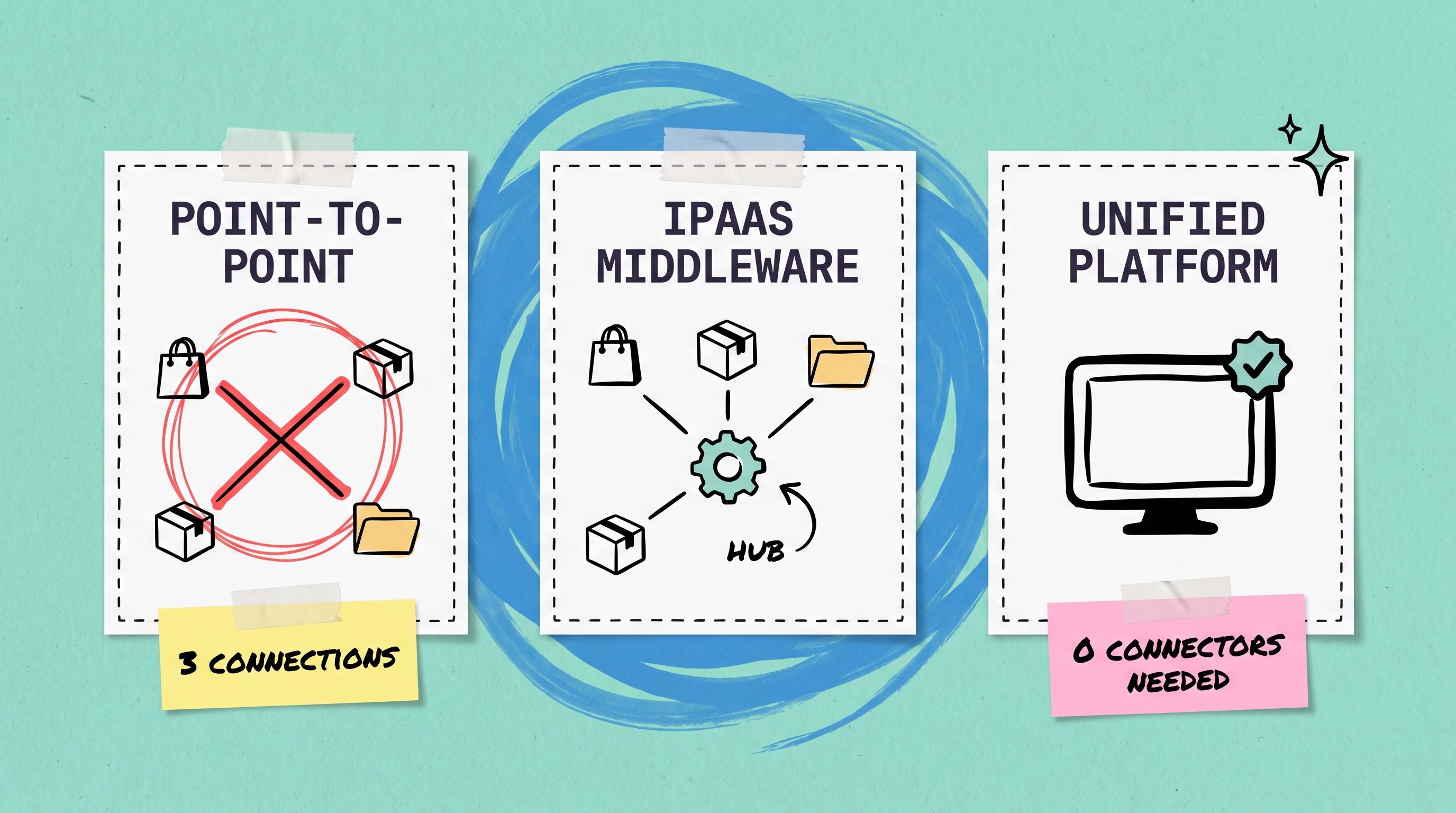
An ecommerce integration platform connects your sales channels, fulfillment systems, inventory, and back-office tools (Shopify, Amazon, your ERP, your 3PL) into a unified data flow so orders, stock levels, and shipping updates move automatically without re-entry. The three main approaches are point-to-point connectors (each system talks directly to one other), iPaaS middleware (a hub routes data between systems), and a unified platform (one system handles orders, inventory, and fulfillment natively). Which approach fits your business depends on how many channels you run, how complex your fulfillment is, and how much integration overhead your team can sustain.
Why Ecommerce Integrations Break Down
Most brands don't start with an integration problem. They start with one channel and one tool. Then comes the second marketplace. Then a new 3PL. Then an ERP the finance team insists on. By the time you're running Shopify, Amazon, Walmart, and a regional carrier, you have five or six systems that need to talk to each other and none of them do by default.
The result is what operations managers call integration sprawl: a patchwork of direct API connections, Zapier automations, and spreadsheet exports that works fine at $500K in revenue and falls apart at $5M. Stock levels lag. Orders drop. Your warehouse count doesn't match your Shopify store. A sale on Amazon allocates stock that your Walmart listing already committed.
These aren't technology failures. They're architecture failures. Solving them starts with understanding your options.
The Three Approaches to Ecommerce Integration
Point-to-Point Connectors
A point-to-point connector links two systems directly: Shopify talks to your shipping software, your shipping software talks to your ERP. Each connection is built and maintained separately.
This works at low volume and low channel count. When you have two or three tools and light order flow, point-to-point connectors are fast to set up and inexpensive to run.
The problem is that connections grow with the square of your system count. Three systems need three connections. Five systems need ten. Eight systems need twenty-eight. Each connection is a potential failure point, and each one breaks differently when an upstream system changes its API version.
iPaaS Middleware
An integration Platform as a Service (iPaaS) sits in the middle. Instead of system A talking directly to system B, both talk to the iPaaS layer, which translates and routes data. MuleSoft, Boomi, and Celigo fall into this category, along with ecommerce-specific middleware like Cleo or TrueCommerce.
iPaaS is powerful for complex enterprise environments where you need to connect dozens of heterogeneous systems. For a growing ecommerce brand, the cost is real. You're paying for the middleware license, the integration build, and ongoing maintenance. When your 3PL changes its API or your ERP vendor updates a field mapping, someone has to fix the connector.
If your team doesn't have dedicated integration engineers, iPaaS can become a liability as fast as it becomes an asset.
Unified Platform
A unified platform handles orders, inventory, and fulfillment in one place. Instead of routing data between systems, you eliminate the need for most of those routes entirely.
Your Shopify and Amazon orders land in the same order management system. Inventory levels sync across all your channels from a single source of truth. Fulfillment rules route each order to the right warehouse automatically. You add new channels through pre-built connectors, not custom integrations, and configure routing logic through a rules engine, not code.
The tradeoff: unified platforms work best when their native capabilities cover your operations. If you have specialized requirements (ERP integrations for multi-entity accounting, custom EDI for big-box retail), you'll still need some point-to-point work outside the platform. For most brands selling across three to eight channels with straightforward fulfillment, a unified platform eliminates 80% of the integration complexity before you write a single API call.
What "Native Ecommerce Integrations" Actually Means
Not all integrations labeled "native" are equal. When you're evaluating ecommerce integration platforms, check three things:
Pre-built or on-request? A pre-built connector syncs automatically on activation. An on-request integration means the vendor builds it for you, sometimes for a fee, sometimes on a roadmap without a firm date. Check the vendor's integrations page directly, not the marketing copy, to see which category each connector falls into.
How does inventory sync work? Some connectors only pull orders. Others push inventory updates back to each channel in real time. Real-time inventory sync is what prevents overselling. A connector that updates every 15 minutes is acceptable at low volume; at high volume, that lag costs you orders and refunds.
Who maintains the connection? If the integration breaks when a marketplace updates its API, who fixes it? With a pre-built connector maintained by the platform vendor, they do. With a custom point-to-point connector your team built internally, your dev team does.
OmniOrders maintains a catalog of pre-built channel and fulfillment integrations covering Shopify, Amazon SP Central, Walmart, WooCommerce, eBay, TikTok Shop, BigCommerce, Etsy, and fulfillment providers including Shipedge and BinLogic. Channel setup connects each source without a middleware layer in between.
Ecommerce ERP Integration: When You Actually Need It
ERP systems handle financial consolidation, procurement, and sometimes manufacturing. Most growing ecommerce brands don't need one until they're running multiple legal entities, dealing with complex tax jurisdictions, or have a finance team that needs multi-entity P&L reports.
If that describes your situation, ecommerce ERP integration connects your order flow to the ERP's financial records. The typical data path: order placed on channel, OMS receives and fulfills, ERP receives the sale and invoice data for accounting.
Where this gets complicated is inventory. Many ERPs include an inventory module, and brands sometimes try to use the ERP as their inventory source of truth. That works with one channel and one warehouse. It stops working when inventory needs to sync across Shopify, Amazon, and Walmart simultaneously. ERPs aren't built for real-time multi-channel inventory sync at ecommerce speed.
The cleaner architecture for most brands: OMS as the operational source of truth for inventory and orders, ERP as the financial system of record. The OMS sends the ERP a real-time or daily feed of sales and inventory movement. Finance stays clean without the ERP being asked to do channel sync work it wasn't designed for.
Ecommerce CRM Integration: Where It Actually Helps
CRM integration connects customer purchase history to your marketing and support tools. When a customer contacts support, your team sees their full order history. When you run a win-back campaign, you can segment by the exact SKU they last purchased.
This is genuinely useful, but it's often lower priority than it seems. Fix your order and inventory integrations first. A CRM receiving clean, complete order data from your OMS is far more valuable than a CRM stitched to three separate sources that disagree on what a customer ordered.
Once your order flow is clean, CRM integration is usually straightforward. Your OMS pushes order and customer data to the CRM via webhook or API. No middleware needed.
Building Automation on Top of Your Integrations
Integration without automation is just data movement. The real operational gain comes when you add routing logic on top.
A no-code automation rules engine lets you configure conditions and actions without writing code. A few examples that matter day-to-day:
When an Amazon order arrives with overnight shipping to a Northeast ZIP, route it to your New Jersey warehouse and select the carrier with the best rate for that lane. When stock for SKU HEADPH-BLK-L drops below 40 units, hold new marketplace orders and trigger a purchase order notification to your supplier. When an eBay order arrives from a buyer with fewer than five feedback points, flag it for manual review before fulfillment begins.
These rules run at order intake, before anything reaches the warehouse. Your team stops making routing decisions one by one and starts managing exceptions instead. That shift, from reactive to rules-based, is where operations teams actually scale.
How to Evaluate an Ecommerce Integration Platform
When you compare platforms (OmniOrders, Linnworks, Brightpearl, Extensiv, ChannelAdvisor), the spec sheet rarely tells you what matters. Test these scenarios instead:
Simulate your day-2 scenario. Most demos show clean, simple order flows. Ask what happens when an order arrives for a SKU split across two warehouses. Ask what happens when your 3PL rejects a shipment. Ask how the system handles a marketplace order that changes status three times before it ships.
Count the manual steps. Walk through an order from intake to shipped. Count every click, every manual field, every screen switch. That number, multiplied by your daily order volume, is your actual operations cost. Platforms that look similar on paper often differ by 30 to 40% in manual-step count.
Test the channel sync. Place a test order on one channel, then check whether inventory counts update across your other channels within 30 seconds. If they don't, you'll oversell. That's the single most important thing to verify before you sign a contract.
Stop Patching. Start Centralizing.
Integration sprawl doesn't fix itself. Every new channel you add without a centralized platform makes the problem harder, not just bigger. You add one more API connection to maintain, one more place where inventory counts can diverge, one more failure point between an order and a shipped package.
OmniOrders gives you a single platform for orders, inventory, and fulfillment across all your channels, with native connectors that sync in real time and a no-code rules engine that handles routing without developer time. No middleware layer. No custom scripts to maintain when APIs change.
Start your free OmniOrders trial and see how many manual steps you can eliminate in your first week.
Frequently asked questions
What is an ecommerce integration platform?
An ecommerce integration platform is software that connects your sales channels (Shopify, Amazon, Walmart, eBay), fulfillment systems (3PLs, warehouses, carriers), and back-office tools (ERP, accounting, CRM) so that order data, inventory levels, and shipping updates move between them automatically. The goal is to eliminate manual re-entry and keep every system reflecting the same current state.
What's the difference between iPaaS middleware and a unified ecommerce platform?
An iPaaS sits between your existing systems and routes data between them. You still run multiple separate tools; the iPaaS just makes them talk. A unified platform replaces multiple systems with one: it handles orders, inventory, and fulfillment natively, so most of the data movement happens inside a single database rather than across API calls between separate vendors.
Do I need middleware to connect my ecommerce channels?
Not necessarily. If your order management platform has pre-built native connectors for your channels (Shopify, Amazon, eBay, Walmart), you can connect them directly without an iPaaS layer. Middleware makes sense when you need to connect systems that don't have native connectors to each other, or when you're dealing with enterprise-scale complexity across dozens of heterogeneous systems.
How does ecommerce ERP integration typically work?
Your OMS receives and processes orders and maintains inventory counts as orders are fulfilled. Once orders ship, the OMS sends sale and inventory movement data to the ERP for financial recording. The typical method is a webhook or direct API feed: the OMS pushes a sales record and the ERP creates the corresponding invoice or journal entry. Real-time sync handles order data well; daily batch sync is usually sufficient for ERP reconciliation.
Which ecommerce integrations should I set up first?
Start with your highest-volume sales channels, since those drive the most operational data. Connect your primary fulfillment partner next so order routing is automated. Inventory sync comes third, but it's the most important to get right: until inventory syncs across all your active channels, you'll continue to oversell and absorb the cost of cancellations and replacements.
Start your 14-day free trial
See how OmniOrders connects your sales channels, 3PLs, and carriers into one operational layer — free for 14 days, no credit card.