










Store Location Limits: Why Pickup Stops at 9 Stores
A retailer put it this way: I can only do pickup in 9 of my stores. Nothing in the platform caps collection at nine. The cap is on locations, a distribution center is a location, and a plan that allows ten locations leaves nine of them for shop floors.
Worth walking through properly, because the same rule reaches considerably further than collection, and the part it reaches costs money quietly.
Where the nine comes from
Shopify's documentation sets a maximum number of active locations by plan: "Starter: 2 locations. Basic: 10 locations. Grow: 10 locations. Advanced: 10 locations. Shopify Plus: 200 locations", read on 19 September 2026. Those are Shopify's figures and this article makes no claim about any other platform's numbers. Some platforms do not cap locations at all. Check your own. What transfers is the model rather than the arithmetic.
The model is that a location is not the same thing as a store. Shopify defines one as "any physical place where you sell products, fulfill orders, or stock inventory." Selling, fulfilling, or stocking: any one of the three qualifies.
So the ten includes the distribution center. It includes the overflow unit taken for peak. It includes the bench where returns are graded, if the system was told stock sits there. It includes the seasonal pop-up and the market stall.
The arithmetic matters more than it looks. On a ten-location plan a retailer with one distribution center has nine slots for shops, which is where the nine comes from. A retailer actually trading ten shops plus a distribution center needs eleven, and the consequence there is sharper than a missing collection option: the eleventh site does not exist on the platform at all. No inventory record, nothing for routing to consider, and stock on its shelves the website can neither sell nor see.
This is also a priced boundary rather than an accident. Ten locations on three plans and two hundred on the top one, with a price step in between, is a packaging decision somebody made deliberately. That is worth naming, because treating it as an oversight leads to the wrong conversation. It is a cost to be weighed, like any other.
Two kinds of location that do not count
Two documented exceptions are worth knowing before anyone prices a tier.
The first: "Locations that you deactivate don't count toward your location limit." Deactivating is not deleting. The documentation says deactivating "doesn't affect inventory quantities at that location", and that you can still view inventory, transfer stock, adjust quantities and process returns there. What you cannot do is fulfill orders from it. A closed store, a unit handed back, last year's pop-up: each holds a slot for as long as it stays active, and reclaiming it costs nothing.
The second is different in kind and easy to misread. On fulfillment services connected as apps: "Although these apps are treated as locations, they don't count toward your location limit." That frees no slot you are currently using. What it tells you is that stock sitting with a fulfillment partner connected that way was never spending one, so the count you are working from may be lower than you assumed, and that modeling the same third-party stock by hand would cost a slot the app route does not.
One constraint while tidying: "You always need to have at least 1 active location."
Be honest about who this helps. A retailer carrying dead sites gets a slot or two back for an afternoon's work. A retailer trading more sites than the plan allows gets nothing from housekeeping, because every location on the list is earning. For them the question is the tier or the platform, and no amount of tidying changes it.
What the cap does to pickup
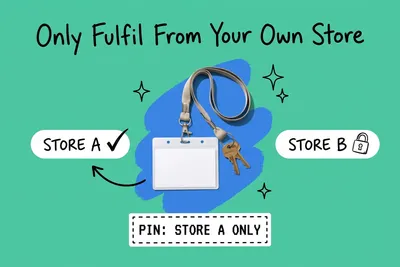
The documentation requires at least one location that fulfills online orders before collection can be set up at all, and collection is then switched on at a location with the option to let customers pick up orders directly there. A site that could not be created cannot be given that option, which is how a limit on locations becomes a limit on collection points without anyone writing a rule about collection.
A second constraint bites earlier and causes more confusion. By default, "pickup in store is available only when the entire order is in stock at the pickup location." The test is the whole order, not the line. A customer with three items, two of which sit in the store they want to collect from, is not offered collection at all.
From the shop floor that looks intermittent, and intermittent looks like a fault. It is the documented default. The remedy the documentation gives is not a switch but a workflow: configuring store transfers so stock is drawn in from elsewhere, which changes the offer and also changes the promise, because the collection date then depends on an internal movement completing.
At checkout the customer chooses between shipping and collection and picks which location to collect from. Everything above decides which locations are on that list.
One thing worth stating precisely, because it is usually described loosely. The availability check runs against the platform's own inventory record for that location. What feeds that record, whether a register system, an ERP or a nightly file, is a separate question, and the gap between the shelf and the record is where collection failures actually originate. That seam is its own subject.
What the cap does to fulfillment
This is the larger half, and it is the half that gets left out.
Routing rules are applied in sequence "to prioritize locations and determine where to fulfill each order". The default configuration works to "minimize split fulfillments by choosing locations that can fulfill all items", to "stay within the destination market when possible", and to "ship from the closest location to reduce delivery times". Routing needs "2 or more active locations" before it does anything. The documentation also describes customizing those rules, including against location metafields such as warehouse capacity or fulfillment speed, and it is worth checking what your own plan includes there rather than assuming.
Every one of those rules operates on the list of locations. A site that is not a location is not a candidate. Its stock is not closest to anything, cannot be chosen to avoid a split, and cannot keep an order inside its own market, because as far as routing is concerned it is not there.
So the limit is not a cap on a collection feature. It is a cap on how much of your inventory the storefront can see and act on. Collection is only where it gets noticed, because a customer asks for it out loud. The quieter version is a parcel travelling from a distribution center past a store that had the item on the shelf, and a markdown later on stock the website was never able to offer. Which location ships an online order is decided from exactly the same list.
What to check before paying to lift it
In this order.
- Write down what is consuming locations today, by name. The site list from the lease or stock-count schedule is the starting point. What you are looking for is the rows that are not shops.
- Deactivate what has stopped trading. Documented as not counting toward the limit, with the inventory records kept.
- Check what is already behind a fulfillment app, so the count you are working from is the real one.
- Then price the tier. The documented ladder steps from ten to two hundred between plans, so ask what that step costs and whether any per-location option exists, rather than assuming either.
If the estate is genuinely larger than the plan allows, the first three steps will not save you, and it is better to know that in an hour than after a month of tidying.
One question here is not about software at all. Every location added is a place a customer can be told to drive to and a shelf somebody has to count. Collection is usually worth having, because it wins orders that shipping cost would otherwise lose, so the real question is not whether a failed collection is embarrassing. It is the accuracy below which a collection point stops paying for itself, which is a threshold each retailer sets from their own numbers. That is answered by how stock is counted and reconciled, not by the plan you are on.
Frequently asked questions
Does my warehouse count toward my store location limit?
On Shopify, yes. The documentation defines a location as any physical place where you sell products, fulfill orders, or stock inventory, so a distribution center consumes the same allowance as a shop floor, as does an overflow unit or a returns bench if the system has been told stock sits there. That is why a retailer on a ten-location plan with one distribution center has nine slots left for stores.
Why does pickup disappear for some orders at a store that has pickup turned on?
Because the default rule tests the whole order, not the line. Shopify's documentation says pickup in store is available only when the entire order is in stock at the pickup location, so one item the store does not hold removes collection for the whole basket. The documented remedy is not a setting but a workflow: configuring store transfers so stock can be drawn in, which then makes the collection date depend on that movement.
Is upgrading the plan the only way to get more locations?
Not always. Locations you deactivate do not count toward the limit and keep their inventory records, so a retailer carrying closed sites can reclaim slots at no cost. The app-based fulfillment exception frees nothing, but it means stock held that way was never consuming a slot, so your real count may be lower than you think. A retailer trading more sites than the plan allows has no housekeeping left and faces the tier.
Start your 14-day free trial
See how OmniOrders connects your sales channels, 3PLs, and carriers into one operational layer — free for 14 days, no credit card.