










Retail Operations in 2025: The Complete Guide to Running Stores and Online from One Platform
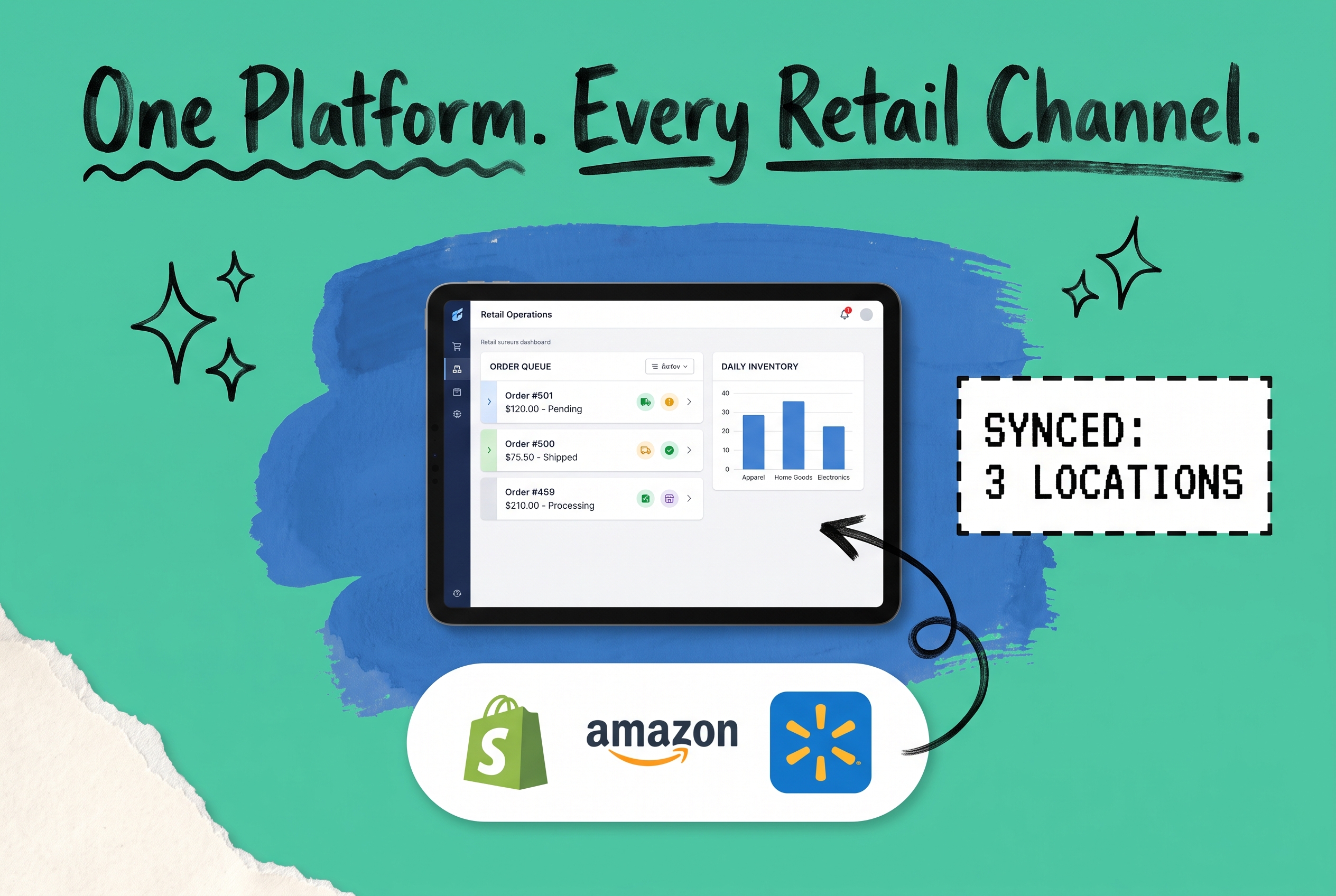
Retail operations is the machinery behind every sale. It's everything that happens between "a customer wants this" and "the product is in their hands" — and then everything that keeps that machine running when you're managing five channels, three warehouse locations, and thousands of SKUs at the same time.
For a single-store retailer, most of this is manageable with spreadsheets and institutional knowledge. For a multi-channel brand selling on Shopify, Amazon, and in physical stores? That same approach turns into a daily crisis by the time you hit meaningful scale.
This guide covers what retail operations actually means, maps the eight core functions that make it work, and walks through the software stack modern e-commerce brands use to run it without hiring a coordination army. It also covers the KPIs worth tracking and the practical sequence for consolidating fragmented operations onto fewer tools.
What Are Retail Operations?
Retail operations refers to the activities, processes, and systems required to run a retail business day to day. It covers everything from receiving inventory and processing orders to managing supplier relationships, fulfilling shipments, and reporting on performance.
In concrete terms: retail operations is how your product moves from supplier to shelf — physical or digital — and how you ensure there's always more stock before you run out. It's the difference between a brand that executes reliably and one that's perpetually fighting fires.
What Is Retail Operations Management?
Retail operations management is the discipline of coordinating those activities across teams, locations, and systems — with the goal of delivering consistent customer experiences while controlling costs.
The "management" part is where growing brands hit friction. One store, one warehouse: operations is simple coordination. Add Amazon, a second warehouse, an eBay storefront, and a brick-and-mortar location, and it becomes multi-variable problem-solving that runs constantly in the background. Which SKU is running low? Which warehouse should ship this order? Why did TSHIRT-BLU-M oversell on Amazon this morning?
Retail operations management answers those questions before they become customer complaints.
The 8 Core Functions of Retail Operations
Retail operations isn't a single department — it's a collection of eight interconnected functions. In most growing brands, each is managed with a different tool, which is usually where the problems start.
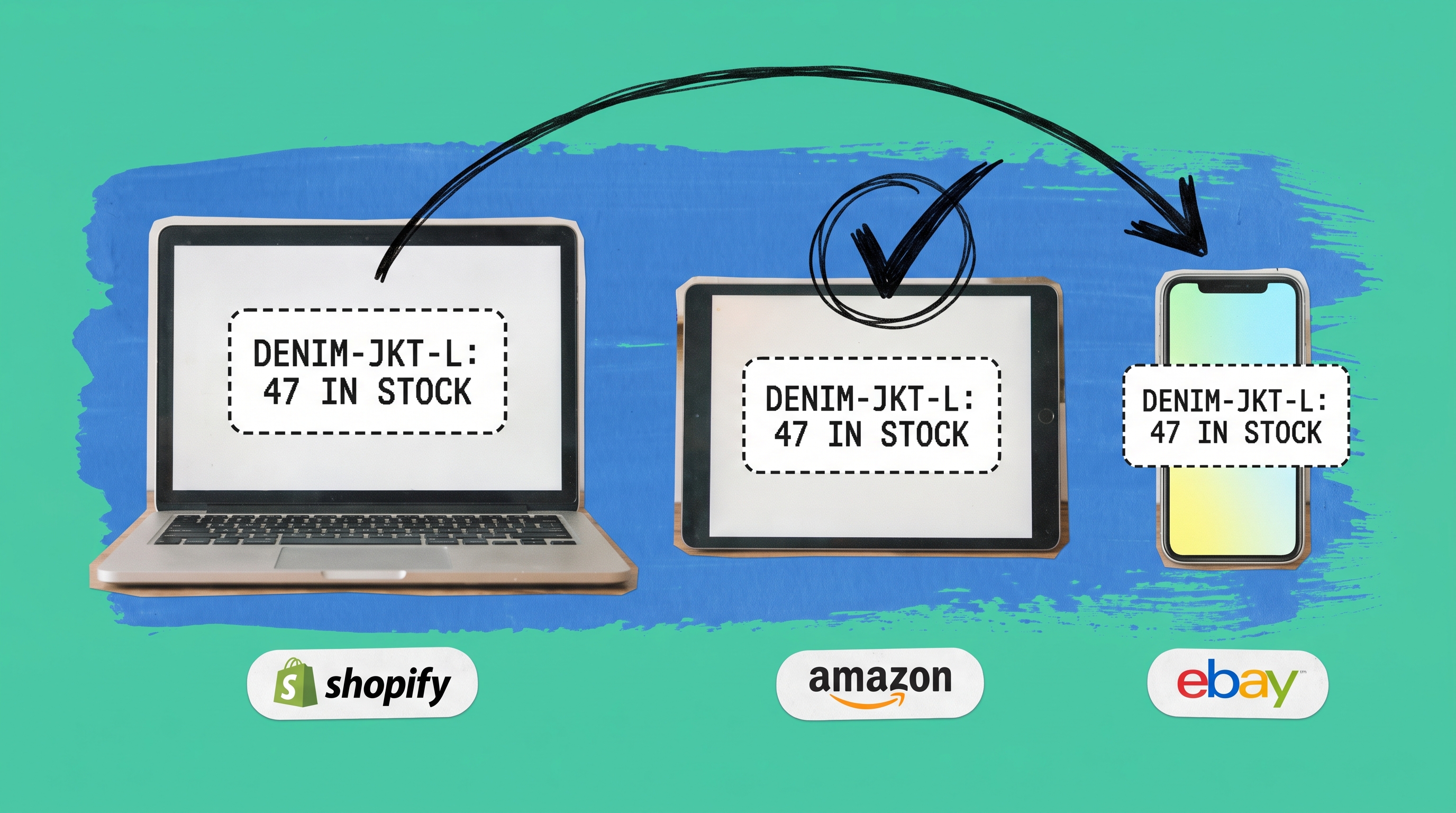
1. Inventory Management Tracking stock levels, reorder thresholds, and location-based allocation across every warehouse and channel. When JACKET-GRN-L shows 47 units on your Shopify storefront, inventory management makes sure that number reflects reality — not a six-hour-old sync.
2. Order Management Receiving, processing, routing, and tracking orders from every channel. This includes fraud holds, multi-location order splits, carrier selection, and exception handling when something goes wrong mid-shipment.
3. Point of Sale (POS) The system your store team uses to transact in person. In an omnichannel setup, POS data needs to feed back to your central inventory immediately — so a sale at your Chicago store doesn't trigger an oversell on your website forty seconds later.
4. Fulfillment and Shipping Picking, packing, and dispatching orders, whether from your own warehouse, a 3PL, or a store location. Rate shopping across carriers, label generation, and managing shipping exceptions all live here.
5. Supplier and Purchase Order Management Replenishment: when to reorder, how much, and from which vendor. This includes managing lead times, EDI compliance with large retail partners like Walmart, and reconciling received goods against purchase orders.
6. Merchandising and Catalog Management Ensuring products are listed correctly, priced consistently, and organized properly across every channel. This prevents TSHIRT-BLU-M from sitting at two different price points on Amazon and your DTC site simultaneously.
7. Staff and Store Management Scheduling, task assignment, and performance tracking for retail staff — especially relevant once you have physical locations alongside digital ones.
8. Reporting and Analytics Pulling data from all of the above into dashboards that answer the questions that actually matter: which products are selling, which channels generate the most margin, where your inventory dollars are sitting idle, and where you're quietly losing money.
These functions are interdependent. A stockout flagged in reporting should trigger a replenishment PO. A POS transaction should update inventory counts everywhere, instantly. An order routed to the wrong fulfillment location shows up as a late shipment in your channel metrics. When these functions operate in separate systems with no shared data layer, the gaps between them are where operational failures hide.
Why Fragmented Retail Operations Break Down at Scale
A single-channel brand with one warehouse can patch this together with Shopify, a spreadsheet, and a carrier account. The setup works — right up until it doesn't.
Here's what "doesn't work" looks like at 500 orders a day across four channels:
- You sell SNEAKER-WHT-10 on eBay. Your inventory file doesn't sync in real time, so two hours later, the same unit sells on Amazon. Now you have two unfulfillable orders, two dissatisfied customers, and a potential Amazon seller metric ding.
- Your Amazon FBA inventory shows 200 units, but there's an inbound shipment stuck in receiving. Your order management system doesn't know this, so it keeps routing Amazon orders to FBA while your real available-to-promise count is closer to 12.
- A Shopify flash sale drives 300 orders in four hours. Your team manually routes each batch to the right warehouse. By hour two, two people are handling it with slightly different logic, and 12 orders go to the wrong location.
None of these are edge cases. They're the predictable failure modes of fragmented retail operations once volume and channel complexity exceed what manual coordination can handle. The fix isn't more people to manage the gaps between systems — it's closing the gaps.
The Retail Operations Tech Stack
Modern multi-channel brands have moved away from point-solution stacks — one tool for orders, a different one for inventory, another for carrier connections — toward consolidated platforms that handle these functions in a single layer. Here's how the tech stack maps to the eight core functions.
Retail Operations Tech Stack
- Order Management System (OMS) — The operational hub. Centralizes orders from every channel, applies routing logic, and manages the lifecycle from placement to delivery confirmation. Replaces the "who's checking the eBay queue this morning" workflow with automated, rule-based routing.
- Real-Time Inventory Sync — Updates channel inventory counts the moment a unit sells, anywhere. Multi-location support lets you track and allocate stock by warehouse, store, or 3PL — not just a single aggregate number.
- Marketplace Connectors — Pre-built integrations to Amazon, eBay, Shopify, Walmart, Etsy, and more. These push inventory updates and pull orders continuously, eliminating the sync delay that causes oversells.
- Carrier and Rate Optimization — Built-in carrier connections (UPS, FedEx, USPS, DHL) with rate shopping and bulk label generation. Your team stops logging into three carrier portals to ship one batch of orders.
- No-Code Automation Engine — Rules that execute the decisions your team currently makes manually. "If an order contains a hazmat SKU, route to Warehouse B." "If an Amazon Prime order arrives after 2 PM EST, use overnight shipping." Rules run in milliseconds. People reviewing order queues don't.
- AI Inventory Forecasting — Machine learning models that use your actual sales history — by channel, location, and season — to recommend reorder quantities before you stockout. Stops the cycle of reactive emergency replenishment.
- Returns Management — A structured workflow for receiving, inspecting, and restocking returned items — or routing them to liquidation. Returns handled without process eat margin; handled with one eat less of it.
- ERP and Accounting Integration — Your OMS and inventory platform push transaction data into your ERP or accounting software (NetSuite, QuickBooks, Xero) so your financial reporting reflects what's actually happening in operations, not a delayed reconciliation.
This isn't an aspirational stack. It's what brands managing $5M–$50M in annual GMV are running today. The question isn't whether you need these capabilities — it's whether you're running them across seven separate tools or one.
Retail Operational Efficiency: The Metrics That Matter
Running retail operations well means knowing where you stand. Here are the metrics worth tracking — and what they reveal when something's wrong.
Order accuracy rate. The percentage of orders fulfilled correctly — right item, right quantity, right address. If yours is consistently below 98%, the cause is usually either picking errors in the warehouse or data sync failures between your OMS and your WMS. One is a process problem; the other is a systems problem.
Inventory accuracy. How often does your system's count match physical reality? For brands managing this manually across multiple channels, the answer is "less often than they'd like." When accuracy drops below 95%, you're making replenishment decisions on bad data — which is how you end up simultaneously overstocked on slow movers and stocked out on bestsellers.
Stockout rate. How often does a SKU hit zero before a reorder triggers? Each stockout is lost revenue and a channel risk — Amazon penalizes high-velocity ASINs that go out of stock by dropping their organic ranking, which takes weeks to recover even after you restock.
Order-to-ship time. From order placed to label generated: how long? For marketplace channels with SLA requirements, this is how you maintain seller account health. For your DTC channel, it's one of the clearest signals to customers that you run a tight operation.
Return rate by channel. Returns aren't a single aggregate number worth tracking. A 15% return rate on Amazon may be standard for your product category; the same rate on DTC might indicate a sizing or product description problem. Breaking it down by channel tells you where the issue is.
Inventory turnover. Units sold divided by average units on hand. High turnover means you're running lean and converting inventory dollars efficiently. Low turnover means capital is sitting in stock that isn't moving — which shows up in your cash flow before it shows up anywhere else.
These metrics are connected. Low inventory accuracy leads to stockouts. Stockouts reduce channel rankings. Lower rankings reduce sales volume — which then makes your inventory look artificially healthy. Tracking them in the same platform, from the same data source, lets you see the relationships and fix root causes rather than symptoms.
What to Look for in Retail Management Software
Before evaluating platforms, agree on what "good" looks like for your specific situation. A few criteria that consistently separate capable platforms from systems that create new problems:
Real-time sync, not batch sync. A 15-minute inventory sync is a 15-minute window for an oversell on a fast-moving SKU. Real-time sync closes that window down to seconds.
Multi-location allocation. Not just "how many units do we have" but "how many at each location, and which location should fulfill this specific order based on proximity, stock levels, and carrier cost."
No-code automation. Your ops manager shouldn't need an engineer to update a routing rule. If changing fulfillment logic requires an IT ticket, your operations are too slow to respond when circumstances change.
Pre-built and maintained connectors. Custom integrations break. They drift out of sync with API changes. Pre-built, maintained connectors to Amazon, eBay, Shopify, and Walmart are non-negotiable for multi-channel brands.
Full-lifecycle visibility. One view of every order — from placement to delivery — across every channel. Not one dashboard per channel, one dashboard total.
How OmniOrders Centralizes Retail Operations
OmniOrders is built specifically for the multi-channel retail operations problem — orders, inventory, and fulfillment centralized in one platform, connected to every channel you sell on.
Here's how it maps to the eight core functions:
Orders centralized. Every order from Shopify, Amazon, eBay, Walmart, Etsy, and your other channels flows into a single queue. Routing rules apply automatically — by carrier, location, product type, or channel. Your team works one screen instead of five.
Inventory synced in real time. When DENIM-JKT-L sells on eBay, the count adjusts everywhere — Shopify, Amazon, your WMS — within seconds. No lag, no batch file, no oversell window.
Fulfillment automated. Built-in carrier connections with rate shopping, bulk label generation, and exception handling. For brands running ship-from-store or BOPIS, OmniOrders routes those orders within the same workflow as warehouse fulfillment — not in a separate system that needs manual reconciliation.
Automation engine for the routine decisions. The no-code rules engine handles the logic your team is currently applying by hand. Set the rules once, and the system applies them to every order — including complex conditionals like split-order handling and time-sensitive carrier exceptions.
AI forecasting from your own data. Inventory forecasting pulls from your actual sales history across channels and locations, factoring in seasonality and supplier lead times. You get recommended reorder quantities before you're out of stock, not after.
Connectors to the channels you already sell on. Pre-built marketplace integrations connect to the major platforms. See the full list on the OmniOrders integrations page — and check which channels are available before you evaluate.
Returns in the same workflow. Structured returns handling routes items back to the right location, triggers restocking or liquidation, and keeps your inventory counts accurate throughout the process.
What this means in practice: instead of your ops team logging into Seller Central, your 3PL portal, and Shopify every morning to reconcile the previous day's orders, they open one dashboard and see everything. The routine work — routing, label generation, inventory sync, reorder alerts — runs automatically. They handle exceptions.
Retail Operational Efficiency: Where to Start
If you're running fragmented operations today and considering consolidating, here's a practical sequence that avoids ripping everything out at once:
Start with inventory sync. Oversells are the most visible, most damaging failure mode. Getting real-time multi-channel inventory sync in place is the fastest ROI available.
Centralize your order queue. Once inventory is accurate, centralizing orders gives you visibility across the full operation — and reveals where routing decisions are inconsistent.
Add automation rules. With centralized orders and accurate inventory, you can start automating the decisions your team makes manually. Start with your highest-volume, most predictable scenarios.
Layer in forecasting. AI inventory forecasting becomes actionable once historical data is flowing through one system — because it's working from clean, consolidated numbers, not averages of averages.
Connect your ERP last. Financial reporting is valuable, but it's most useful when the operational data underneath it is already accurate. Fix the operations first, then surface the financials.
The Standard Has Moved
The retail operations guides from five years ago were built around single-channel retail: store layout, staff training, customer service protocols. Those fundamentals still matter. But for multi-channel brands, the competitive pressure has moved to execution accuracy and fulfillment speed.
Your customer expects correct inventory counts, real-time shipment tracking, and a consistent experience whether they're buying on Amazon or your DTC site. Delivering that with fragmented tools and manual coordination gets harder every time you add a channel or a warehouse location.
The brands that are winning on operations aren't necessarily better-funded. They've consolidated onto a platform that handles the routine work, so their team focuses on the decisions that actually require judgment.
See what OmniOrders can do for your retail operations — from features to pricing.
Start your free OmniOrders trial and run your retail operations from one place.
Frequently asked questions
What are retail operations?
Retail operations refers to the activities, processes, and systems required to run a retail business day to day. It covers everything from receiving inventory and processing orders to managing supplier relationships, fulfilling shipments, and reporting on performance.
What is retail operations management?
Retail operations management is the discipline of coordinating retail activities across teams, locations, and systems — with the goal of delivering consistent customer experiences while controlling costs.
What are the 8 core functions of retail operations?
The eight core functions are inventory management, order management, point of sale (POS), fulfillment and shipping, supplier and purchase order management, merchandising and catalog management, staff and store management, and reporting and analytics.
What makes up a modern retail operations tech stack?
A modern retail operations tech stack centers on an order management system (OMS), real-time inventory sync, marketplace connectors, carrier and rate optimization, a no-code automation engine, AI inventory forecasting, returns management, and ERP or accounting integration.
What metrics measure retail operational efficiency?
The key metrics are order accuracy rate, inventory accuracy, stockout rate, order-to-ship time, return rate by channel, and inventory turnover.
Start your 14-day free trial
See how OmniOrders connects your sales channels, 3PLs, and carriers into one operational layer — free for 14 days, no credit card.