







Quote-to-Cash Explained: The B2B Order Process From Quote to Payment
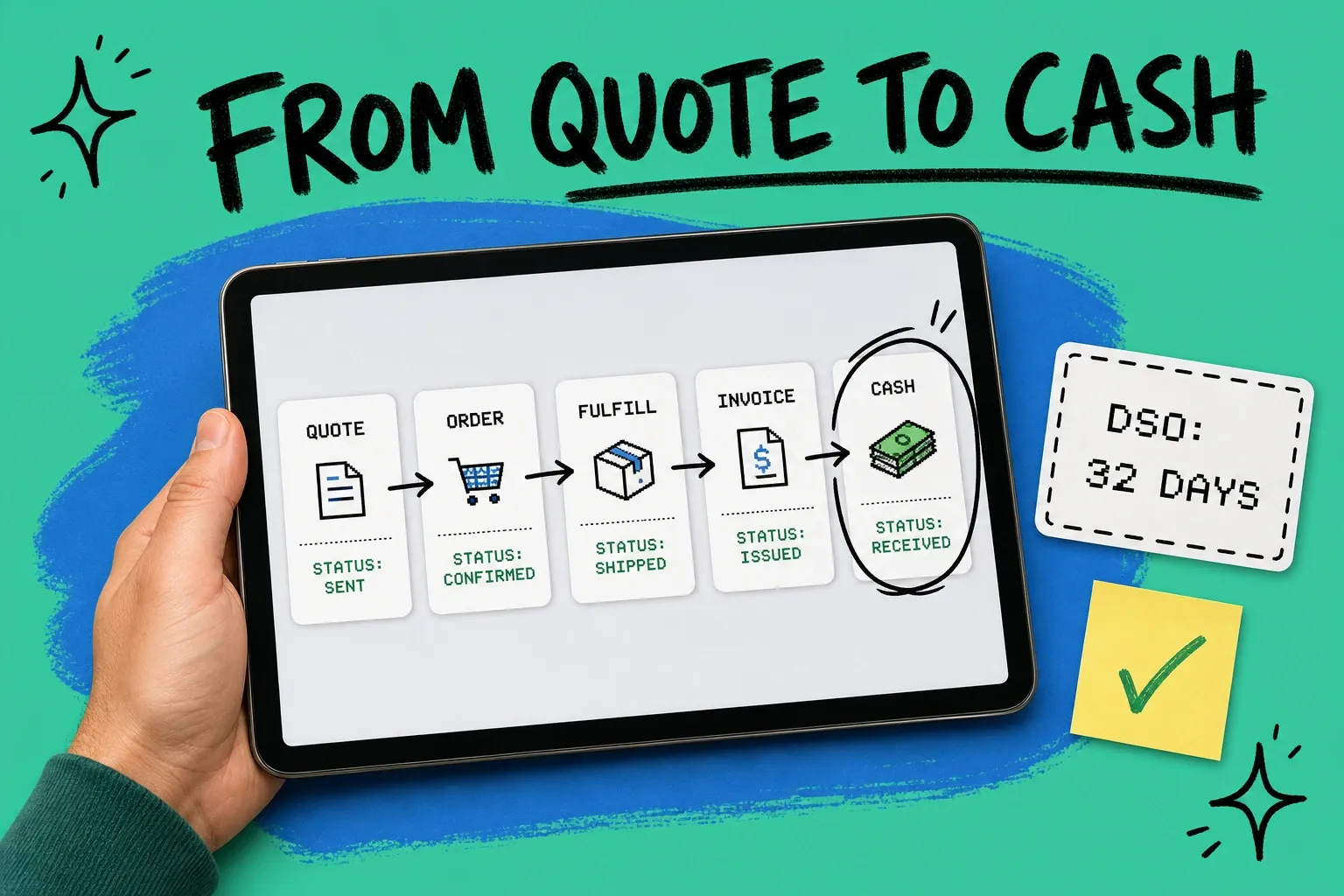
Quote-to-cash is the full business process that runs from the moment you build a price quote to the moment the customer's payment lands in your bank account. It covers quoting, order capture, fulfillment, invoicing, and collections in one connected cycle.
Quote-to-cash (Q2C) is the end-to-end flow that turns a sales quote into collected cash, linking your front-end sales steps to your back-end fulfillment and finance systems.
Most B2B sellers do not lose deals in Q2C. They lose time and margin. A quote sits waiting for approval. An order gets re-keyed from a PDF into the wrong system. An invoice goes out late because nobody told finance the order shipped. Each gap adds days to how long it takes you to get paid. This guide maps the whole process, shows you where it usually breaks, and explains how to tighten it without buying an enterprise suite you do not need.
What is quote-to-cash?
Quote-to-cash, often shortened to Q2C, is the sequence of steps a B2B deal moves through from the first quote to final payment. It is a revenue process, not a single tool. A quote-to-cash cycle touches your sales team, your fulfillment operation, and your finance team, and it usually crosses three or four different systems along the way.
The term matters because it forces you to look at the whole chain instead of one department. Sales cares about closing the quote. Operations cares about shipping the order. Finance cares about collecting the cash. Q2C is the view that connects all three, so a slow handoff between any two of them shows up as slower revenue.
Here is the simplest quote-to-cash definition to keep in your head: everything that has to happen between "here is your price" and "the money cleared."
What are the 7 stages of the quote-to-cash process?
Most teams break the quote-to-cash process into seven stages. Your business may combine a few of them, but the flow is the same.
1. Configure and quote
Sales builds a quote for the customer. For simple catalogs this is a line-item list. For configurable or bundled products, this is where configure-price-quote (CPQ) logic lives, making sure the pricing, discounts, and product combinations are valid before the quote goes out.
2. Negotiate and approve
The customer pushes back on price, quantity, or terms. Internal approvals kick in for anything outside standard pricing. This stage is where deals stall the most, because each manual approval waits on a person to notice a request and act on it.
3. Capture the order
The customer says yes and sends a purchase order (PO) by email, PDF, or EDI (electronic data interchange, the standard format big-box retailers use). The order gets validated against customer records and entered into your order management or ERP system. In most B2B operations this is the highest-volume, most manual step in the whole cycle.
4. Fulfill and ship
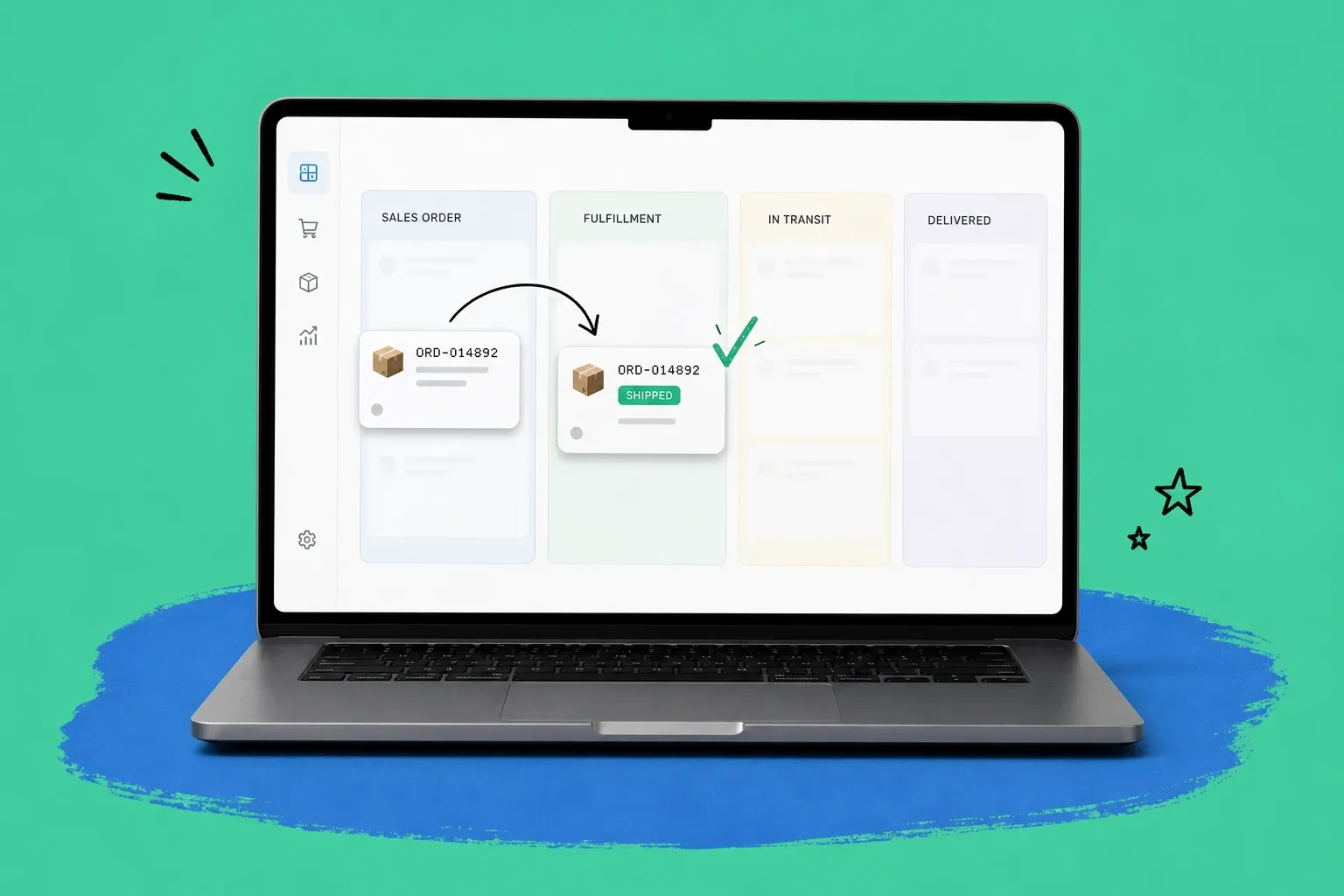
Inventory is allocated, the order is picked, packed, and shipped, and a tracking number is generated. This is the handoff from sales data to physical operations, and it is where a broken connection between systems causes the most visible pain: overselling, split shipments, and missed ship dates.
5. Invoice
Once the order ships, finance issues the invoice with the correct amounts, terms, and tax. If the invoice does not match the order the customer received, you get a dispute, and disputes are expensive to unwind.
6. Collect cash
Payment arrives and finance matches it to the open invoice. This stage is measured in days sales outstanding (DSO), the average time it takes to get paid after invoicing. A healthy DSO for many B2B sellers sits around 30 to 45 days.
7. Resolve disputes
Customers short-pay, claim deductions, or dispute a line. Each case has to be identified, assigned an owner, and backed with evidence before it clears. Most disputes trace back to an error made earlier in the cycle, which is why fixing the front end pays off at the back end.
Quote-to-cash vs order-to-cash: what is the difference?
Quote-to-cash and order-to-cash get used interchangeably, but they are not the same scope.
Order-to-cash (O2C) starts when the order is placed and runs through fulfillment, invoicing, and collection. Quote-to-cash starts earlier. It adds the front-end sales work: configuring the product, generating the quote, negotiating, and contracting. So Q2C includes O2C, plus everything that happens before an order exists.
Why the distinction is useful: if your quotes are clean and fast but cash still comes in slowly, your problem is in the O2C half. If deals stall before they ever become orders, the friction is in the quoting and approval stages. Naming the right half tells you where to focus.
Where does the quote-to-cash process break down?
The leaks in Q2C are rarely dramatic. They are small, repeated frictions that compound across every order.
Manual re-keying at order capture. When a rep copies a PO from a PDF or email into your ERP by hand, errors follow. According to the Sapio Research B2B Buyer Report 2025, 33 percent of B2B online orders contained errors, and 68 percent of buyers said those errors discouraged them from ordering online again. Most of that comes from the human transcription step, not from bad data in the order itself.
Uncontrolled discounts and slow approvals. Every quote that waits on a manual sign-off adds days to the cycle. Discounts applied outside the rules quietly erode margin on deals you already thought you had won.
Broken sales-to-fulfillment handoff. When your sales orders live in one system and your fulfillment lives in another with no live sync, someone has to move data between them. That gap is where oversells and shipping delays start.
No collections follow-up. A DSO north of 60 days is almost never because customers cannot pay. It is because nobody owns the reminder. A polite nudge a few days after the due date collects most of what is late.
Added up, these gaps are real money. MGI Research estimates that a typical company leaks 1 to 5 percent of annual revenue to preventable quote-to-cash breakdowns, and that roughly 42 percent of companies experience some form of this leakage without ever tracing the cause. On top of that, industry benchmarks put the all-in cost of processing a single B2B order by hand between 25 and 100 dollars once you count error correction and rework.
How an order management system streamlines quote-to-cash
You do not need a full enterprise CPQ platform to fix most of this. For mid-market sellers, the biggest wins live in the order-to-cash half of the cycle, and that is exactly what a modern order management system (OMS) handles.
An OMS sits between your sales channels and your fulfillment, so the order that gets captured is the same order that gets shipped and invoiced. No re-keying, no drift. That single change removes the most error-prone step in the whole process.
The practical levers an OMS gives you:
- Automated order capture. Orders from your store, marketplaces, and EDI trading partners flow in and get validated automatically. If you sell into big-box retail, connecting through EDI onboarding keeps PO intake clean and compliant instead of manual.
- Rule-based routing and fulfillment. You can automate order fulfillment without writing any code, so orders route, allocate, and ship on rules instead of someone's checklist.
- A self-service ordering layer for repeat buyers. A B2B customer portal lets wholesale accounts reorder, check status, and manage their own account, which shrinks the quoting and order-capture stages for your recurring business.
- Net-terms and status visibility. When order, shipment, and invoice data live in one place, finance knows the moment an order ships, so invoices go out on time and collections start on schedule.
This is where OmniOrders fits. It centralizes multichannel orders and inventory so the handoff from sales order to fulfillment to invoice happens automatically, which is the part of quote-to-cash that quietly costs mid-market sellers the most.
Quote-to-cash software: what should you look for?
Quote-to-cash software is any tool that moves a deal from quote to payment. The enterprise version bundles CPQ, contract lifecycle management, billing, and revenue recognition into one suite. That is overkill for most companies under a few hundred people.
For a scaling B2B or hybrid seller, look for tools that cover these jobs:
- Order management that unifies every sales channel and pushes clean orders to fulfillment.
- Automated invoicing triggered by shipment, not manual entry.
- Collections and reminders that run on a schedule so late invoices get chased without anyone remembering to.
- Open integrations so your CRM, accounting, and warehouse systems share one version of the truth.
The goal is not to automate every stage on day one. It is to remove the manual handoffs, starting with order capture, so cash moves faster and your team stops fixing preventable errors. Map your own cycle against the seven stages above, find the stage that adds the most days, and fix that one first.
The bottom line on quote-to-cash
Quote-to-cash is the whole revenue chain from quote to collected payment, and the money is not lost in any single stage. It leaks in the handoffs between them. Get the order captured cleanly, keep sales and fulfillment on the same data, and invoice the moment an order ships, and you shorten the cycle without a heavy platform. Start with the one stage costing you the most days, then work outward from there.
Frequently asked questions
What is quote-to-cash?
Quote-to-cash (Q2C) is the end-to-end business process that starts when you build a sales quote and ends when the customer's payment clears. It covers quoting, order capture, fulfillment, invoicing, and collections, tying your sales and finance systems together into one revenue cycle.
What are the stages of the quote-to-cash process?
Most teams map Q2C in seven stages: configure and quote, negotiate and approve, capture the order, fulfill and ship, invoice, collect cash, and resolve disputes. Each stage hands data to the next, so a clean handoff at every step is what keeps the cycle short.
What is the difference between quote-to-cash and order-to-cash?
Quote-to-cash covers the whole cycle, including quoting, pricing, and contracting before an order exists. Order-to-cash (O2C) starts later, at the moment the order is placed. In short, Q2C includes O2C plus the front-end sales steps that create the deal.
What is quote-to-cash software?
Quote-to-cash software connects the tools that move a deal from quote to payment, usually configure-price-quote (CPQ), order management, invoicing, and collections. For mid-market sellers, an order management system often covers the order-to-cash half without a full enterprise CPQ suite.
How do you automate the quote-to-cash process?
Start where re-keying happens, which is almost always order capture, then automate invoicing and payment reminders. Rules that route orders, apply pricing, and trigger follow-ups remove the manual handoffs that stretch your payment cycle. You do not need to automate every stage at once.
Start your 14-day free trial
See how OmniOrders connects your sales channels, 3PLs, and carriers into one operational layer — free for 14 days, no credit card.