







B2B Ecommerce Examples: 9 Order Models That Work
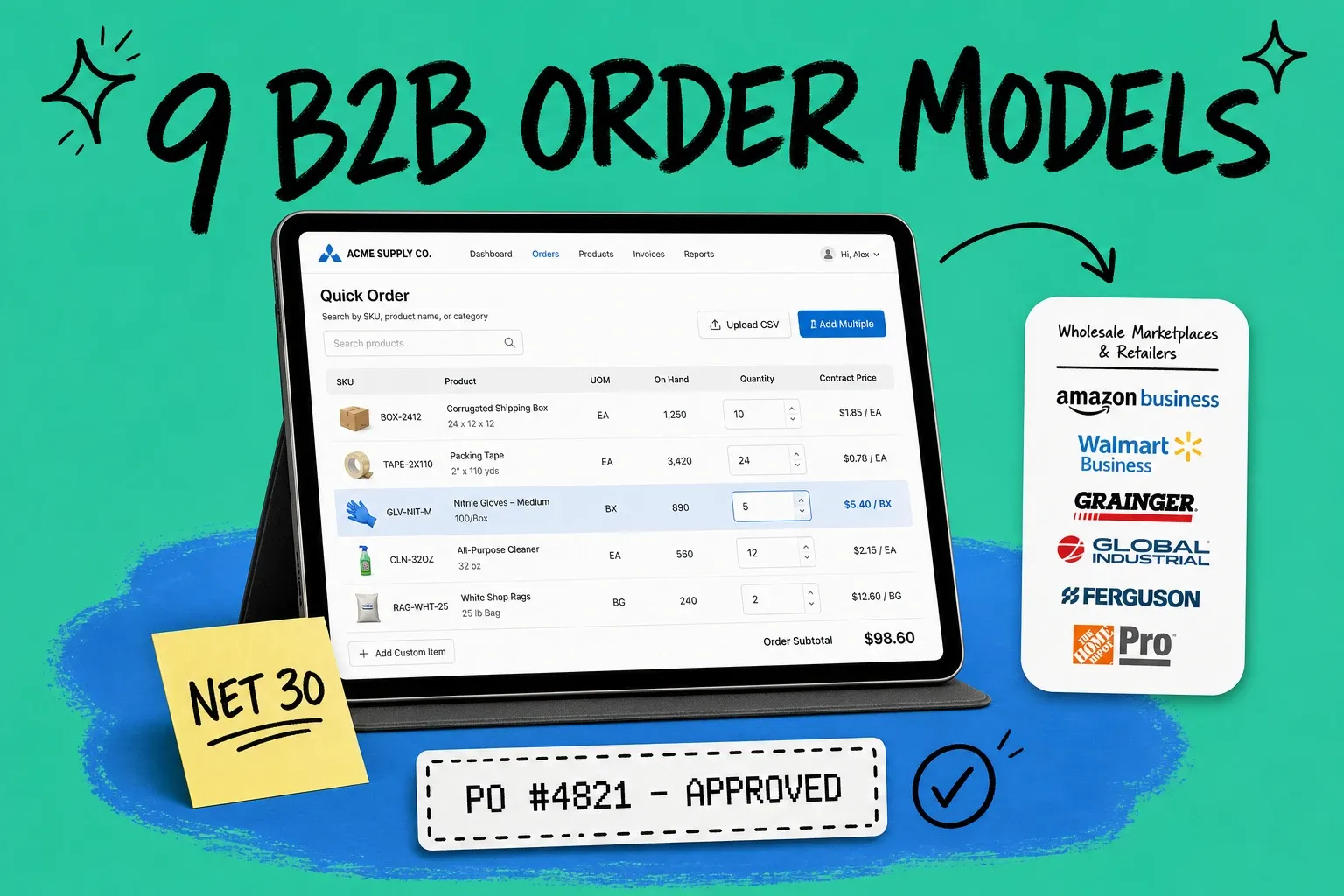
B2B ecommerce examples fall into a handful of repeatable order models: reorder portals, contract-priced storefronts, wholesale marketplaces, punchout catalogs, EDI trading with retailers, and B2B plus DTC hybrids. Each one works for the same reason. The order workflow behind it, pricing, approvals, and fulfillment, runs online instead of living in someone's inbox.
B2B ecommerce is the sale of goods or services from one business to another through an online channel, where business buyers browse a catalog, see their own pricing, and place orders themselves. The examples below show what that looks like in practice, and what has to happen behind the checkout button for each model to hold up.
This matters more than it used to. McKinsey's 2026 Global B2B Pulse survey, which polled nearly 4,000 decision-makers across 13 countries, found that 71 percent of B2B companies now offer ecommerce, and among those that do, roughly one-third of total revenue flows through digital channels, making it the single most important sales channel for many of them. Online ordering is no longer the side project. It is the storefront.
What is B2B ecommerce?
B2B ecommerce covers any business-to-business transaction that happens through an online store, portal, or marketplace rather than a manual quote-and-invoice cycle. A restaurant reordering supplies from a distributor, a boutique buying inventory from a brand on a wholesale marketplace, and a manufacturer receiving purchase orders from a big-box retailer are all B2B ecommerce, even though they look nothing alike on the surface.
The common thread is a business on both sides of the order and a set of rules that a consumer checkout never deals with: negotiated pricing, minimum order quantities, credit terms, tax exemptions, and approval chains.
B2B vs B2C ecommerce
The gap between B2B and B2C is mostly about the order, not the website. A B2C shopper sees one price, pays with a card, and checks out in minutes. A B2B buyer often sees pricing negotiated for their account, orders by the case or pallet, and pays on invoice after a purchase order clears an internal approval.
That difference shapes everything downstream. Your online store has to recognize who is logged in, show the right price list, enforce order minimums, and route the order into fulfillment and accounting without a human retyping it. Get that plumbing right and almost any B2B model can run online.
9 B2B ecommerce examples (and the order model behind each)
Here are nine B2B ecommerce examples you will actually recognize, grouped by the order model that powers them.
1. Reorder portals for repeat buyers
The most common B2B ecommerce example is the humble reorder portal. A distributor or supplier gives each account a login, saved order history, and a quick-order grid so buyers can refill a standing order in under a minute. Think of a coffee roaster's wholesale cafes reordering beans every week, or a dental practice restocking consumables.
Repeat orders are where self-service pays off fastest, because the buyer already knows what they want. A B2B customer portal that shows past orders, contract pricing, and live stock turns a recurring email thread into a two-click reorder.
2. Contract-priced storefronts
Many B2B sellers negotiate pricing per account, then need that pricing to appear automatically when the buyer logs in. A contract-priced storefront applies customer-specific price lists so Account A sees one number and Account B sees another, with no rep involved.
This is the model behind most distributor and manufacturer web stores. The buyer browses the full catalog, but every price reflects their agreement, volume tier, or promotional deal.
3. Wholesale marketplaces
Wholesale marketplaces like Faire, Amazon Business, and Alibaba let brands reach buyers they would never find on their own. A candle maker lists once on Faire and gets discovered by hundreds of boutiques; those boutiques get net terms and a familiar checkout.
The tradeoff is that marketplace orders arrive in the platform's format, on the platform's schedule. To keep inventory accurate, you have to sync those orders back to the same system that handles your other channels, or you will oversell.
4. Punchout catalogs and procurement integration
Larger buyers often purchase through a procurement system like SAP Ariba or Coupa. A punchout catalog connects your store to that system, so the buyer "punches out" from their procurement tool into your catalog, builds a cart, and sends it back as a formatted purchase order for internal approval.
This is common when selling to enterprises, hospitals, and government agencies. It looks invisible to the buyer, but behind it your store is speaking the buyer's procurement language.
5. Manufacturer to distributor ordering
A manufacturer selling to a network of distributors runs a B2B store where each distributor sees wholesale tiers, available-to-promise inventory, and lead times. Orders here are large and planned, so the model leans on accurate stock data and clear shipping windows more than on flashy product pages.
6. Distributor to retailer with EDI
When you sell into big-box retail, the "store" is often EDI, or electronic data interchange, the standardized format retailers use to send purchase orders and receive shipping notices. Walmart, Target, and similar retailers send an EDI 850 purchase order, expect an EDI 856 advance ship notice back, and issue chargebacks when the documents are late or wrong.
It is not a pretty storefront, but it is still B2B ecommerce: automated, document-driven ordering at scale. If you are moving into this model, our guide to EDI integration for ecommerce sellers walks through onboarding with the major retailers without drowning in chargebacks.
7. B2B plus DTC hybrid brands
A growing number of direct-to-consumer brands add a wholesale channel once retailers start asking to carry them. The hybrid model runs a public consumer store and a password-protected wholesale storefront side by side, often from the same platform, using customer groups to keep pricing and terms separate.
The operational risk is inventory. When retail shoppers and wholesale buyers pull from the same stock, one channel can quietly starve the other unless both draw from a single, live inventory count.
8. Blanket orders and standing orders
Some B2B relationships run on blanket orders: the buyer commits to a total quantity at an agreed price, then releases it in scheduled shipments over months. A parts supplier to a factory is a classic case. Online, this shows up as a saved order template and a release schedule the buyer can manage without renegotiating each shipment.
9. Quote-to-order for configured products
When products are configured, priced by spec, or sold in complex bundles, the order starts as a quote. The buyer requests pricing, a rep or a rules engine builds the quote, and once approved it converts straight into an order. This is the quote-to-cash model, and moving it online removes the email back-and-forth that stalls big deals.
How B2B ecommerce works behind the scenes
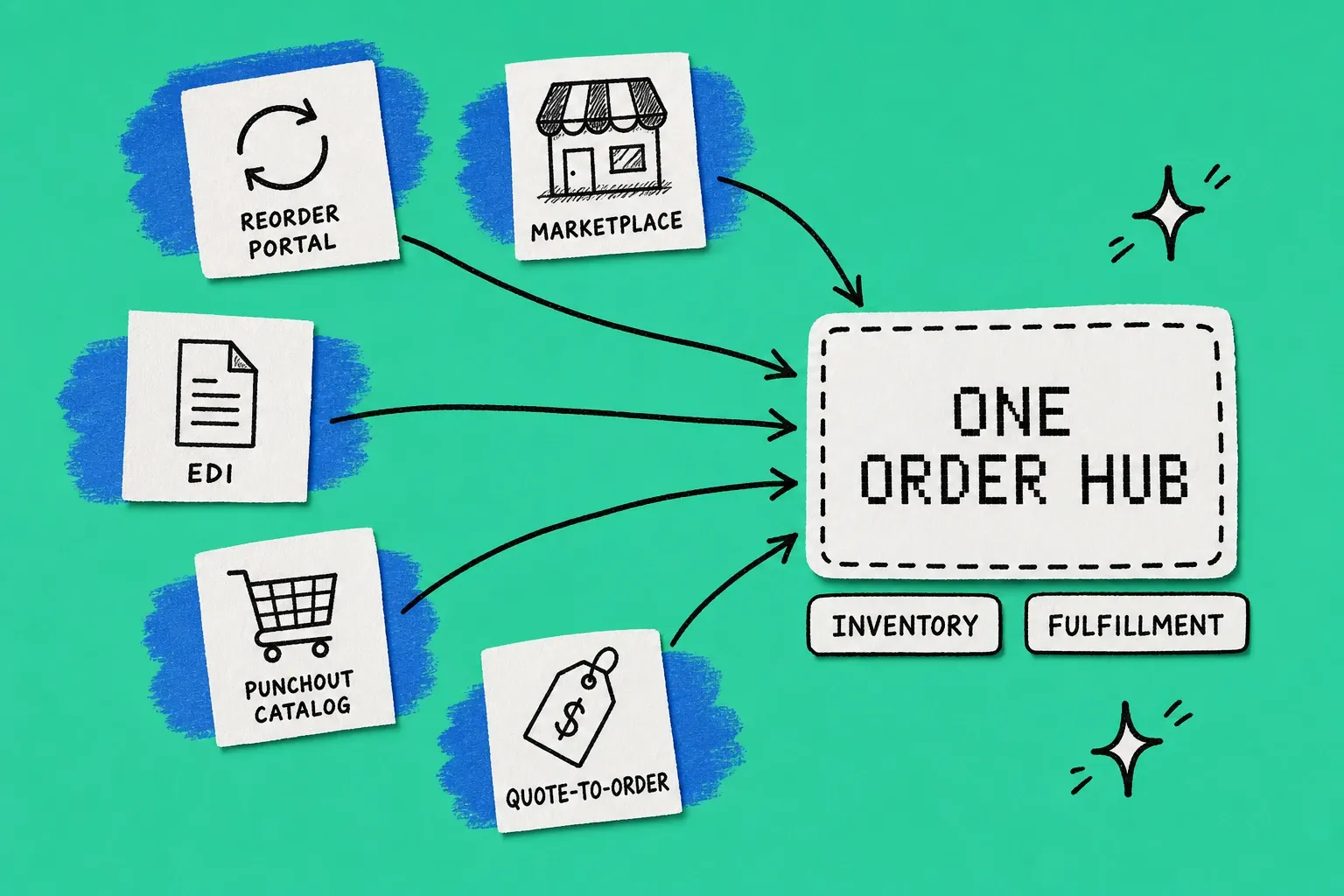
Every example above shares the same hidden machinery. A buyer places an order through some front door, a portal, a marketplace, an EDI feed, or a quote, and that order has to land in one place where inventory is checked, pricing is confirmed, credit terms are applied, and fulfillment kicks off.
The front door varies. The back end should not. When each channel keeps its own order list, teams end up rekeying orders, overselling stock, and reconciling numbers by hand at month end. That is the failure mode behind most stalled B2B ecommerce projects, and it has nothing to do with how the website looks.
eMarketer estimates that US B2B ecommerce site sales, meaning web and portal orders and excluding EDI, reached 2.297 trillion dollars in 2024, up 10.5 percent year over year, and projects the figure will climb to roughly 3.027 trillion dollars by 2028. The buyers driving that growth expect the same self-service they get as consumers. Gartner's 2025 sales survey found that 67 percent of B2B buyers now prefer a rep-free buying experience, and 45 percent used AI during a recent purchase. If your order process still requires a phone call, you are working against how your customers want to buy.
How to start B2B ecommerce (or move it online)
You do not need to launch all nine models at once. Start with the order type that eats the most manual time today, which for most sellers is repeat orders from existing accounts.
- Give your top accounts a login and load their contract pricing so every price they see is correct.
- Turn their most frequent orders into saved templates or a quick-order grid.
- Connect that order flow to a single inventory and fulfillment view so nothing gets rekeyed.
- Only then add quotes, approvals, and marketplace channels on top.
Moving one workflow online and getting it right beats launching a full catalog that your team still has to babysit. Once repeat orders run themselves, each additional model, marketplace, EDI, punchout, becomes another front door into the same reliable back end.
Making your B2B order model actually work
The B2B ecommerce examples that succeed are not the ones with the slickest storefront. They are the ones where the order, no matter which channel it came from, flows into a single system that knows the buyer, applies the right price, checks real stock, and triggers fulfillment without a human in the loop.
That is the problem OmniOrders is built for. It pulls orders from your storefronts, marketplaces, and wholesale channels into one place, so you can run reorder portals, marketplace listings, and retail EDI without three disconnected systems fighting over the same inventory. Pick the model that fits how your buyers already order, then make sure the workflow behind it can keep up.
Whichever B2B ecommerce example matches your business, the test is the same: can a buyer place an order without emailing your team, and can that order reach fulfillment without anyone retyping it? When the answer is yes, the model works.
Frequently asked questions
What is B2B ecommerce?
B2B ecommerce is the sale of products or services between businesses through an online channel, such as a wholesale storefront, a reorder portal, or a marketplace. Instead of taking orders by phone, email, or fax, the seller lets business buyers browse catalogs, see their contract pricing, and place orders themselves. The order then flows into the seller's systems for approval, fulfillment, and invoicing.
What are examples of B2B ecommerce?
Common B2B ecommerce examples include a distributor's reorder portal, a manufacturer selling to retailers through EDI, a wholesale brand listing on Faire or Amazon Business, a punchout catalog wired into a buyer's procurement system, and a DTC brand that adds a password-protected wholesale storefront. Each one moves a specific order type online.
How is B2B ecommerce different from B2C?
B2B orders are usually larger, repeat often, and depend on account-specific pricing, credit terms like Net 30, and approval steps that B2C checkouts do not have. A B2C shopper pays a fixed price with a card at checkout, while a B2B buyer may see negotiated pricing, order by the case or pallet, and pay on invoice after a purchase order is approved.
How do I start selling B2B online?
Start by picking one order type that already causes the most manual work, usually repeat orders from existing accounts, and move just that online first. Give those accounts a login, load their contract pricing, and let them reorder without emailing your team. Once that workflow is stable, layer in quotes, approvals, and marketplace channels.
Do I need a separate platform for B2B and B2C?
Not always. Many brands run both from one system by applying customer groups, price lists, and login rules so wholesale buyers see different pricing and terms than retail shoppers. What matters more than one platform versus two is that every order, wholesale or retail, lands in a single place for inventory, fulfillment, and reporting.
Start your 14-day free trial
See how OmniOrders connects your sales channels, 3PLs, and carriers into one operational layer — free for 14 days, no credit card.