










International Ecommerce Shipping: Duties, Taxes, and Cross-Border Fulfillment Without Margin Leak
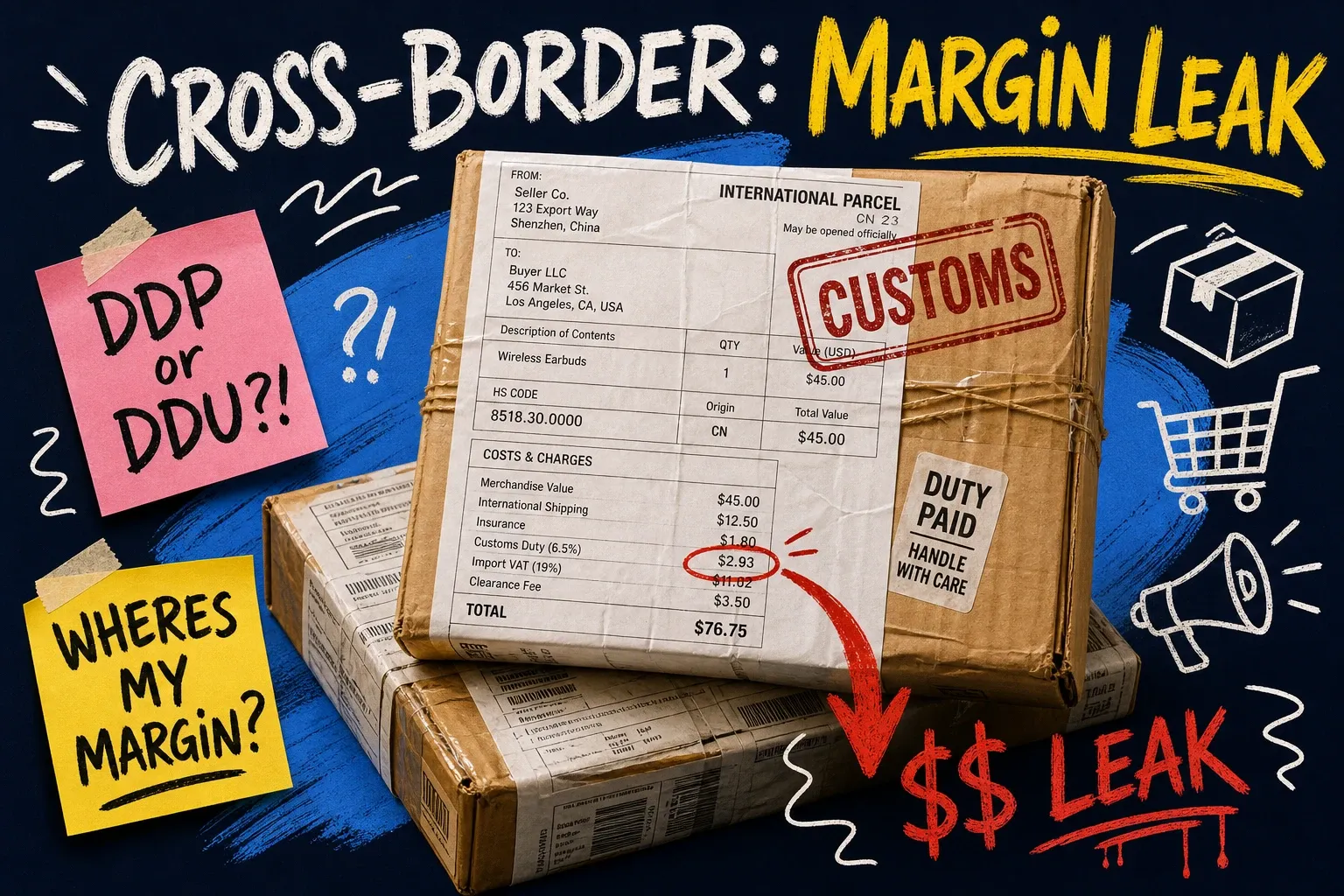
Most brands think the hard part of international expansion is finding a carrier. It isn't. The hard part is discovering, three months in, that your best-selling $80 hoodie generates a 6% gross margin to the UK instead of the 44% you modeled. The shipping cost was fine. The customs duty, VAT, brokerage fee, and one misclassified HS code did the damage.
Cross border logistics is fundamentally a margin-protection problem, not a carrier-selection problem. Every carrier guide will tell you how to print a label for Germany. None of them will tell you that your landed cost math needs to be done before you accept the first international order — not after you've already built the campaign.
This guide is for operators who are serious about getting it right. We'll cover the DDP vs. DDU decision, HS code accuracy, customs documentation, the per-market landed cost formula, and fulfillment models worth considering. By the end, you'll have a framework for evaluating whether a given market is worth entering at your current cost structure.
DDP vs. DDU: The Decision That Shapes Customer Experience
This is the single most consequential operational decision in international ecommerce shipping. Get it wrong and you'll see either surprise abandonment at delivery or margin erosion you didn't model.
DDU (Delivered Duty Unpaid) means the carrier delivers the package and the customer pays duties and taxes upon delivery or pickup. DDP (Delivered Duty Paid) means you collect and remit the taxes at checkout — the customer pays once, receives the package, done.
Here's a side-by-side comparison:
Factor | DDU | DDP |
|---|---|---|
Who pays duties/taxes | Customer, at delivery | Merchant, collected at checkout |
Customer experience | Surprise bill on delivery | Clean, no surprises |
Abandonment risk | High (15–20% in UK/EU markets) | Low |
Checkout conversion | Can be higher (lower upfront price shown) | Usually higher overall (trust) |
Merchant cash flow | No upfront tax outlay | You remit taxes on behalf of customer |
Compliance burden | Low | Higher — requires market-specific setup |
Best for | Low-value orders under de minimis, testing new markets, B2B with tax-registered buyers | Established B2C markets, higher AOV, repeat customer segments |
You've probably already seen the DDU abandonment problem without realizing what caused it. A customer in France orders, everything looks normal through shipping, and then the package sits at a carrier facility for a week while they ignore the duty notice. You issue a refund on the returned shipment and pay return freight. The $80 order cost you money.
DDU has its place — primarily for orders under the destination country's de minimis threshold, where no duty or tax is owed anyway, and for B2B buyers who expect to handle their own customs entry. For consumer-facing brands with any meaningful volume into the UK or EU, DDP is almost always the right answer once you have the compliance infrastructure in place.
The practical implication: running DDP requires your checkout to calculate landed cost accurately in real time, or at minimum to collect a flat tax estimate that covers your actual remittance. Underestimating this at checkout means you absorb the difference.
HS Codes: The Invisible Cost Driver
An HS (Harmonized System) code is a six-to-ten digit product classification number used by customs authorities worldwide to determine duty rates. Every country builds its national tariff schedule on top of the six-digit international standard.
Most brands treat HS codes as a shipping formality. They are not. They determine your duty rate, which determines your landed cost, which determines whether the market is profitable.
Common mistakes operators make:
The most frequent error is using a generic catch-all code because it seemed close enough. Apparel alone has hundreds of HS codes distinguished by fiber content, construction method, and end use. Classifying a 60% cotton / 40% polyester fleece hoodie under the wrong blend threshold can shift your duty rate by several percentage points — compounded across thousands of units, that's real money.
The second common mistake is applying US-centric codes to international shipments. The US uses a 10-digit HTS code. The EU uses an 8-digit CN code. The UK uses its own UK Global Tariff. The first six digits are harmonized internationally; the additional digits are not. Your classification process needs to account for destination country codes, not just a single global code.
The third mistake is set-and-forget. Trade agreements change. Tariff schedules are updated. The US-China tariff environment has shifted materially in recent years, and country-of-origin rules under USMCA affect Canadian duty treatment for goods assembled in the US from foreign components.
Building a maintainable catalog:
For brands with fewer than 200 SKUs, the practical approach is to classify every product manually against the destination countries you're actually shipping to, document the code and the reasoning, and schedule a quarterly review. For larger catalogs, software-assisted classification with human review is worth the investment. The EU's TARIC database and the UK's Trade Tariff are both free and reasonably navigable.
One more thing: if customs reclassifies your goods at entry and the duty rate is higher than what you declared, you pay the difference plus potential penalties. Accuracy here is not bureaucratic detail — it's risk management.
Customs Documentation: What You Actually Need
The commercial invoice is the core document for any international shipment. It needs to include: seller and buyer name/address, a full description of goods (not "merchandise" or "gift"), quantity, unit value, total value, country of origin, currency, and HS code. Carriers will print labels; almost none of them will verify your commercial invoice is compliant. That's your job.
De Minimis Thresholds
Below these thresholds, imports are typically exempt from duties (though rules vary by country and are subject to change):
Market | De Minimis Threshold | Notes |
|---|---|---|
United States | USD $800 | Per shipment, per day |
European Union | EUR €150 | VAT still applies via IOSS above €0 |
United Kingdom | GBP £135 | VAT applies on all orders; duties waived below |
Canada | CAD $40 (taxes) / CAD $150 (duties) | Two separate thresholds |
Australia | AUD $1,000 | GST applies on all imports sold by registered merchants |
The EU threshold deserves a closer look. A lot of brands assume the €150 de minimis means no taxes on small orders. It doesn't. Since July 2021, VAT applies to all B2C orders into the EU regardless of value. The mechanism is IOSS — the Import One-Stop Shop.
IOSS (EU) explained: If you register for IOSS, you collect VAT at checkout and remit it monthly to a single EU member state, which distributes it to the relevant countries. Your packages then clear customs faster because the VAT is pre-declared. If you don't register for IOSS, your carrier handles VAT collection at delivery (on orders up to €150), usually with a service fee charged to the customer. Above €150, standard import VAT and customs entry procedures apply.
The practical recommendation for any brand doing meaningful EU volume: get IOSS registered, or use a fiscal representative service. The customer experience improvement alone usually justifies the administrative overhead.
For the UK, the rules changed post-Brexit. All B2C sales to UK consumers require you to register for UK VAT if you're selling through your own channel. The £135 threshold covers duty exemption only — VAT on goods is collected at point of sale, not at the border.
Carrier Selection by Market
International ecommerce shipping isn't one-carrier-fits-all. The right carrier for a $30 accessory to Toronto is not the right carrier for a $200 apparel order to Tokyo.
A few practical observations by market:
Canada is often treated as a domestic extension, which leads to complacency. USPS First Class International and UPS Standard are common choices for small parcels. For DDP treatment, most brands use Canada Post or a courier with broker-inclusive pricing. Watch for brokerage fee structures — some carriers charge per-entry fees that erode margin on low-AOV orders.
United Kingdom is DHL Express, FedEx International Priority, or Evri (formerly Hermes) for budget-tier domestic last-mile after customs clearance. Post-Brexit customs processing is real — expect 1–3 additional days versus pre-2021. Royal Mail's tracked international products can work for lower-value items.
EU is more fragmented than most brands expect. DHL Express and DPD are strong for pan-EU coverage. Local carriers (DPD, GLS, PostNL) often have better last-mile delivery rates in specific countries. If you're shipping high volumes to Germany, France, or the Netherlands specifically, it's worth benchmarking against regional carrier rates.
Australia and New Zealand have long transit times from North America regardless of carrier. DHL Express and FedEx are the primary options for reliable tracked service. Australia Post can work for volume agreements. Build transit time expectations into your customer communication — seven to fourteen days is realistic, not a service failure.
Asia-Pacific varies enormously. Japan has excellent carrier options but strict import documentation requirements. Singapore is a straightforward free-trade hub. Southeast Asian markets (Indonesia, Thailand, Vietnam) are more complex and often require local 3PL relationships for viable economics.
Most brands making their first serious push into cross border e-commerce try to negotiate carrier rates before they have volume to negotiate with. A better approach: run multi-carrier rate shopping on live orders to find the market-specific optimum, then revisit direct contracts once you have data.
The Landed Cost Math
This is where international expansion either makes sense or doesn't. The formula:
Landed Cost = Product Cost + Shipping Cost + Duty + VAT/GST + Brokerage/Customs Fees + Insurance
Your gross margin on an international order is: Revenue − Landed Cost − COGS − (Reverse logistics provision)
Let's work through a real example.
Product: A fleece hoodie. Retail price $80 USD. COGS $22. Domestic US margin: ~$58 contribution, or roughly 45% gross if we add $8 in domestic shipping.
Destination: United Kingdom. DDP.
Cost Component | Amount |
|---|---|
Retail price | $80.00 |
International shipping (tracked, 5–7 days) | $14.00 |
UK customs duty (8% on $80 CIF value) | $6.40 |
UK VAT (20% on $80 + duty + shipping = $100.40) | $19.68 |
Brokerage / customs entry fee | $2.50 |
Total landed cost to merchant | $42.58 |
COGS | $22.00 |
Contribution | $15.42 |
Gross margin | ~19.3% |
That's not the worst outcome, but it's less than half the domestic margin. Run this with a $5 brokerage fee and missed VAT coverage, and you're at 11–12% — which many brands discover in their P&L three months post-launch, not in a pre-launch model.
The key insight: at $80 retail, your UK margin runs roughly 19–25% under favorable conditions. That's not necessarily a reason not to sell in the UK. It might mean you need a higher average order value to justify the economics, a UK-based fulfillment hub to reduce shipping cost, or a price adjustment for the market.
Before entering any international market, build this model for your top ten SKUs. Our landed cost guide walks through the formula in more detail with worked examples across multiple markets and duty rate scenarios.
Fulfillment Models for Cross-Border Trade
Most brands in the $1M–$20M GMV range don't need the complexity they think they do. Here are the five models worth knowing, with honest tradeoffs:
Direct cross-border shipping from your existing warehouse is the simplest starting point. Viable for testing, for low-volume markets, and for high-AOV products where international shipping as a percentage of value is tolerable. The downside is transit time, potential customs delays, and higher per-unit shipping cost.
International fulfillment hubs — a warehouse in the Netherlands serving EU orders, or one in the UK post-Brexit — dramatically improve delivery speed and can eliminate import duty on per-shipment customs processing (you pay once on the inbound stock transfer, not per order). The economics improve significantly at volume. Most operators look at this seriously around $500K+ annual revenue per market.
FBA International (Amazon) works well if you're already selling on Amazon internationally. Fulfillment By Amazon handles customs, last-mile delivery, and returns. The tradeoff is limited control, FBA fees, and channel dependency.
3PLs with international reach are the pragmatic middle ground for most growing DTC brands. Look for a 3PL with both domestic and UK/EU fulfillment infrastructure, because the operational benefit of consolidated inventory visibility outweighs any per-unit cost savings from optimizing each market independently.
Nearshore positioning for Canada/Mexico is underutilized. A warehouse in Memphis or Seattle cuts Canadian delivery times materially. USMCA provides favorable duty treatment for qualifying goods. If Canada represents more than 15% of your potential international revenue, the nearshore math often works.
Pre-Launch Checklist
Most brands discover operational gaps the hard way — either through a customs hold on their first container or a wave of abandoned DDU parcels in week two. Work through this before your first international shipment goes out:
- [ ] HS codes assigned for every SKU in the active catalog, validated against destination country tariff schedules
- [ ] Commercial invoice template reviewed and compliant (includes HS codes, country of origin, accurate declared values)
- [ ] DDP vs. DDU decision made per market, with checkout configuration to match
- [ ] De minimis thresholds mapped for each target market, with order routing logic to take advantage where applicable
- [ ] IOSS registration completed (or fiscal representative engaged) if selling B2C into EU
- [ ] UK VAT registration completed if selling direct-to-consumer in the UK
- [ ] Landed cost model built for top SKUs by market — validate margin assumptions before launch
- [ ] Returns policy defined for international orders (reverse logistics cost needs to be provisioned)
- [ ] Carrier selection finalized per market with rate benchmarks run on representative order profiles
- [ ] Fulfillment model selected with clear criteria for when you'd shift to an international hub
- [ ] Customer communication updated with accurate international transit time estimates
- [ ] Customs broker identified for markets where you'll exceed the de minimis threshold at meaningful volume
Frequently Asked Questions
What is the difference between DDP and DDU in international shipping?
DDP (Delivered Duty Paid) means the seller collects duties and taxes at checkout and remits them to the destination country's customs authority. The buyer receives the package without additional charges. DDU (Delivered Duty Unpaid) means duties and taxes are the buyer's responsibility upon delivery. DDU typically results in a worse customer experience and higher abandonment rates — 15–20% in markets like the UK and France — because customers face unexpected charges after checkout.
How do I calculate landed cost for international orders?
Landed cost equals your product cost plus international shipping plus customs duty (typically calculated on the CIF value — cost, insurance, freight) plus destination-country VAT or GST plus any brokerage or customs entry fees. For a full worked example across major markets, see the OmniOrders landed cost guide.
What is IOSS and do I need it for EU shipping?
IOSS (Import One-Stop Shop) is the EU's VAT collection mechanism for B2C imports under €150. If you register for IOSS, you collect VAT at checkout, declare it monthly, and your shipments clear EU customs faster with fewer delivery delays. If you don't register, your carrier collects VAT at delivery — adding fees for the customer and creating a DDU-like experience. For any brand doing regular EU consumer sales, IOSS registration is strongly recommended.
What are the most common HS code mistakes in international ecommerce?
Three mistakes account for most classification errors: (1) using a generic or approximate code instead of the correct specific classification, which is especially common in apparel where fiber content and construction determine the code; (2) applying the same code across all destination markets without checking country-specific extensions beyond the first six digits; and (3) not updating codes when products change or trade agreements are renegotiated. Misclassification results in penalties, reclassification at entry, or overpaid duty that reduces margin unnecessarily.
The Operational Reality
Cross border trade rewards brands that treat it as a systems problem before it's a growth problem. The ones who get hurt are the ones who figure out landed cost after they've already run a campaign, built the audience, and accepted 400 UK orders at a margin that doesn't work.
International ecommerce shipping doesn't have to be complicated to manage. But it does need to be modeled honestly, configured correctly, and monitored continuously as exchange rates, duty rates, and de minimis rules shift.
For operators managing multiple fulfillment locations and carrier relationships, OmniOrders handles multi-carrier rate shopping and order routing across locations — so the carrier decision for each international order reflects actual rates, not a fixed contract you negotiated when your volume was different. That's a small operational detail that compounds meaningfully at scale.
Start with one market. Build the model. Get the documentation right. Then expand.
Start your 14-day free trial
See how OmniOrders connects your sales channels, 3PLs, and carriers into one operational layer — free for 14 days, no credit card.