










How to Choose a 3PL Partner: The Ecommerce Brand's Evaluation Checklist
Picking the wrong 3PL costs you more than money. It costs you Friday afternoons manually reconciling inventory counts that were 48 hours stale while customer service fields a backlog of oversell complaints. It costs you the peak season you prepared for all year, undone by a warehouse that couldn't staff up fast enough.
This checklist exists because most evaluation guides are written by 3PL vendors — and they leave out the parts that actually burn brands: hidden minimums, weak integrations, and inventory data you can't trust.
What follows is a genuinely brand-agnostic framework. Work through each criterion before you sign anything.
What Is a 3PL Company?
A 3PL (third-party logistics) company stores your inventory, picks and packs your orders, and ships them to customers on your behalf. You send bulk shipments to their warehouse; they handle the last-mile fulfillment. Some 3PL service providers also offer returns processing, kitting, and freight services.
The model lets ecommerce brands scale without owning warehouse space or managing warehouse labor. But "outsourced fulfillment" is only as good as the 3PL partnership you build — and that depends entirely on choosing the right partner for your specific operation.
The 6 Criteria That Actually Matter
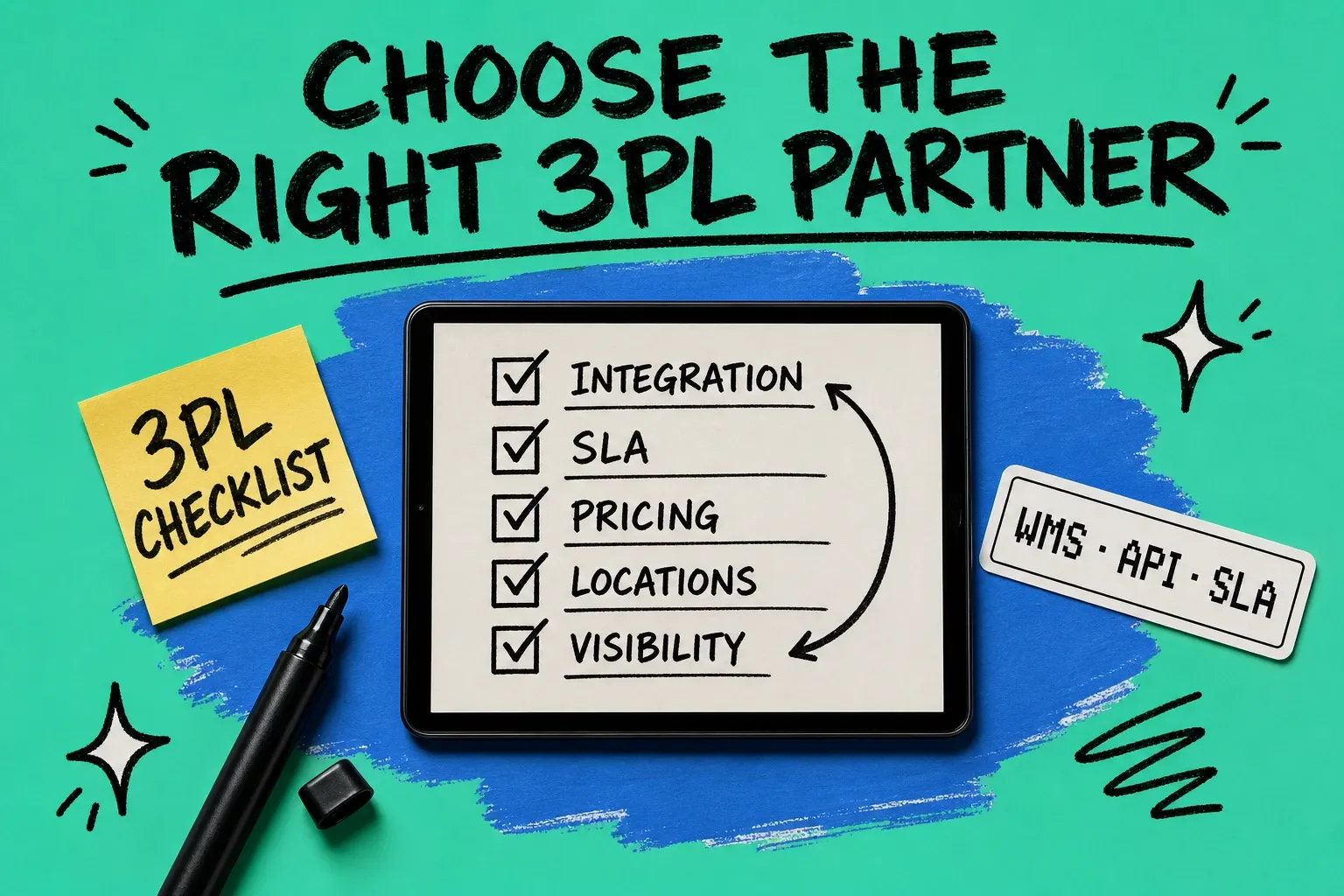
1. Integration Depth and API/EDI Connectivity
This is the criterion most evaluation guides skip. It's also where brands get hurt most.
Your 3PL needs to receive orders and send back shipment confirmations, tracking numbers, and inventory updates automatically. If any of that happens manually — via spreadsheet, email, or a portal your team logs into — you've introduced a lag and a human error point into every single order.
Ask these questions before any demo:
- Does the 3PL have a direct integration with your OMS, shopping cart, or ERP — for does it rely on a middleware connector you're responsible for maintaining?
- What is the latency on inventory updates? Real-time, hourly, or End-of-day?
- Does it support EDI if you sell to wholesale or retail accounts?
- Who owns the data? Can you pull a full inventory and order history export at any time, in a standard format?
The data ownership question matters more than most brands realize. Some 3PL companies make it structurally difficult to leave by holding your historical fulfillment data hostage. You want contractual access to your own records from day one.
Green flag: the 3PL has a documented API, publishes a changelog, and can point you to current integration partners.
Red flag: "Our system talks to everything" with no technical specifics, or integrations handled entirely by their sales team rather than a technical onboarding specialist.
2. SLA Structure and Service-Level Commitments
A 3PL partnership without written SLAs is a handshake deal. You need specific, measurable commitments — not marketing language.
The key SLAs to nail down in 3PL shipping agreements:
Order cutoff and same-day fulfillment. If an order comes in at 2 PM, does it ship today? What's the actual cutoff, and does it apply only on weekdays?
Pick accuracy rate. What percentage of orders ship correctly? Industry standard is typically above 99.5%. Get the actual figure for their operation, not a marketing claim.
Receiving turnaround. When you send an inbound shipment, how long before inventory is available to fulfill? Two business days is reasonable; ten is not.
What happens when they miss? A 3PL SLA is only meaningful if there's a financial consequence for failure. If the contract has no remedies clause, the SLA is decorative.
Also ask about insurance and liability. Damaged or lost inventory happens. Understand their coverage limits and your recourse before it becomes relevant.
3. Pricing Model: Per-Pick, Storage, and Minimums
3PL pricing structures vary significantly, and the complexity is often intentional. Build a full cost model before you compare quotes.
The main cost components:
- Receiving fees — charged per pallet, per carton, or per SKU when inventory arrives
- Storage fees — usually per pallet or cubic foot, per month
- Pick-and-pack fees — per order, per unit, or a combination
- Packaging materials — sometimes included, often not
- Special handling — kitting, inserts, hazgáat, fragile items, custom packaging
- Returns processing — frequently a separate fee schedule
The line item most brands miss is the monthly minimum. Many 3PL service providers charge a floor regardless of your order volume. If your volume dips — seasonally or because of a slow month — you pay the minimum anyway. Know that number before you sign.
Also get clarity on how pricing scales. A rate that looks attractive at 500 orders per month may work differently at 5,000. Ask for the rate card at 2x and 5x your current volume.
4. Location Footprint and 3PL Warehousing Coverage
Where a 3PL warehouses your inventory directly affects your shipping costs and delivery speed.
A single warehouse on the East Coast will put 2-day ground delivery out of reach for West Coast customers. A fulfillment partner with distribution points in multiple regions can cut your average shipping zone — and your carrier cost — meaningfully.
When evaluating 3PL warehousing options:
- Map your customer geography against the 3PL's warehouse locations
- Ask about zone skipping or zone averaging programs with major carriers
- Understand whether multi-location inventory splitting is something they handle operationally, or whether it's your problem to manage
- Find out whether they have capacity at each facility, or whether certain locations are at or near capacity
If you sell internationally, ask whether they have international 3PL shipping capability or established carrier partnerships for customs-clear cross-border shipping, or whether that's entirely outside their scope.
5. Inventory Visibility and Reporting
You need to know where your inventory is, at all times, across every location. That sounds obvious. The gap between what brands assume and what they actually get is where most fulfillment disasters originate.
Ask for a walkthrough of the reporting dashboard, not a screenshot. Specifically:
- Can you see real-time on-hand quantities by SKU and by warehouse location?
- How are adjustments and discrepancies reported, and how quickly?
- Can you set low-stock alerts that trigger before you're already out?
- Does the system support lot tracking, expiration dates, or serial numbers if your products require it?
- What does your historical inventory data look like, and can you export it?
Inventory accuracy is the foundation everything else rests on. A 3PL that can't give you a clean, current picture of your stock is a 3PL that will eventually cause you to oversell, delay orders, or write off shrinkage you can't explain.
6. Scalability and Growth Capacity
The 3PL partner that's right for you today needs to still be right for you in 18 months. Growth — and seasonal peaks — stress-test every part of a fulfillment operation.
Ask direct questions:
- What was their order volume last Q4, and how did they perform against SLAs?
- What is their capacity utilization at the warehouses you'd use?
- Have they onboarded brands at your target growth trajectory before?
- What's the process if you need to add warehouse locations or enter a new region?
- How do they handle labor surges during peak periods — do they staff up proactively or reactively?
A 3PL that maxes out during your peak season and then apologizes afterward is not a growth partner. Get references from brands that have scaled with them, not just brands that signed last quarter.
3PL Evaluation Scorecard
Use this table to score each provider you're evaluating. Rate each criterion 1–5 and weight by importance to your operation.
Criterion | What to Look For | Green Flag | Red Flag |
|---|---|---|---|
Integration Depth | Direct API or EDI; documented endpoints; real-time inventory sync | Published API docs; named integration partners | "We integrate with everything" — no specifics |
SLA Structure | Written SLAs with financial remedies; specific cutoffs and accuracy rates | Remedies clause in contract; audit-ready reporting | SLAs in marketing deck only; no consequences for misses |
Pricing Transparency | Full rate card including minimums, specials, and returns | Itemized quote with volume tiers | Quote missing minimums or special handling fees |
Location Footprint | Warehouse locations aligned to your customer geography | Multi-region coverage; capacity available | Single location with no expansion roadmap |
Inventory Visibility | Real-time dashboards; low-stock alerts; export capability | Live, accessible portal with export | Periodic reports only; no self-serve access |
Scalability | Peak season performance history; references from growing brands | Case studies at your target volume | Vague answers about Q4 capacity |
Common Mistakes Brands Make When Choosing a 3PL
Going with the cheapest per-pick rate. The per-pick rate is one line on a rate card. Brands that optimize for it often find the minimums, receiving fees, and special handling costs more than offset the savings.
Skipping the integration due diligence. A 3PL that requires manual order uploads is not a logistics partner — it's a warehouse with a website. The integration question should come before pricing, not after.
Not testing the relationship before committing. If a 3PL won't do a pilot with a defined evaluation period, that tells you something. A confident operation welcomes the test.
Ignoring the exit terms. Read the contract termination clause before you sign. Switching 3PL partners mid-operation is painful; switching when they're holding your inventory and data hostage is worse.
Keeping Your Operations Connected Across 3PLs
One challenge that comes up as brands grow: you may end up working with more than one 3PL. Different providers for different regions, different SKU categories, or different channels. At that point, the problem isn't which PL you chose — it's keeping order routing, inventory data, and channel sync coherent across all of them.
That's what an OMS handles. OmniOrders, for example, sits between your sales channels (Shopify, Amazon, Walmart, and others) and your fulfillment partners, routing orders to the right 3PL, syncing inventory counts back to each channel in real time, and giving you a single view of what's where. Whichever 3PL you choose, having that unified data layer means your operations don't fragment as you scale.
Frequently Asked Questions
What is a 3PL partner?
A 3PL partner (third-party logistics partner) is an outsourced fulfillment provider that stores your inventory, picks and packs orders, and ships them to your customers. The term "partner" distinguishes ongoing fulfillment relationships from one-off freight or shipping services. Most ecommerce brands engage 3PL partners to avoid owning warehouse infrastructure as they scale.
How many 3PL partners should an ecommerce brand use?
There's no single right answer. Most brands start with one 3PL and add a second when they need regional coverage, category separation, or a backup fulfillment option. Using multiple 3PL partners increases complexity — specifically around inventory allocation and order routing — which is where an OMS or centralized operations layer becomes important.
What's the difference between a 3PL and a fulfillment center?
The terms are often used interchangeably. Technically, a 3PL (third-party logistics provider) may offer a broader range of services including freight, customs brokerage, and supply chain consulting, while a fulfillment center typically refers specifically to the warehouse and pick-pack-ship operation. For most ecommerce brands, the practical distinction is minor.
What SLAs should I require from a 3PL?
At minimum, require written commitments on order cutoff times, same-day fulfillment rates, pick accuracy (typically 99.5% or above), receiving turnaround (how quickly inbound inventory becomes available), and damage/loss liability. The SLA is only as useful as the remedies clause — make sure there's a defined financial consequence if they miss.
How do I evaluate a 3PL's integration capabilities?
Ask for their API documentation or EDI specs. Ask specifically which OMS, ERP, and ecommerce platforms they have live integrations with — not what they "can" integrate with. Ask about inventory update frequency (real-time vs. batch), who maintains the integration if something breaks, and whether you can pull a full export of your data at any time. If they can't answer these questions technically, escalate to their integration or technical team before signing.
What hidden fees should I watch for in 3PL pricing?
The most commonly overlooked costs are monthly minimums (a floor charge regardless of volume), receiving fees (charged per pallet or carton on inbound shipments), special handling fees (kitting, fragile items, custom inserts), returns processing fees, and account setup or onboarding fees. Ask for an itemized rate card that covers all of these — Not just the per-pick and storage rates.
How long does it take to onboard with a new 3PL?
Timelines vary by provider and complexity, but a realistic onboarding — from contract signing to live fulfillment — is typically four to eight weeks. That includes integration setup, inbound inventory shipment and receiving, system testing, and staff training on your SKUs and packaging requirements. If you're switching 3PLs rather than starting fresh, add time for the transition overlap period.
OmniOrders helps ecommerce brands route orders and sync inventory across multiple sales channels and 3PL partners from a single operations layer. Learn more at omniorders.com.
Start your 14-day free trial
See how OmniOrders connects your sales channels, 3PLs, and carriers into one operational layer — free for 14 days, no credit card.