









3PL vs In-House Fulfillment: When to Outsource and When to Keep It In-House
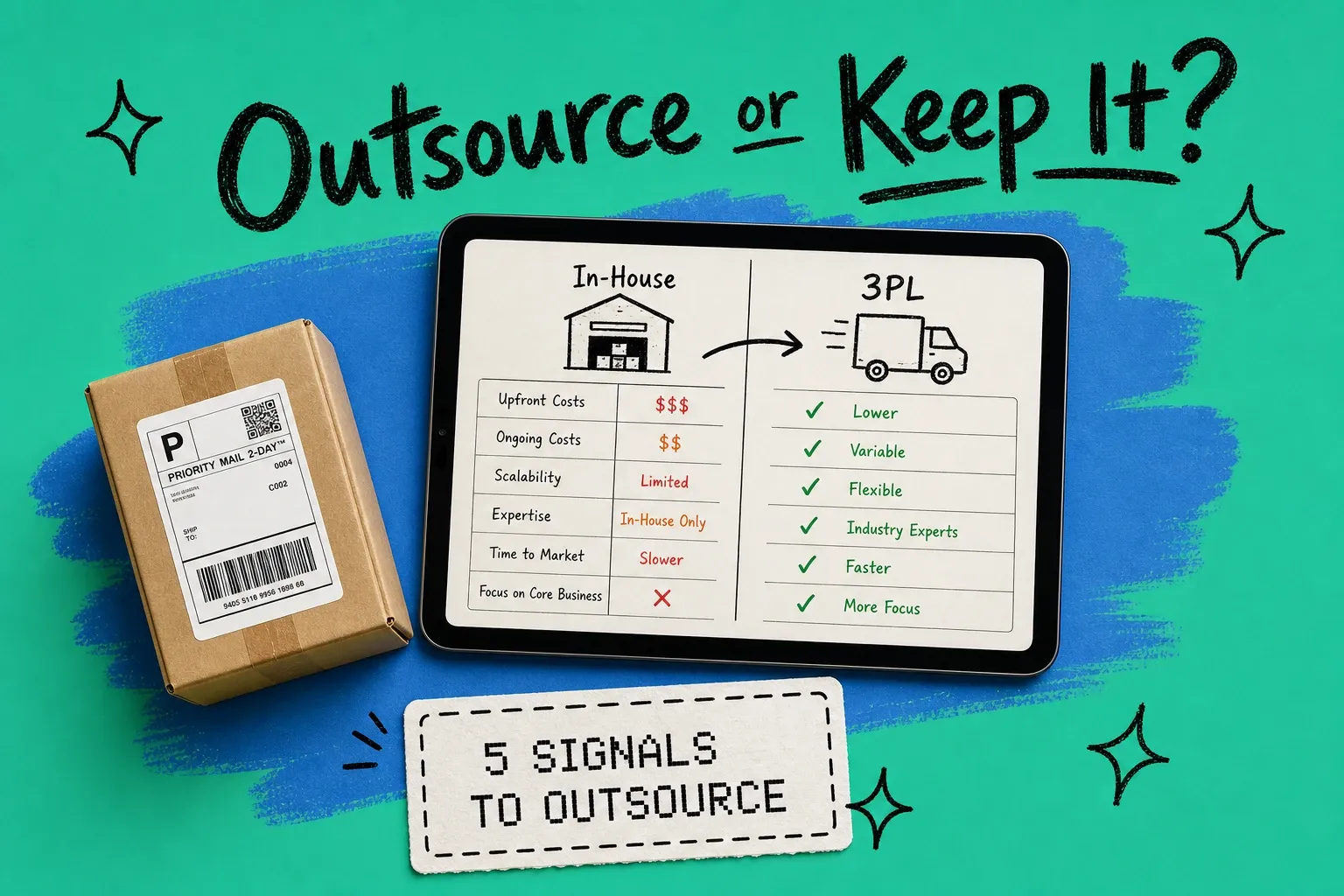
Outsource to a 3PL when your order volume and operational complexity outpace what your team can handle cost-effectively. Keep fulfillment in-house when your margins, SKU count, and customer geography make self-fulfillment the cheaper, more controllable option.
Neither is always right. The right call depends on where you are in your growth curve — and whether your tech stack can support whichever model you're running, or shift to the other one when the math changes.
This guide walks through the actual decision triggers, what a true cost comparison looks like, and a 5-point framework for making the call at your current scale.
What is 3PL fulfillment?
A third-party logistics provider (3PL) is a company that handles warehousing, pick-and-pack, shipping, and returns on your behalf. You ship inventory to their facility; they fulfill orders as they come in from your sales channels.
The 3PL provides the physical infrastructure — warehouse space, racking, labor, carrier accounts, and shipping software. You pay per-unit fees that typically cover receiving, storage, pick-and-pack, and carrier costs.
Popular 3PLs serving DTC ecommerce brands include ShipBob, Red Stag Fulfillment, and ShipMonk. There are also thousands of regional operators that specialize by geography or vertical.
The case for keeping fulfillment in-house
In-house fulfillment works at early stages and in specific operational scenarios. Here's when it makes sense.
Low order volume
Below 200–300 orders per month, in-house is almost always cheaper. Most 3PLs charge minimums of $500–$1,000/month before you've shipped a single order. At low volume, a small team and rented storage beats 3PL economics.
High-touch or customized packaging
If your brand depends on the unboxing experience — tissue paper, custom inserts, handwritten notes — in-house gives you control that most 3PLs can't match without expensive value-added service fees. Candles, skincare, and subscription boxes often fall here.
Local or regional distribution
If 90% of your customers are within 200 miles of your location, local fulfillment outperforms a centrally-located 3PL on both shipping cost and transit time. That geographic advantage disappears when you move to a national warehouse.
Tight-margin products
Gross margins below 40% leave little room for 3PL fees. A $4–5 pick-and-pack charge on a $20 product cuts deep into what you have to work with after cost of goods.
The five triggers that signal it's time to outsource
At some point, the calculation flips. These are the specific signals that fulfillment outsourcing has become the right move.
1. Order volume has crossed 500–1,000 per month
At this volume, 3PL unit economics start to look better than in-house. The fixed costs of leasing space, managing warehouse labor, and maintaining equipment begin to exceed per-order 3PL fees. More to the point: you're now spending meaningful management hours on operations instead of growth.
2. Your shipping costs are above market
3PLs negotiate carrier rates across hundreds of clients. A 3PL shipping 100,000 packages a month gets UPS and FedEx pricing that a brand shipping 1,000 packages can't access. If your per-shipment cost is 30–40% above what comparable brands pay, that gap alone may justify outsourcing.
3. You're expanding to new channels or geographies
Adding Walmart Marketplace or Amazon alongside your Shopify storefront puts new operational demands on your fulfillment setup. Walmart's delivery-time requirements and EDI compliance rules are genuinely difficult for in-house operations to meet consistently. A 3PL with multi-location fulfillment handles this without the capital investment.
4. Seasonal swings are straining your operation
If Q4 means hiring 10 temporary workers and doubling your floor space — and then reversing all of it in January — you're carrying peak-capacity costs year-round. A 3PL absorbs the seasonality. You pay variable fees that track actual volume instead of fixed overhead through your slow months.
5. Pick accuracy is slipping
When in-house accuracy drops below 99%, the cost of mis-picks — reshipping, customer service time, returns processing — often exceeds what outsourcing would cost. That's usually the final signal that the operation has grown past what your current setup can handle.
A simple decision framework
Use this to assess where you stand right now:
Factor | Signals in-house | Signals outsource |
|---|---|---|
Order volume | Under 500/month | Over 1,000/month |
Gross margin | Above 60% | Below 50% |
SKU count | Under 50 active SKUs | Over 100 SKUs or frequent bundles |
Customer geography | 80%+ regional | National or international |
Seasonality | Stable year-round | More than 2x peak-to-trough swing |
Three or more factors in the outsource column means the math likely favors a 3PL. Two or fewer, in-house is probably still your better option.
The question most ecommerce brands miss
Here's where most 3PL vs in-house comparisons stop. There's a harder question underneath.
When you switch fulfillment models, does your order management infrastructure move with you?
Brands running orders through Shopify's native dashboard and a spreadsheet discover this the hard way. Switching from in-house to a 3PL means rebuilding fulfillment workflows from scratch: inventory sync breaks, channel routing needs reconfiguration, return handling gets renegotiated. Every time you add a channel or change fulfillment partners, you're back to square one.
This is why the 3PL vs in-house decision is also a technology decision. Brands that run a centralized order management system between their sales channels and their physical fulfillment layer can switch models without rebuilding from scratch. The OMS routes orders to the right location, keeps inventory synced across all channels in real time, and manages carrier selection regardless of whether the picking is done by your team or a 3PL partner.
OmniOrders is built for this setup: a fulfillment-model-agnostic OMS that connects your channels to your operations and stays intact when your fulfillment model changes. Run in-house today, add a 3PL tomorrow, split inventory across multiple locations next quarter — the platform keeps routing, syncing, and reporting across all of it.
What the true cost comparison actually looks like
Brands consistently undercount the cost of in-house fulfillment because they compare it only to 3PL labor fees. Here's what belongs in a real comparison.
True in-house cost:
- Warehouse rent and utilities
- Full loaded labor (wages, benefits, management time)
- Packaging materials
- Shipping at your negotiated or retail rates
- Returns processing labor
- WMS and shipping software subscriptions
- Capital tied up in inventory and equipment
True 3PL cost:
- Receiving fees ($5–25 per pallet is typical)
- Storage fees ($0.20–$0.50 per cubic foot per month)
- Pick-and-pack fees ($2–5 per order, $0.20–$0.50 per additional item)
- Carrier costs at 3PL negotiated rates
- Returns processing fees
- Integration and setup fees (one-time)
The comparison needs to capture all fixed overhead — especially if you're evaluating a lease expansion. A 3PL becomes substantially more competitive once you factor in the capital and complexity of scaling your own space.
Questions to ask when evaluating a 3PL
Once you've decided to outsource, the next job is finding the right partner. Here's what to ask:
On operations: What's your average pick accuracy rate? What's your on-time ship rate by carrier? How do you handle damage claims and insurance?
On integrations: Which platforms do you connect to natively? What does the integration setup process look like, and who manages it?
On pricing: What are your minimum monthly fees? Are storage fees cubic or pallet-based? Are there charges for receiving returns?
On scaling: Do you have multiple warehouse locations? How do you handle volume spikes during peak season?
On contract terms: Is there a volume commitment? What's the process if the relationship isn't working?
What about hybrid fulfillment?
Brands in the $3–10M GMV range often run a hybrid model: in-house for their home market, 3PL for expansion channels or geographies. This works when you have a strong local customer base with high-touch packaging requirements, but need scalable infrastructure elsewhere.
Hybrid fulfillment is operationally complex. It requires routing logic to direct each order to the right location based on customer address, SKU availability, channel, and fulfillment cost. An OMS handles this automatically — orders go to the best fulfillment option without manual intervention every time.
Frequently asked questions
What is 3PL fulfillment?
3PL fulfillment means outsourcing your warehousing, picking, packing, and shipping to a third-party logistics company. You send your inventory to their facility; they pick, pack, and ship orders directly to your customers as they come in from your sales channels.
When should an ecommerce brand switch to a 3PL?
The clearest signals: order volume crossing 1,000 per month, shipping costs significantly above 3PL negotiated rates, geographic expansion that requires multi-location fulfillment, and seasonal swings that make in-house staffing inefficient.
How much does 3PL fulfillment cost?
Receiving fees typically run $5–25 per pallet. Storage costs are $0.20–$0.50 per cubic foot per month. Pick-and-pack fees are usually $2–5 per order plus $0.20–$0.50 per additional item. Carrier costs pass through at the 3PL's negotiated rates, which are generally below what brands pay directly.
What's the difference between a 3PL and an OMS?
A 3PL handles physical fulfillment: the warehouse, packing, and shipping. An order management system (OMS) is the software layer connecting your sales channels to your fulfillment operations. You can use an OMS regardless of whether you fulfill in-house or through a 3PL — it routes orders, syncs inventory, and manages carriers from a single dashboard.
Can I use a 3PL alongside in-house fulfillment?
Yes. Many brands run hybrid fulfillment: in-house for their core market, 3PL for expansion geographies or new channels. This requires routing logic that sends each order to the right location automatically based on address, SKU, and inventory position — which is what an OMS handles.
Making the decision
Neither model is permanent. Most growing brands make this call more than once, and the right answer changes as your volume, SKU mix, and geography shift.
What matters more than the initial decision is whether your operational infrastructure can support the model you're running cleanly — and adapt when the math changes.
If you're approaching the point where in-house fulfillment is straining your team, book a demo with OmniOrders to see how a centralized OMS connects your channels to your fulfillment operations, regardless of who does the picking.
Start your 14-day free trial
See how OmniOrders connects your sales channels, 3PLs, and carriers into one operational layer — free for 14 days, no credit card.