










Warehouse Operations Guide: The 6-Stage Process Every Ecommerce Brand Must Optimize
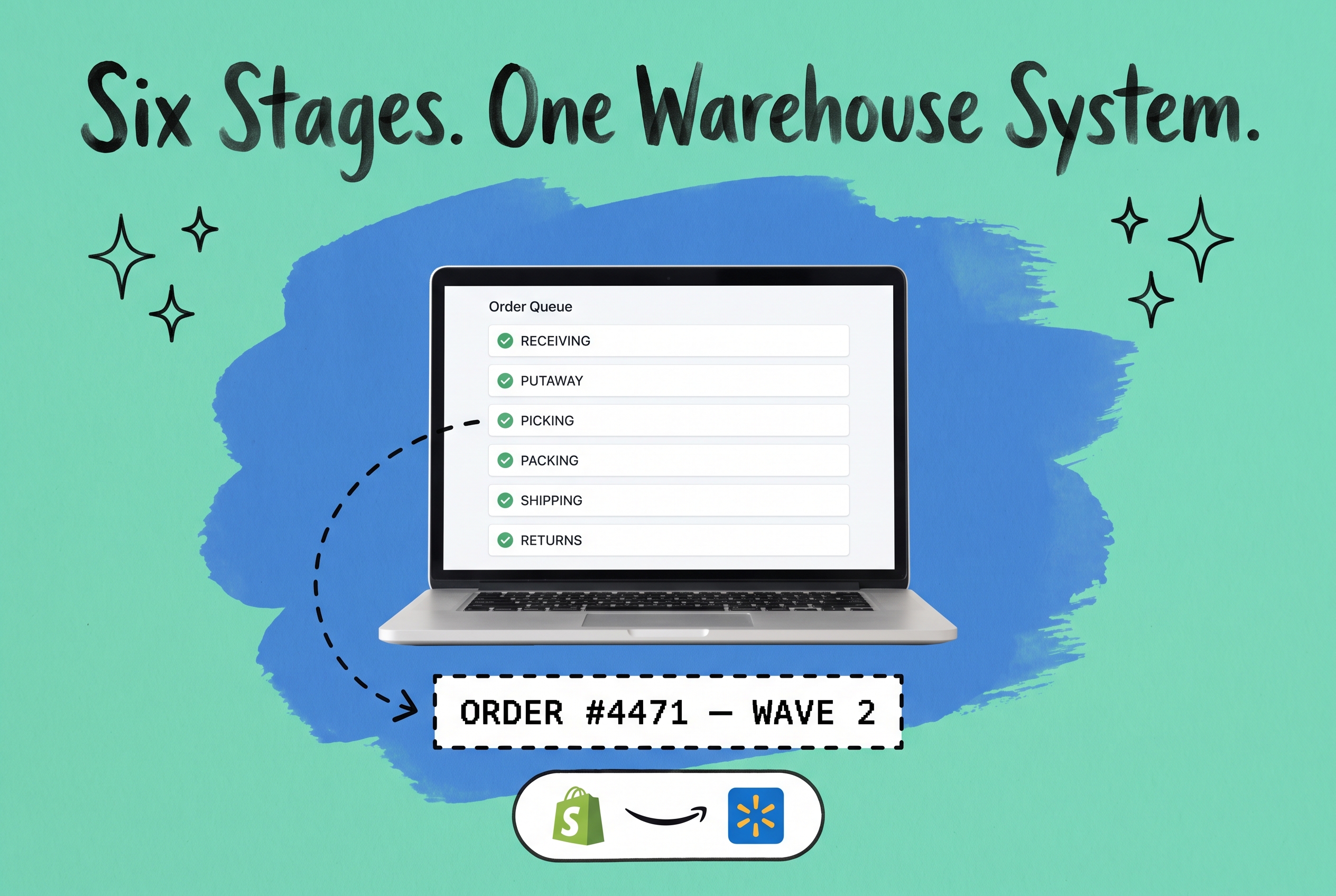
Warehouse operations are the physical and system-driven processes that move inventory from receiving dock to customer door. For ecommerce brands, those six stages are: receiving, putaway, picking, packing, shipping, and returns. Each stage connects to the next, and a bottleneck in any one of them shows up as a delayed order, a mis-pick, or an oversell on a channel you forgot to update.
This guide covers what actually happens at each stage, where things go wrong for multi-channel brands, and how the right order management system eliminates the manual handoffs that slow your warehouse down.
What Happens in a Warehouse? The 6 Core Stages
Most warehouse operations guides describe a generic floor with forklifts and bin locations. That's useful context, but if you're running a multi-channel ecommerce brand selling on Shopify, Amazon, Walmart, and a couple of marketplaces, your warehouse has a specific challenge generic WMS guides don't address: orders from a dozen sources need to hit the pick floor with the right priority, the right routing, and the right carrier, all without your team touching a spreadsheet.
Here's how each stage works, and where the OMS layer above your warehouse makes the difference.
Stage 1: Receiving
Receiving is where inventory enters your facility. A purchase order goes out to your supplier, the goods arrive, and your team counts, inspects, and checks items in against expected quantities.
When this goes well, every unit is scanned, SKUs are matched to open purchase orders, and stock levels update across every sales channel the moment the PO is confirmed. When it goes wrong, a box of 48 units gets received as 84, and you spend the next week dealing with oversells on Amazon and phantom inventory in your Shopify store.
Receiving also sets up putaway. Items scanned in at receiving need a destination: a bin, a shelf, a zone. That assignment feeds directly into picking efficiency later.
Stage 2: Putaway and Slotting
Putaway is the act of moving received inventory to its storage location. Slotting is the strategy behind it: which SKUs go where, and why.
Fast movers (the top 20% of SKUs that drive roughly 80% of pick volume) should live closest to the packing station. Seasonal products can sit in bulk storage until you shift them forward before a peak. Hazardous or fragile items need designated zones.
Good slotting cuts picker travel time. When a picker walks 30% less distance per order, you fulfill the same volume with fewer labor hours, or you handle more orders with the same headcount.
Stage 3: Picking
Picking is where most warehouse operations either scale or fall apart. Single-order picking (one picker, one order) works fine at low volumes. As you grow, it gets expensive fast.
Batch picking groups multiple orders together so a picker collects for several orders in one trip. Wave picking schedules pick runs by carrier cutoff or order priority. A batch of 30 orders tagged for priority 2-day shipping goes out in the first wave; standard ground orders follow.
Your OMS should be driving this logic, not a whiteboard. When the system's automation rules set wave priority and batch groupings based on carrier cutoffs, order tags, and shipping destination, your pick floor runs on consistent rules instead of individual judgment calls. That means predictable output even when you're onboarding seasonal staff in Q4.
Stage 4: Packing
Packing seems simple until you count the decisions it requires: box size selection, dunnage type, whether to include a branded insert, which packing slip format to print, and how to handle a multi-SKU order that spans two pick locations.
A few things matter at scale:
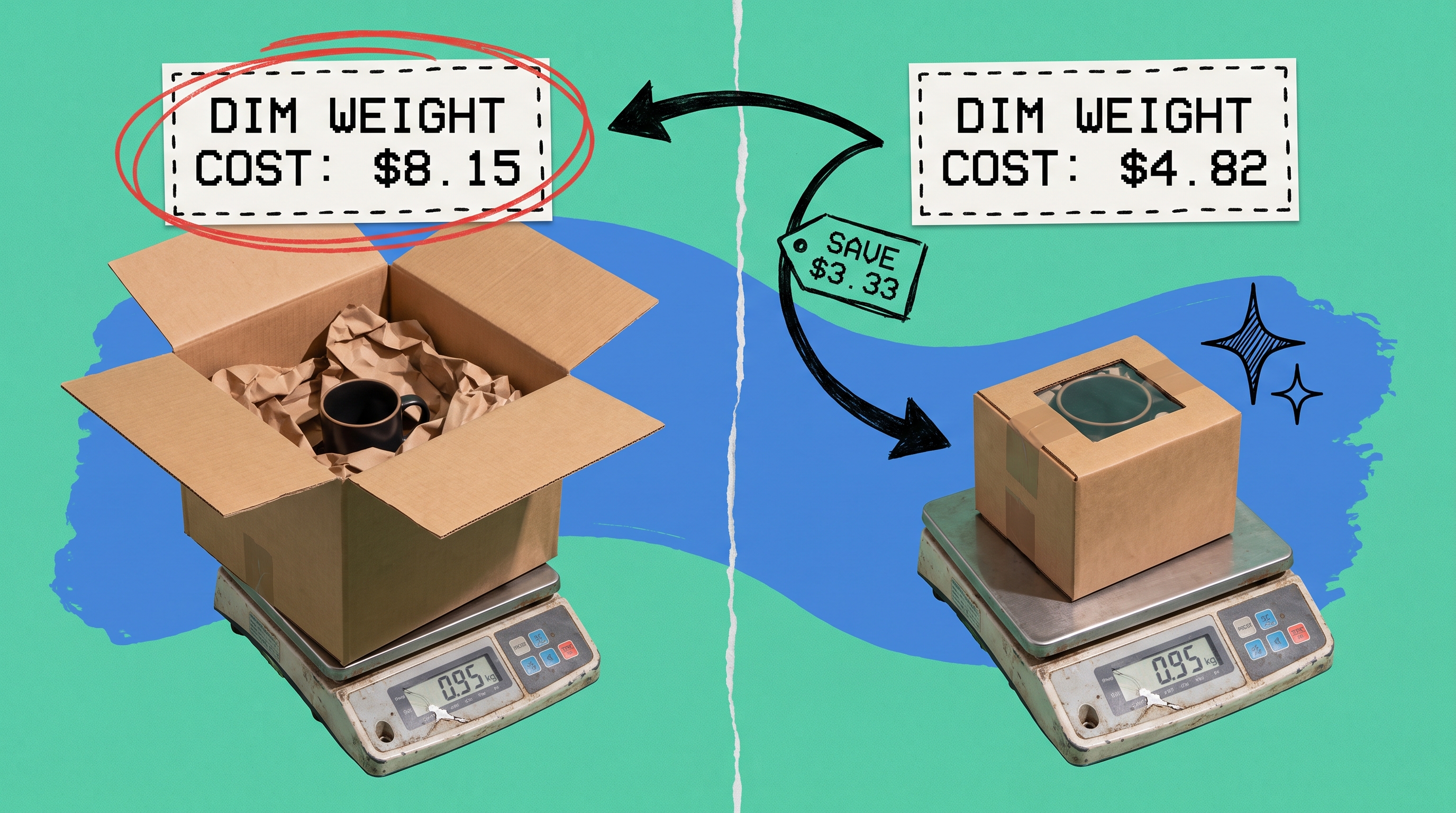
Cartonization: selecting the right box dimensions for each order reduces dimensional weight charges. If your carriers charge by the larger of actual vs. dimensional weight, putting a flat item in a 10x10x10 box costs you real money, per shipment, every day.
Packing slip accuracy: the slip inside the box is often the last touchpoint your brand has before a customer opens the package. An incorrect slip, or a slip mixed up with another order, generates returns and support tickets that cost more to resolve than the order was worth.
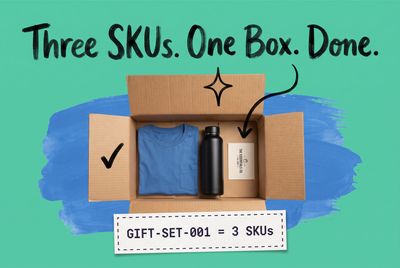
Kits and bundles: if you sell bundled SKUs (say, MOISTURIZER-50ML plus SERUM-30ML as SKINCARE-KIT-001), your packing process needs to know whether to pick the components separately or pull a pre-built kit from a kit storage location. That distinction lives in your product catalog and order rules, not on the pick floor.
Stage 5: Shipping
Shipping is where carrier selection and rate optimization happen. You have a packed box, a ship date, a service level, and a dozen carriers offering different rates.
Rate-shopping compares live carrier rates across UPS, FedEx, USPS, and regional options, then selects the cheapest service that still hits the required delivery date. Per order, the savings are modest. Across 500 shipments a day, they're real. You can see exactly how carrier rate-shopping works at scale if you're evaluating this for your operation.
For multi-location brands, shipping also involves routing: which warehouse ships this order? The answer depends on real-time inventory availability at each location, proximity to the customer, and whether the SKU is actually in stock. An OMS routes orders automatically based on those rules rather than relying on someone to manually check stock across facilities before each assignment.
Stage 6: Returns
Returns are the stage most brands underinvest in, and the cost shows up two ways: customer satisfaction drops when the return process is slow, and inventory sits unprocessed instead of going back on the shelf.
A clean returns process receives the item, inspects it, decides whether it goes back to sellable stock or to a damage/write-off bin, and updates inventory counts and channel listings. If you're selling on Amazon and Walmart simultaneously, a returned unit that passes inspection should go back into your available pool for both channels, not just the one the order came from.
Warehouse KPIs: What to Measure
Running a warehouse without tracking KPIs is like driving without a dashboard. These are the metrics that tell you whether each stage is working:
Receiving accuracy rate: the percentage of received POs where counted quantities match expected quantities. Below 98% points to a process or supplier problem worth investigating.
Putaway cycle time: time from receiving to a unit being scan-confirmed in a bin location. Long putaway times create inventory that's "in the building" but unavailable to pick, which shows up as a stock discrepancy your team will chase for hours.
Order pick accuracy: the percentage of orders where picked items match the order exactly. Most operations aim for 99.5% or higher. Below that, you're generating downstream errors that compound into packing mistakes and return costs.
Orders shipped on time: the percentage of orders that leave the building by the carrier cutoff. This metric integrates all previous stages. If receiving is slow, if putaway is backed up, if pick accuracy is low, it shows up here first.
Cost per order: total warehouse labor plus packing materials plus shipping cost, divided by order count. This is the unit economics number that tells you whether your warehouse is scaling or just getting more expensive.
Return processing time: time from a returned item arriving to it being available for resale. Every day a returnable unit sits unprocessed is a day you can't sell it.
Track these weekly, not monthly. A metric that drifts for four weeks before you notice it has already cost you real money.
How Your OMS Orchestrates Warehouse Operations
A warehouse management system handles the physical floor: bin locations, pick paths, scan confirmation. But for ecommerce brands, the WMS alone doesn't know which of the 300 orders queued up should go out first, which carrier to use, or whether to split an order across locations.
That's the OMS layer. OmniOrders acts as the orchestration platform that sits above your warehouse and connects it to every sales channel:
- Orders from Shopify, Amazon, Walmart, Etsy, and eBay land in one place and route to the right fulfillment location based on stock levels across every warehouse and location
- Automation rules apply pick priorities, put holds on orders missing address data, and trigger PO replenishment when a SKU hits its reorder point
- Inventory counts sync across all channels in real time, so a unit sold on Amazon is unavailable on Walmart within seconds
- Rate-shopping selects the best carrier and service level before the label prints
The result: your pick team sees a clean, prioritized queue instead of a pile of unranked orders from six different portals.
Run a Tighter Warehouse with OmniOrders
Every stage in your warehouse connects to the next. A slow receiving process creates inaccurate inventory that leads to oversells. A poor pick sequence creates packing errors that generate returns. And without real-time inventory sync, selling on multiple channels means every sale is a small gamble on whether the stock is actually available.
OmniOrders centralizes orders, inventory, and fulfillment across every channel, then automates the routing decisions that slow warehouse teams down. Start your free OmniOrders trial and see how much cleaner your pick queue looks when the system handles prioritization for you.
Frequently asked questions
What is warehouse operations?
Warehouse operations are the end-to-end processes that manage inventory inside a fulfillment facility, covering receiving, putaway, picking, packing, shipping, and returns. For ecommerce brands, effective warehouse operations also depend on systems (OMS and WMS) that automate routing decisions and keep inventory counts accurate across every sales channel in real time.
What are the most important warehouse KPIs?
The KPIs that matter most are order pick accuracy, on-time shipment rate, receiving accuracy rate, and cost per order. Pick accuracy and on-time shipment reflect customer-facing outcomes. Receiving accuracy and cost per order reveal whether your internal processes are efficient or quietly deteriorating.
What is warehouse slotting and why does it matter?
Warehouse slotting is the practice of assigning storage locations to SKUs based on pick frequency. Fast-moving items go closest to packing stations; slow-moving and seasonal SKUs go to bulk storage. Good slotting reduces picker travel time and increases the number of orders you can fulfill per labor hour without adding headcount.
What is the warehouse receiving process?
The warehouse receiving process covers everything from unloading a supplier shipment to confirming quantities, scanning SKUs, and assigning putaway locations. Proper receiving requires matching incoming units against open purchase orders and triggering inventory updates the moment a PO is confirmed, so every sales channel reflects the new stock immediately.
How does an OMS improve warehouse operations?
An order management system does not replace your warehouse's physical processes; it orchestrates them. It routes orders to the right fulfillment location, applies picking priorities and batch groupings, selects the best carrier rate at ship time, and syncs inventory across every channel in real time. Without that layer, warehouse teams spend time on manual routing decisions that software should handle automatically.
Start your 14-day free trial
See how OmniOrders connects your sales channels, 3PLs, and carriers into one operational layer — free for 14 days, no credit card.