










Walmart WFS vs Amazon FBA: Which Fulfillment Program Should You Use?
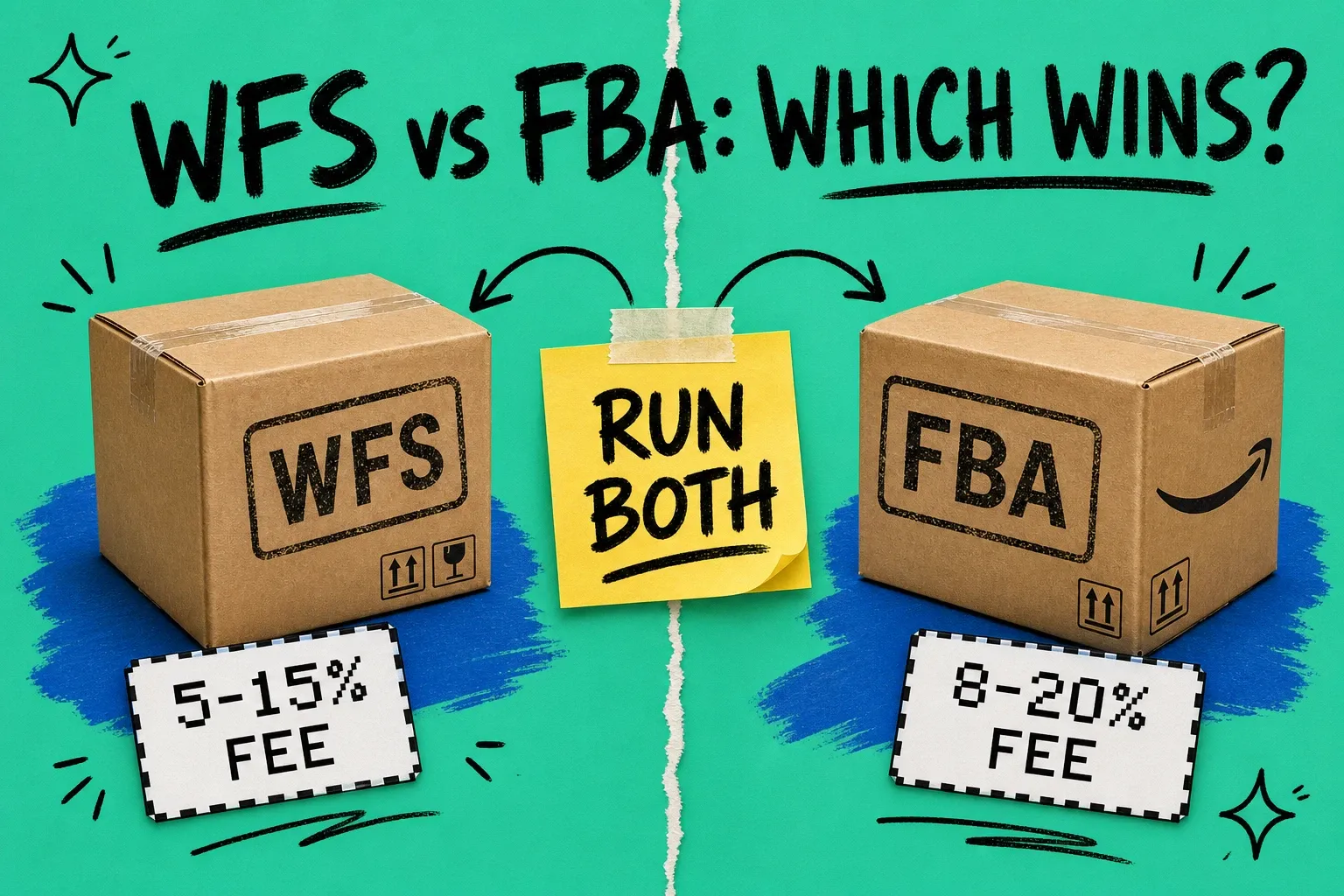
Walmart WFS is the cheaper, simpler program for sellers who already have traction on Walmart Marketplace, while Amazon FBA is the higher-reach program for sellers who need Prime shoppers and the widest two-day delivery footprint. Walmart Fulfillment Services (WFS) and Fulfillment by Amazon (FBA) are marketplace fulfillment programs where the marketplace stores your inventory, then picks, packs, ships, and supports every order for a per-unit fee. If you sell on both channels, you do not really choose one. You run both and keep them in sync.
That last point trips up most operators. WFS lowers your fees and FBA grows your volume, but managing two separate inventory pools, two fee schedules, and two sets of shipping rules is where the margin quietly leaks. This guide breaks down the real differences (fees, delivery speed, eligibility, and branding) so you can decide where each SKU belongs.
What is Walmart WFS?
Walmart Fulfillment Services is Walmart's in-house fulfillment arm for third-party Marketplace sellers. You ship inventory into Walmart's fulfillment centers, and from there Walmart handles storage, order picking, packing, shipping, returns, and customer service. Orders ship with the "Fulfilled by Walmart" tag and a two-day (or faster) delivery promise, which also improves your placement in Walmart search.
The program is newer than FBA, and it is growing fast. Walmart Marketplace crossed 200,000 active third-party sellers in mid-2025, according to ecommerce research firm Marketplace Pulse. On Walmart's side, WFS adoption reached 52% of sellers, a record high, per the company's fiscal 2026 earnings commentary. When more than half the marketplace uses WFS, the delivery-speed bar that shoppers expect rises for everyone, including sellers who still fulfill their own orders.
What is Amazon FBA?
Fulfillment by Amazon is the original marketplace fulfillment program and the benchmark the rest of the industry copies. You send inventory to Amazon's fulfillment centers, and Amazon stores, picks, packs, and ships each order, handles returns, and provides customer service. Products become Prime-eligible, which unlocks fast, free shipping for Prime members and typically lifts conversion.
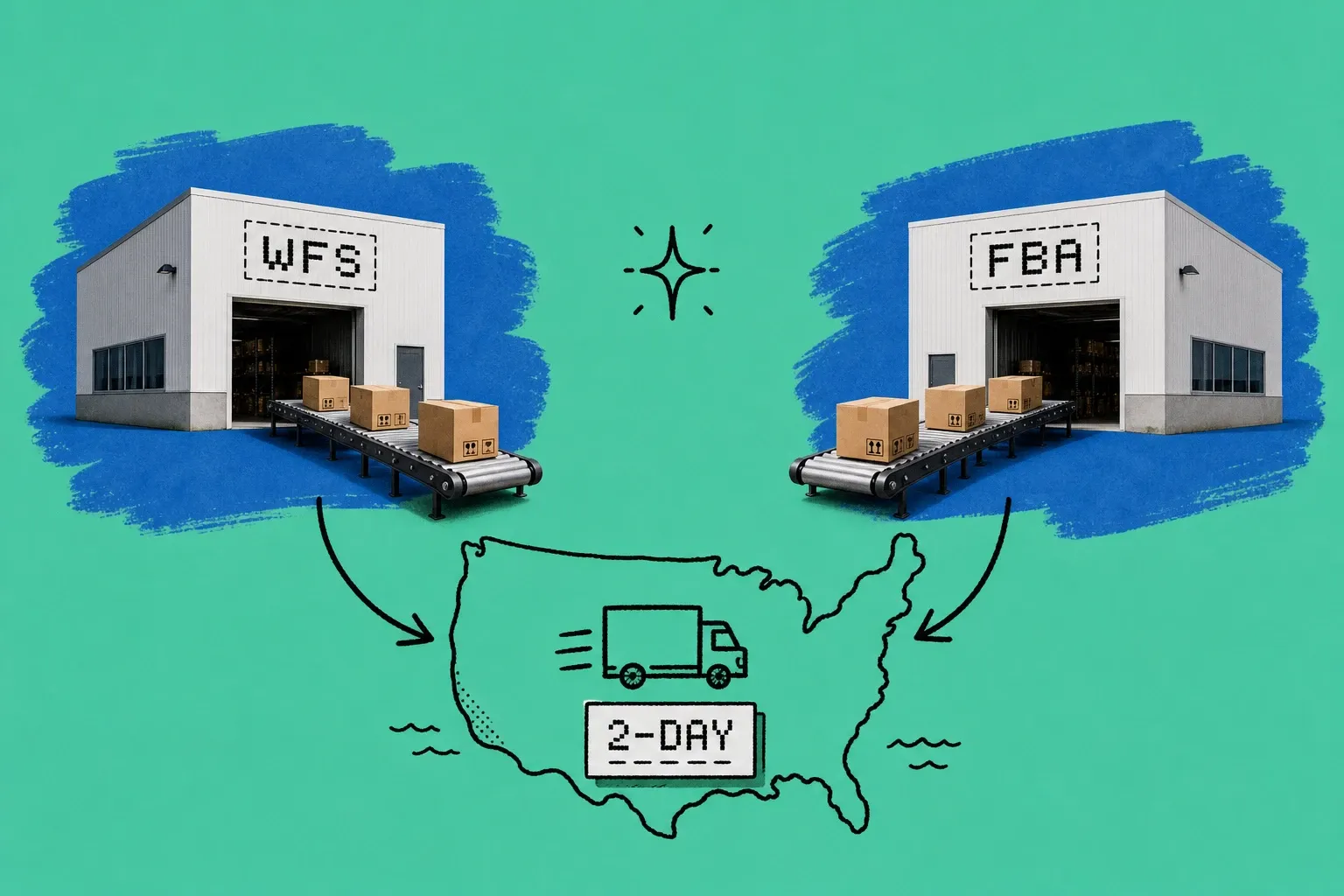
Scale is FBA's biggest advantage. Amazon's fulfillment network covers roughly 96% of the contiguous US at two-day speed, and Amazon's third-party GMV base is still several times larger than Walmart's. If your buyers are Prime members, FBA meets them where they already shop.
Walmart WFS vs Amazon FBA: the fee comparison
Fees are where these two programs separate the most. Both charge a per-unit fulfillment fee based on size and weight, plus a category referral fee. The difference is in how each is calculated and what extra charges pile on top.
Cost factor | Walmart WFS | Amazon FBA |
|---|---|---|
Referral fee | 5% to 15% of item price | 8% to 20% of price plus shipping |
Referral fee basis | Item price only | Price, shipping, and gift wrap |
Fulfillment fee (standard) | Around $3.45 and up | Around $3.06 to $3.96 and up |
Monthly subscription | None | $39.99 (Professional plan) |
Inbound placement fee | None | $0.21 to $0.58 per unit |
Fuel and logistics surcharge | None | 3.5% on fulfillment fees (2026) |
Aged inventory surcharge | Starts after 1 year | Starts earlier, per cubic foot |
A few things stand out. WFS charges its referral fee on the item price alone, while Amazon includes shipping and gift wrap in the base, so the same percentage costs you more on Amazon. Amazon also layers on a monthly Professional plan fee, an inbound placement fee, and, in 2026, a 3.5% fuel and logistics surcharge on all FBA fulfillment fees, according to Amazon's own 2026 seller fee update. WFS keeps a flatter structure with no monthly fee and no fuel surcharge.
Walmart also markets a direct cost edge. Per Walmart first-party data covering orders from mid-2024 to mid-2025, WFS fulfillment costs run about 15% lower per item than competing services on average. Numbers like these move, so always model your actual SKUs in each platform's fee calculator before you commit. The category, weight, and dimensions of your product matter more than any headline average.
Which program wins on cost?
For most standard-size, mid-priced items, WFS comes out cheaper on total fees, mainly because of the item-price-only referral basis and the missing monthly and surcharge fees. FBA can still win on unit economics when Prime velocity is high enough that faster inventory turns offset the higher fees. Heavy or oversized low-margin items are the danger zone on both, so run those through a calculator first.
Delivery speed and customer reach
Reach is FBA's edge and WFS's catch-up story. Amazon's two-day coverage sits near 96% of the contiguous US, backed by the Prime membership base that trains shoppers to expect fast, free delivery. WFS two-day coverage reaches a strong but smaller share of the country as Walmart expands its fulfillment center network.
The trade-off is audience. FBA puts you in front of Prime members. WFS puts you in front of Walmart.com shoppers, a large and growing base that skews toward value buyers and is less saturated with competing sellers than Amazon. If you are fighting for visibility in a crowded Amazon category, the same product can be easier to surface on Walmart.
Branding, control, and the buyer relationship
Both programs are largely a white-label experience. Your orders arrive in the marketplace's packaging (Amazon boxes, Walmart boxes), and the marketplace owns most of the customer touchpoints, including returns and support. Neither gives you the branded unboxing or direct customer data you get from shipping yourself or through a third-party logistics (3PL) provider.
If control over branding and the post-purchase experience is a priority, that usually points toward keeping some volume in your own warehouse or a 3PL rather than putting everything into WFS or FBA.
Eligibility: who can actually use each program
Getting into FBA is easy. Any active Amazon seller account can enroll products, and you can start small.
WFS has a higher bar. You first apply and get approved as a Walmart Marketplace seller, then enroll in WFS. Walmart generally expects a US-based business with an EIN, a demonstrated ecommerce track record, and GS1-verified product identifiers (GTINs). That gate keeps the marketplace cleaner, but it means WFS is not an instant on-ramp for a brand-new seller the way FBA can be.
If you are weighing Amazon's own fulfillment choices before you even get to the WFS question, our breakdown of Amazon FBA vs FBM vs Seller Fulfilled Prime covers when to hand fulfillment to Amazon versus keep it in-house.
Why most growing brands run both (and where it gets hard)
Here is the honest answer to "WFS or FBA": if you sell on both marketplaces at any real volume, use both. You do not want to route Walmart orders through FBA or Amazon orders through WFS. Each program fulfills its own marketplace's orders, gives you that marketplace's fulfillment badge, and protects the delivery promises that drive placement.
The problem is operational, not strategic. Running WFS and FBA side by side means two inventory pools that can drift out of sync, two fee schedules to reconcile, and two dashboards to watch. Split your stock wrong and you oversell on one channel while sitting on dead stock in the other. This is exactly the fragmentation that a central order management system is built to remove.
An order management system (OMS) sits above your marketplaces and warehouses, syncs inventory across every location in near real time, and routes each order to the right fulfillment source automatically. This is the core of what OmniOrders does: it connects your WFS and FBA inventory alongside your own warehouse or 3PL, so you allocate stock intelligently instead of guessing. If you also sell direct on Shopify or other channels, keeping that unified matters even more, as we cover in multichannel inventory management for Shopify and Amazon sellers.
How to decide between Walmart WFS and Amazon FBA
Use this quick decision guide:
- Choose WFS first if most of your sales momentum is on Walmart, your margins are tight, or you want a simpler fee structure without monthly and surcharge line items.
- Choose FBA first if your buyers are Prime members, you need the widest two-day delivery footprint, or Walmart is not yet a meaningful channel for you.
- Run both if you already sell on both marketplaces at volume. Keep separate inventory in each program and connect them to one OMS so stock and orders stay in sync.
- Keep some volume in a 3PL or your own warehouse if branded packaging, direct customer data, or non-marketplace channels are important to your business.
The programs are not really competitors for your whole business. They are two tools that each own their marketplace. The win is not picking one. It is running the right mix and keeping it coordinated so you protect margin on every order, wherever it ships from.
The bottom line
Walmart WFS gives you lower fees and a cleaner pricing structure on a fast-growing marketplace. Amazon FBA gives you unmatched Prime reach and the most mature fulfillment network in ecommerce. For a single-channel seller, pick the program that matches where your customers already are. For everyone selling on both, the smarter move is to run WFS and FBA together and unify them with an order management system, so you get the best of each without letting the operational complexity eat your profit.
Frequently asked questions
Is Walmart WFS better than Amazon FBA?
Neither is universally better. Walmart WFS usually costs less per order because referral fees run 5% to 15% (charged on the item price only) and there is no monthly subscription. Amazon FBA reaches more shoppers through Prime and a network that covers roughly 96% of the US at two-day speed. The right pick depends on where your buyers already are and which margins you can protect.
What is Walmart WFS?
Walmart Fulfillment Services (WFS) is Walmart's in-house fulfillment program for Marketplace sellers. You send inventory to Walmart's fulfillment centers, and Walmart stores, picks, packs, and ships each order, handles customer service, and gives your listings the "Fulfilled by Walmart" tag with two-day delivery promises.
Can you use both Walmart WFS and Amazon FBA at the same time?
Yes, and many growing brands do. You keep separate inventory pools in each program and sell on each marketplace natively. The main challenge is keeping stock, orders, and reporting in sync across both, which is why sellers running both usually connect them to one order management system.
How much does Walmart WFS cost compared to Amazon FBA?
Both charge a per-unit fulfillment fee (roughly $3.45 and up, based on size and weight) plus a category referral fee. WFS referral fees range from 5% to 15% on the item price with no monthly subscription. Amazon referral fees range from 8% to 20% on the price plus shipping, add a $39.99 monthly Professional plan, and include a 3.5% fuel and logistics surcharge in 2026.
Do you need approval to use Walmart WFS?
Yes. You first apply and get approved as a Walmart Marketplace seller, then enroll in WFS. Walmart generally expects a US-based business with an EIN, a track record in ecommerce, and GS1-verified product identifiers (GTINs). Amazon FBA has a lower bar: any active Amazon seller account can enroll products.
Start your 14-day free trial
See how OmniOrders connects your sales channels, 3PLs, and carriers into one operational layer — free for 14 days, no credit card.