








The Best ERP for Small Ecommerce Businesses in 2026 (and Why Most Don't Need One)
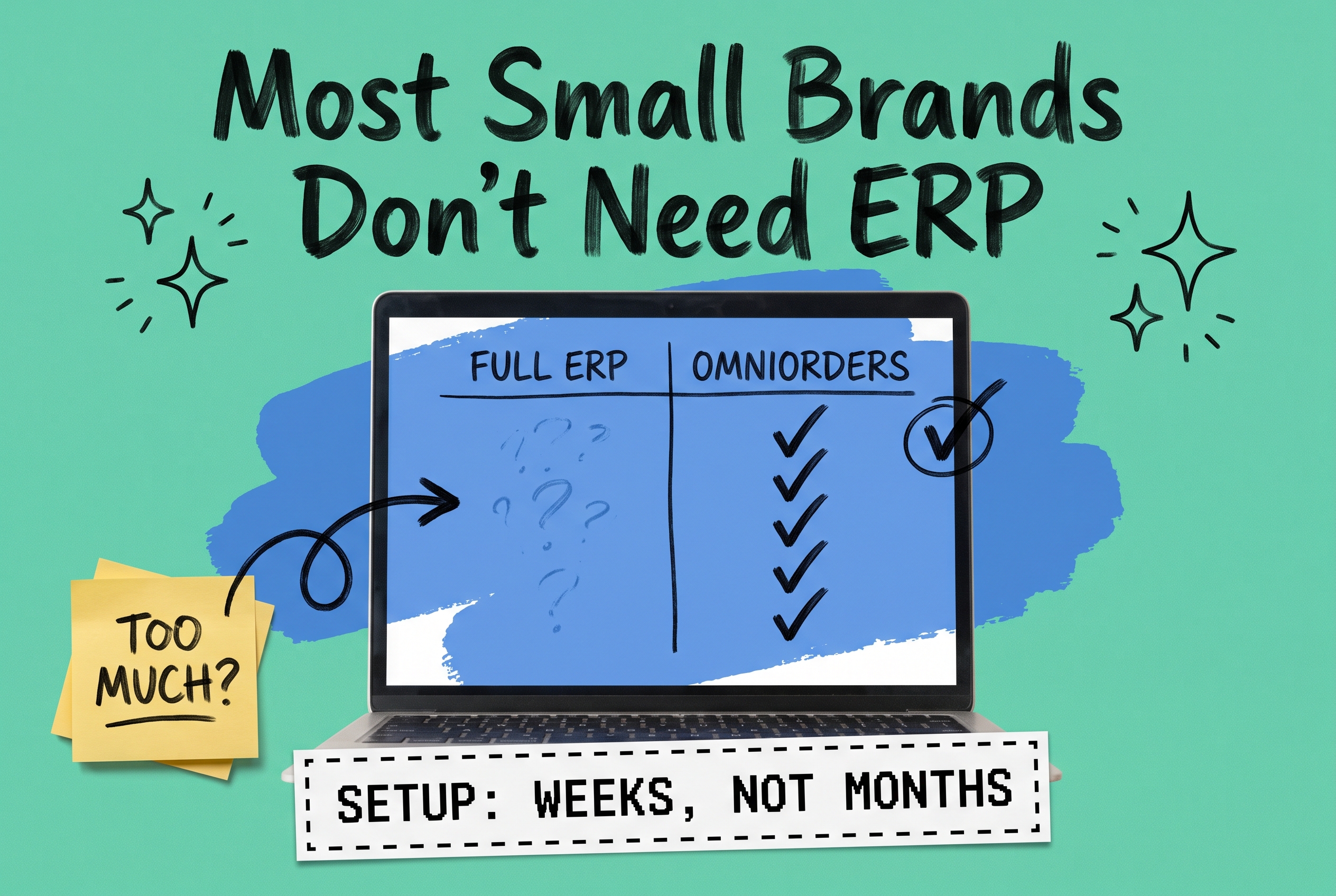
A small business ERP (Enterprise Resource Planning) is software that connects your company's core operations into one database: accounting, HR, procurement, inventory, and often manufacturing. Most ecommerce brands searching for one don't actually need a full ERP. What they need is better visibility over their orders, inventory, and fulfillment across channels. That is a different problem, and it has a more targeted solution. This guide covers what ERP software really does, which affordable options are worth evaluating, and the honest framework for deciding whether your business has an ERP-shaped problem or an OMS-shaped one.
What ERP Software Actually Does
ERP software started in discrete manufacturing, where companies needed to connect raw materials, production schedules, workforce capacity, and financial reporting across departments into one system. Every major ERP platform today still carries that DNA.
The typical module list:
- General Ledger and Financial Reporting. Revenue recognition, accounts payable and receivable, multi-currency, and cross-entity consolidation.
- HR and Payroll. Headcount, compensation structures, benefits administration, and compliance.
- Procurement and Supplier Management. Purchase orders, vendor performance, and landed cost tracking.
- Manufacturing (MRP/MES). Bill of materials, production work orders, and capacity planning.
- Inventory and Warehouse. Stock levels, bin locations, and transfers between locations.
- Order Management. Sales orders, fulfillment routing, and shipping.
If you sell finished goods across Shopify, Amazon, and Walmart, the last two items on that list are what you actually need. Paying for HR and multi-entity financial consolidation you won't use for years is how ERP evaluations turn into months-long projects that often exceed budget.
Why Ecommerce Brands End Up Searching for ERP
The frustrations that drive founders and ops managers into ERP research are real. They usually look like one of these:
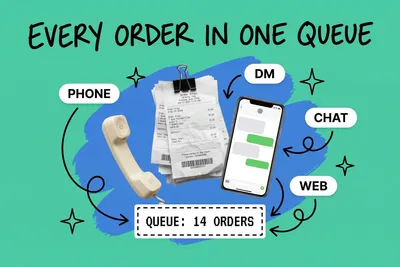
- Orders arrive from four different channel dashboards with no unified view, so customer service can't answer a basic tracking question without logging into each platform separately.
- TSHIRT-BLU-M shows 47 units in inventory, but Amazon sells 12 while Shopify keeps showing the old count and oversells three more.
- Reorder decisions happen via spreadsheet and gut feel, resulting in six months of slow-moving stock on some SKUs and stockouts on top performers at peak season.
- Your accountant asks for sales data you have to export from five different places, reconcile by hand, and send as a CSV file.
These are legitimate operational problems. They're also problems that a purpose-built order management system is designed to solve directly, without the overhead of a full ERP implementation.
The Affordable ERP Options for Small Business (An Honest Look)
If you've done any ERP research, the same names come up repeatedly. Here is a straight assessment of the realistic options:
NetSuite (Oracle)
NetSuite is the most-cited small business ERP and genuinely capable. Its financial module handles multi-subsidiary operations, its analytics are solid, and its partner ecosystem is large. It is also expensive. NetSuite prices by custom quote, but implementation partners consistently put total first-year cost, covering licenses, implementation services, data migration, and training, well into the five-to-six-figure range for most small business deployments.
If you're a brand with manufacturing operations, international subsidiaries, or complex revenue recognition requirements, NetSuite often earns that investment. If you're a $1M-$5M ecommerce brand that needs better order and inventory visibility, you're paying for capability you won't use for years, and the configuration needed to make NetSuite work well for multi-channel ecommerce requires significant consultant time. We've covered the integration architecture and its tradeoffs for brands evaluating this path.
Microsoft Dynamics 365 Business Central
Business Central (formerly Navision) has more accessible per-user pricing than NetSuite and solid financial module depth. Its ecommerce story is weaker out of the box. Native connections to Amazon, Walmart, or multi-channel marketplaces require third-party connectors or custom development. Implementations still require a Microsoft Partner, and projects typically take three to six months. It's a reasonable choice for a product company with significant accounting complexity and an internal IT resource available to own the rollout.
Odoo
Odoo is the open-source option. Community edition is free. Enterprise edition runs on a per-user subscription model with publicly listed pricing. The flexibility is genuine: Odoo can be configured to handle ecommerce, inventory, and accounting in ways commercial ERPs can't match without a consultant. The tradeoff is that flexibility requires technical investment. Deploying Odoo without a developer who knows the platform well is harder than the marketing suggests.
SAP Business One
SAP B1 targets companies with meaningful manufacturing or distribution complexity, generally in the $10M-$100M revenue range. For a pure-play ecommerce brand without factory operations, it is almost certainly more than you need, and the sales cycle reflects that.
What You Actually Need When Running Multi-Channel Ecommerce
Reframe the original frustrations. Three operational gaps drive most ERP searches from ecommerce brands:
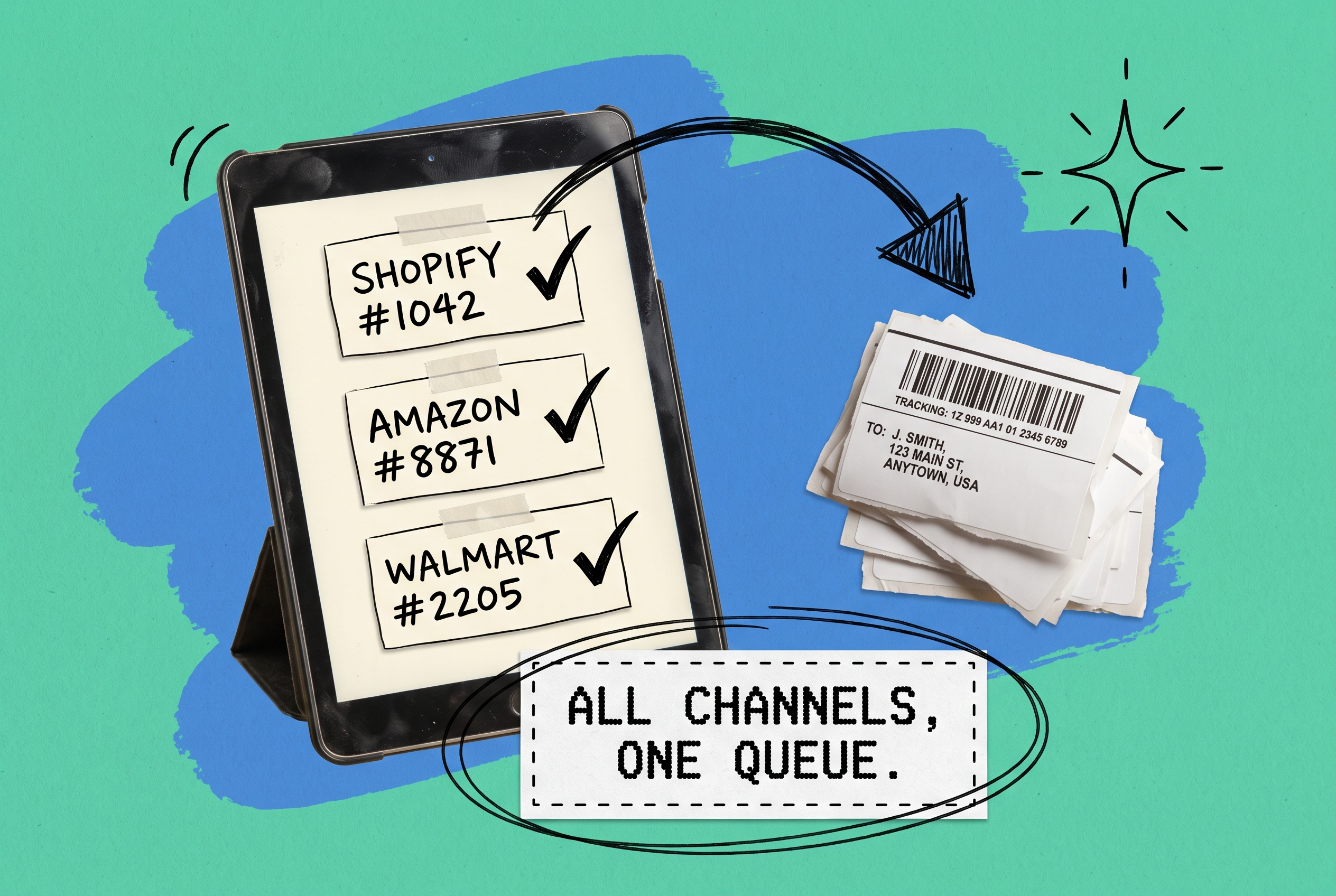
Channel-level order visibility. You want one view of every order, from Shopify, Amazon, eBay, Walmart, and your B2B wholesale portal, with real-time status, item details, and fulfillment tracking. That is exactly what an order management system is built for. An ERP can replicate it, but with far more setup cost and time.
Inventory accuracy across channels. When a buyer purchases TSHIRT-BLU-M on Amazon, that unit should decrement from your Shopify available count, your warehouse pick queue, and your reorder calculation at the same time. Keeping inventory synced across every channel you sell on is the core capability here, and it's where most brands bleed margin through overselling, safety-stock bloat, and emergency reorders.
Smarter purchasing decisions. Reorder decisions driven by channel-level velocity, supplier lead times, and seasonal trend data are more accurate than decisions made from last month's export. AI-powered inventory forecasting delivers exactly that. It doesn't require a full ERP to get there.
For finance, most growing ecommerce brands run their accounting in QuickBooks or Xero. The practical move is connecting your operations platform to your existing accounting software so it receives accurate sales and cost data, rather than replacing your accounting stack with an ERP general ledger.
OmniOrders vs. a Full ERP: What Each Covers
Capability | Full ERP (NetSuite, Dynamics) | OmniOrders OMS |
|---|---|---|
Multi-channel order management | Yes (with customization) | Yes, native |
Real-time inventory sync across channels | Yes (with connectors) | Yes, native |
No-code automation rules | No (requires developer or partner) | Yes |
AI inventory forecasting | Add-on or partner | Built-in |
Multi-location fulfillment routing | Yes | Yes |
Carrier rate optimization | Typically third-party | Yes |
Returns management | Yes | Yes |
Pre-built marketplace connectors | Via partner connectors | Shopify, Amazon, Walmart, eBay, WooCommerce, BigCommerce, Etsy, TikTok Shop |
General Ledger / Accounting | Yes | No (connects to your accounting platform) |
HR and Payroll | Yes | No |
Manufacturing (MRP/MES) | Yes | No |
Implementation time | Months to over a year | Days to weeks |
The accounting and HR gap is real. If you need a general ledger that handles multi-entity consolidation, ERP is the right category. If your financial system already works and your pain is on the operational side, adding operational control to your existing stack makes more sense than replacing it.
The Automation Engine That Replaces Manual Workflows
A common reason brands pursue ERP is the sheer volume of manual work involved in multi-channel operations. Someone is copying orders out of Amazon Seller Central into a tracking sheet. Someone is manually adjusting stock counts after a warehouse pick. Someone is typing purchase orders into a supplier portal from a spreadsheet.
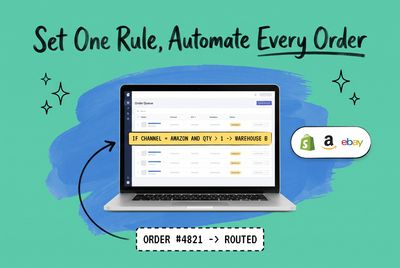
OmniOrders' no-code automation engine lets you configure and manage workflow rules without touching code. Route every order over $500 to a specific 3PL for priority handling. Flag orders containing FRAGILE-tagged SKUs for a manual review step before shipping. Generate a purchase order automatically when any SKU drops below its reorder point. These are the workflows that teams currently approximate with spreadsheets and Zapier chains. They run natively in the platform.
When You Actually Do Need a Full ERP
There are situations where a full ERP is genuinely the right call:
You manufacture your own products. If you produce goods and need to track bill of materials, work orders, production capacity, and raw material costs, a manufacturing-capable ERP earns its cost. The use case is specific and real. We've covered the landscape for this in our guide to manufacturing ERP systems.
You operate multiple legal entities. Consolidated financial reporting across subsidiaries with different currencies and accounting standards is genuinely hard to replicate outside an ERP-grade general ledger.
You have significant HR complexity. A large workforce with complex compensation structures, compliance requirements across jurisdictions, and benefits administration can justify the HR modules inside a full ERP.
Large wholesale or retail relationships require heavy EDI compliance at a scale that demands tight integration with your financial and forecasting systems. OmniOrders also supports EDI connections, but at the scale where EDI is deeply embedded in financial reporting, ERP can simplify the architecture.
Outside these situations, for a brand primarily selling finished goods through ecommerce channels without manufacturing or multi-entity accounting, the ERP pitch is usually a solution looking for your problem.
The Five-Question Diagnostic
Before committing to an ERP evaluation, work through these:
- Do you manufacture your own goods? If yes, evaluate ERP platforms with strong manufacturing modules. If no, your operational needs are likely OMS-shaped.
- Do you operate multiple legal entities requiring consolidated reporting? If yes, ERP's accounting depth matters. If no, your current accounting software plus an OMS covers the gap.
- Is your main pain point order management, inventory accuracy, or fulfillment routing? An OMS is purpose-built for these. An ERP solves them too, with significantly more setup time and cost.
- Do you have three or more months and internal IT resources available for implementation? ERP deployments without dedicated internal ownership routinely run over time and budget.
- Are you over $10M in revenue with plans to add manufacturing capacity or legal entities within 18 months? If yes, the investment case for ERP strengthens. If not, you're paying for headroom you won't use.
If your answers point toward questions 1 or 2, evaluate ERP seriously. If they point toward question 3 alone, you're solving an OMS-shaped problem.
Solve the Operational Problem, Not the Hypothetical One
The ERP industry has a strong financial incentive to frame every operational problem as an ERP problem. If the pain you're experiencing is orders spread across five different dashboards, inventory that drifts out of sync with your selling channels, or purchasing decisions made on instinct instead of data, those are order management and inventory problems. A full ERP can solve them, but with months of implementation time and cost that a purpose-built platform handles in weeks.
OmniOrders centralizes your orders, inventory, and fulfillment across every channel you sell on, with a no-code automation engine that replaces the manual workflows draining your team's time. Start your free OmniOrders trial today and see what your operations look like when everything runs through one platform.
Frequently asked questions
What is an ERP for small business?
A small business ERP (Enterprise Resource Planning) is software that centralizes core business functions, including accounting, HR, procurement, inventory, and order management, into one shared database. For ecommerce brands specifically, the most-used modules are usually inventory management and order management. The rest of the ERP suite, particularly accounting consolidation and HR, often goes unused by small to mid-size ecommerce operators.
How much does ERP cost for a small business?
ERP pricing varies significantly by platform and configuration. Open-source options like Odoo Community start free but require technical implementation investment. Commercial ERPs like NetSuite and Dynamics 365 Business Central use subscription pricing plus implementation services from certified partners. Total first-year cost for a commercial ERP deployment at a small business routinely runs from tens of thousands to well over $100,000 when implementation, training, customization, and data migration are included.
What is the difference between an ERP and an OMS?
An ERP covers the full breadth of business operations: accounting, HR, manufacturing, procurement, and supply chain. An OMS (Order Management System) focuses specifically on order processing, multi-channel inventory synchronization, fulfillment routing, carrier management, and returns. For ecommerce brands without manufacturing or multi-entity accounting requirements, an OMS handles the operational problems that drive most ERP searches, at lower cost and shorter implementation time.
Can an OMS replace an ERP for ecommerce?
For most ecommerce brands, an OMS handles the operational functions an ERP delivers on the order and inventory side: channel order management, inventory sync, fulfillment routing, carrier optimization, and returns management. It connects to your existing accounting software rather than replacing it. If your business doesn't have manufacturing, complex HR, or multi-entity accounting requirements, an OMS covers the operational ground that sends most brands to ERP searches in the first place.
What is the best ERP for a small ecommerce business?
The honest answer depends on your actual requirements. Odoo is the most accessible for teams with technical resources and tight budgets. NetSuite is the most capable but carries significant implementation cost and complexity. Dynamics 365 Business Central sits in the middle on both dimensions. For the majority of ecommerce brands under $20M in revenue without manufacturing, a purpose-built OMS connected to your existing accounting stack covers the operational ground you're searching for, at a fraction of ERP cost.
Start your 14-day free trial
See how OmniOrders connects your sales channels, 3PLs, and carriers into one operational layer — free for 14 days, no credit card.