










eBay Inventory Management Software: Stop Overselling Across eBay, Amazon & Shopify
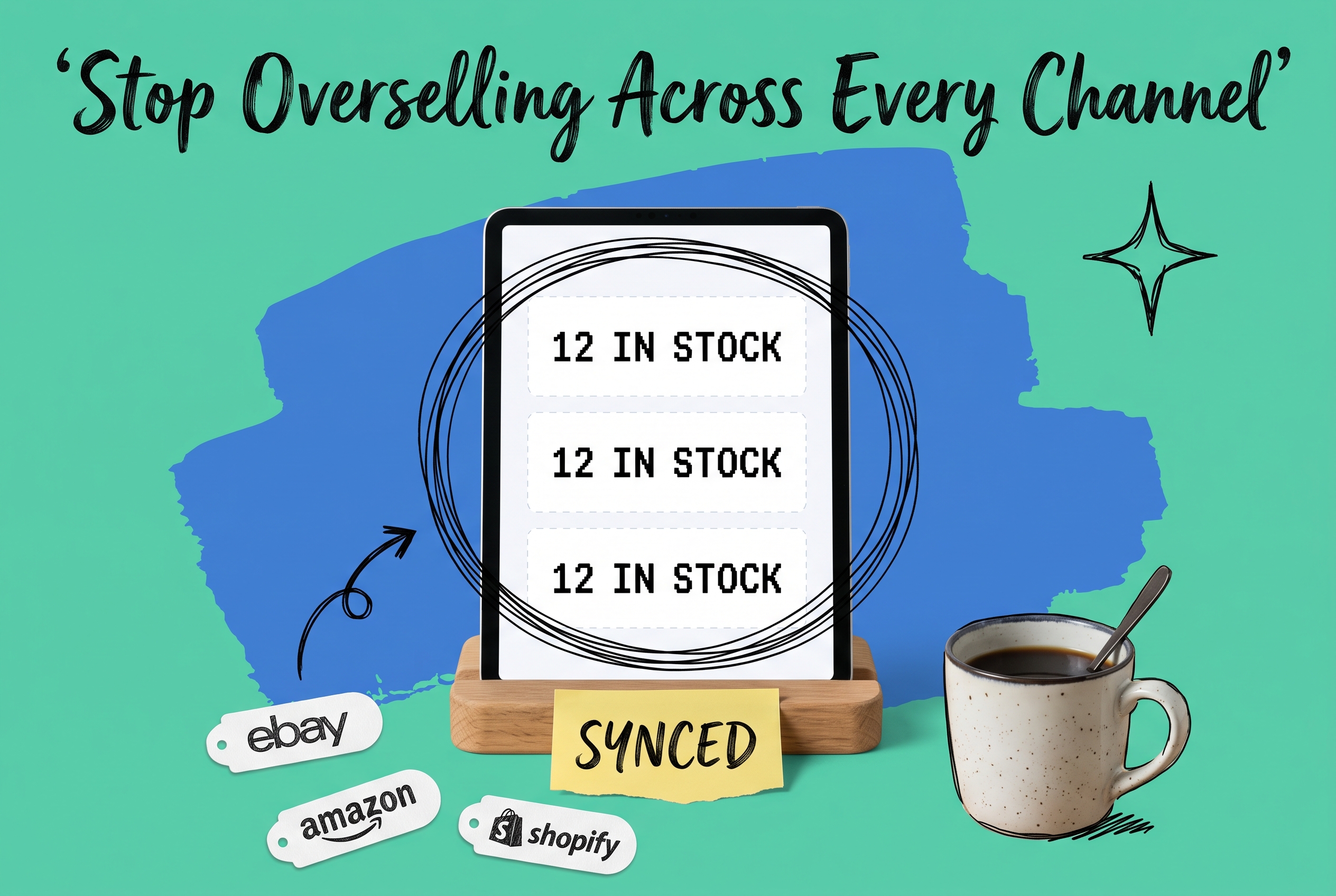
You're running a solid eBay operation. Then an order comes in for a size-medium blue hoodie (HOODIE-BLU-M) that sold out on Shopify three hours ago. The buyer paid. eBay still shows 4 units. Your warehouse has zero.
That's the overselling trap — and it's the most predictable consequence of managing inventory without software that connects every channel in real time. The further you scale, the more expensive each incident becomes: refunds, negative feedback, shipping cancellations, and the time your team spends cleaning it up.
This guide covers what eBay inventory management software actually does, what separates a useful system from a basic one, and how to evaluate your options as a multi-channel seller.
What Is eBay Inventory Management Software?
eBay inventory management software connects your eBay seller account to a central inventory database so stock counts update automatically whenever you make a sale — on eBay or anywhere else you sell.
It starts with preventing you from listing items you don't have. At higher volumes, it does considerably more: real-time visibility across every sales channel, warehouse, and supplier; automated order routing; replenishment forecasting; and returns processing that feeds back into your inventory counts without manual entry.
That distinction matters because many tools that market themselves as "eBay inventory software" only sync eBay. If you also sell on Amazon, Shopify, or Walmart, a single-channel tool pushes the problem somewhere else rather than solving it.
Why eBay's Native Tools Fall Short for Multi-Channel Sellers
eBay has its own seller tools — Seller Hub, Inventory Manager, Selling Manager Pro. They work fine when eBay is your only channel. Add a second storefront and the limitations appear quickly:
- No cross-channel sync. eBay's tools see eBay orders and eBay listings. They don't communicate with your Shopify store or your Amazon inventory.
- Manual adjustments required. If you sell out on Amazon, you need to log into eBay separately and update the listing count. By the time you do, someone may have already bought a unit that doesn't exist.
- No multi-location awareness. If you ship from two warehouses and a retail location, eBay Seller Hub can't allocate inventory intelligently across them.
- Limited automation. Order routing, reorder triggers, and fulfillment rules require additional tools or spreadsheets to implement.
Most multi-channel sellers end up stitching together a stack: eBay Seller Hub, a Shopify app, a carrier integration, and a set of manual processes. Each piece works in isolation. The gaps between them are where overselling, mis-ships, and late fulfillment live.
What to Look for in eBay Inventory Management Software
Your requirements will depend on order volume and channel count, but these capabilities matter across nearly every growth stage.
Real-Time Inventory Sync Across All Channels
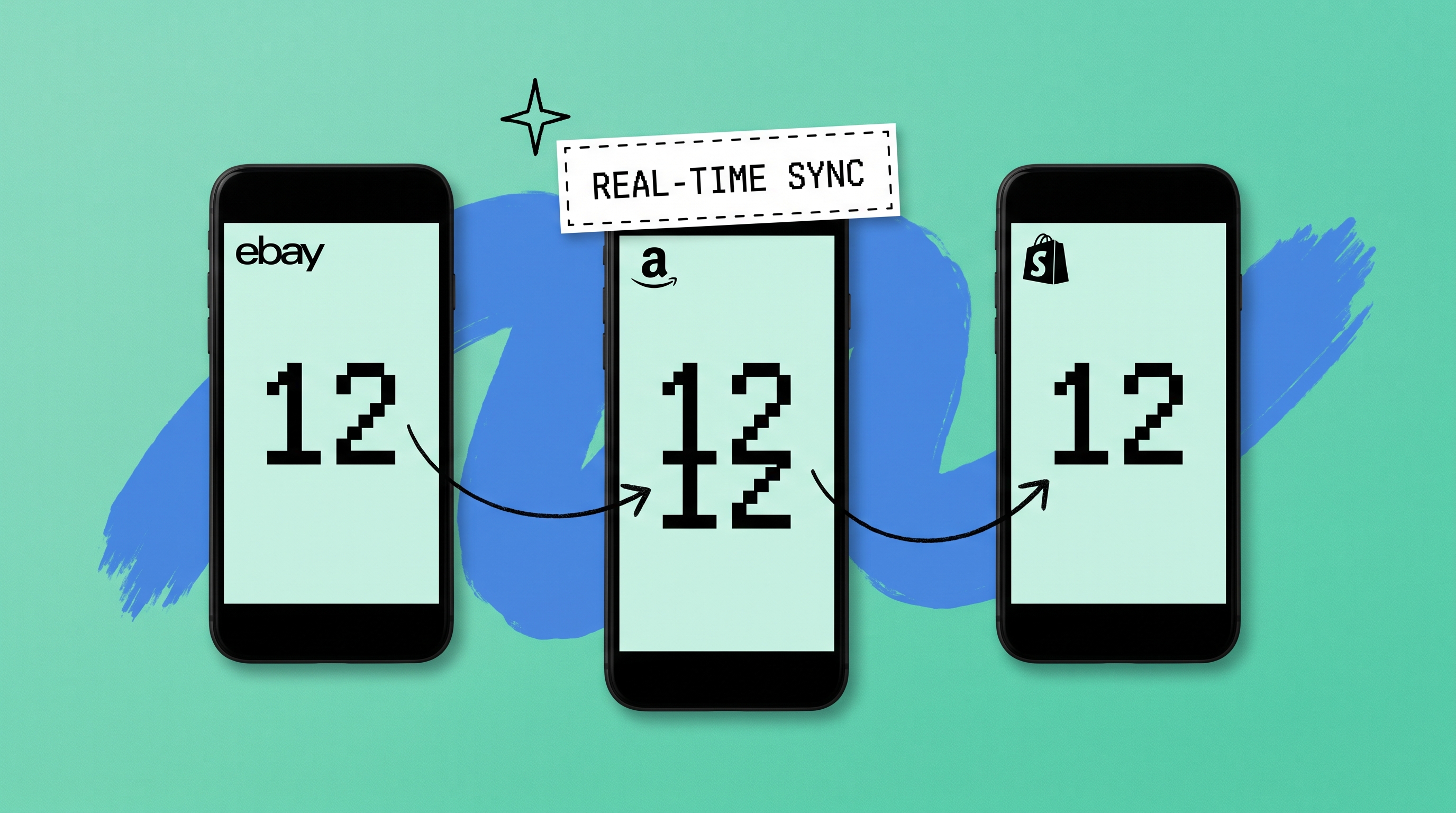
Every time an order arrives — from eBay, Amazon, Shopify, Etsy, or anywhere else — your inventory counts should update across all channels within seconds, not minutes. A five-minute polling interval is enough to sell the same unit twice during a peak event.
Look for a system that pushes stock updates to each channel the moment an order is confirmed. The difference between push-on-demand and a scheduled sync determines whether you can run a weekend promotion on eBay without risking cancellations.
Multi-Location Inventory Allocation
If you hold stock in more than one place — a primary warehouse, a 3PL, a retail location — the system needs to know which location should fulfill which order. That logic should be configurable: route eBay orders to the nearest warehouse, exclude retail inventory from your online pool, reserve certain SKUs for B2B orders.
Without location-aware allocation, you either run a single blended pool (which creates fulfillment chaos at scale) or maintain separate counts per location by hand.
Automated Order Routing
Once an order arrives, something has to decide which warehouse fills it, which carrier handles it, and what happens if the primary location is out of stock. That decision shouldn't require manual input for every order.
A good system lets you define routing rules — by channel, SKU, geography, carrier preference — and execute them without intervention. When your eBay order volume doubles in Q4, your operations team shouldn't have to double too.
AI-Powered Inventory Forecasting
Stocking eBay correctly requires knowing how much to reorder and when. Forecasting by gut feel or spreadsheet breaks down around seasonal spikes, new listing launches, and supplier delays.
Forecasting built into your OMS uses actual sales velocity by channel — not blended totals — so an eBay-specific surge doesn't trigger inaccurate replenishment signals on your Amazon side. It also accounts for supplier lead times so you're not caught short when a shipment runs late.
Returns Management
eBay's buyer-friendly returns policy means return rates on certain categories run high. Your inventory software needs to process return labels, restock returned items when condition allows, and adjust inventory counts automatically. Manual return processing at scale introduces inventory discrepancies that compound over time.
How OmniOrders Handles eBay Inventory
OmniOrders is a multi-channel order management system built for brands selling across eBay, Amazon, Shopify, Walmart, and other channels from a single platform. It addresses the eBay inventory problem at each point in the order lifecycle.
Real-time inventory sync. When an eBay order lands, OmniOrders updates inventory counts across every connected channel immediately — your Shopify store, your Amazon listings, your Walmart catalog. You can see the full operational picture from OmniOrders' centralized features dashboard.
Multi-location allocation. You define the rules: which warehouse fulfills eBay orders, how to handle low-stock scenarios, what fallback logic applies when a location runs out. OmniOrders applies those rules at order time, not after the fact.
No-code automation engine. You don't need a developer to configure routing logic or workflow rules. OmniOrders lets you build automations through a visual interface — route all eBay orders above 2 units to your East Coast warehouse, flag orders with non-standard shipping addresses for manual review, automatically apply a specific carrier for expedited eBay listings. The logic you need without the engineering overhead.
AI-powered forecasting. OmniOrders' inventory forecasting uses channel-level sales data to generate replenishment recommendations. If your eBay store is trending upward while Amazon velocity is flat, the forecast reflects that channel-specific signal rather than averaging the two together.
eBay integration built in. OmniOrders connects to eBay as part of its core integration suite, alongside Amazon, Shopify, Walmart, Etsy, and other major channels. It's not a third-party plugin layered on top — it's part of the same platform handling your orders and inventory end to end.
Returns processing. eBay returns feed back into OmniOrders automatically, triggering inventory adjustments and return label generation without manual input.
Stop Overselling. Start Scaling.
Every oversold eBay order costs more than the refund: it costs you feedback score, buyer trust, and the time your team spends on cleanup. Those costs compound as volume grows.
OmniOrders centralizes eBay alongside every other channel you sell on — one platform for orders, inventory, and fulfillment, with real-time sync and no-code automation built in. You stop managing exceptions and start running an operation that scales cleanly.
Start your free OmniOrders trial and see how it handles your eBay inventory from day one.
Frequently asked questions
Do I need inventory management software if I only sell on eBay?
If eBay is your only channel and you manage fewer than 200 active SKUs, eBay's native Seller Hub may cover your needs. Once you add a second channel or cross 200–300 daily orders, the manual reconciliation involved in native tools starts producing real errors and eating meaningful time.
What's the difference between eBay inventory software and a full OMS?
eBay-specific inventory software manages eBay listings and eBay stock. An order management system (OMS) manages the entire order lifecycle across all your channels — eBay, Amazon, your DTC site, wholesale accounts, wherever you sell — from a single platform. For multi-channel sellers, an OMS is the more durable choice because it doesn't create another disconnected data source to maintain.
Can inventory management software prevent all eBay seller defects?
It eliminates the most common defect triggers: overselling, late shipment from fulfillment confusion, and listing errors from stale data. It can't prevent defects caused by product quality issues or carrier failures outside your control.
How does inventory sync handle eBay's out-of-stock policy?
When your inventory count hits zero, a real-time sync system like OmniOrders updates your eBay listing immediately — ending or pausing it to avoid out-of-stock violations. When you replenish, the listing reinstates with the updated quantity. No manual toggling in Seller Hub required.
How is this software typically priced?
Pricing usually scales by order volume, channel count, or both. Review [OmniOrders' pricing tiers](https://omniorders.com/pricing) to understand what's included at each level — and check whether channel connections are bundled or billed separately. Extra per-channel fees add up quickly when you're active on four or five platforms.
Start your 14-day free trial
See how OmniOrders connects your sales channels, 3PLs, and carriers into one operational layer — free for 14 days, no credit card.