










What Is Kitting? The Fulfillment Process Explained (+ When to Outsource)
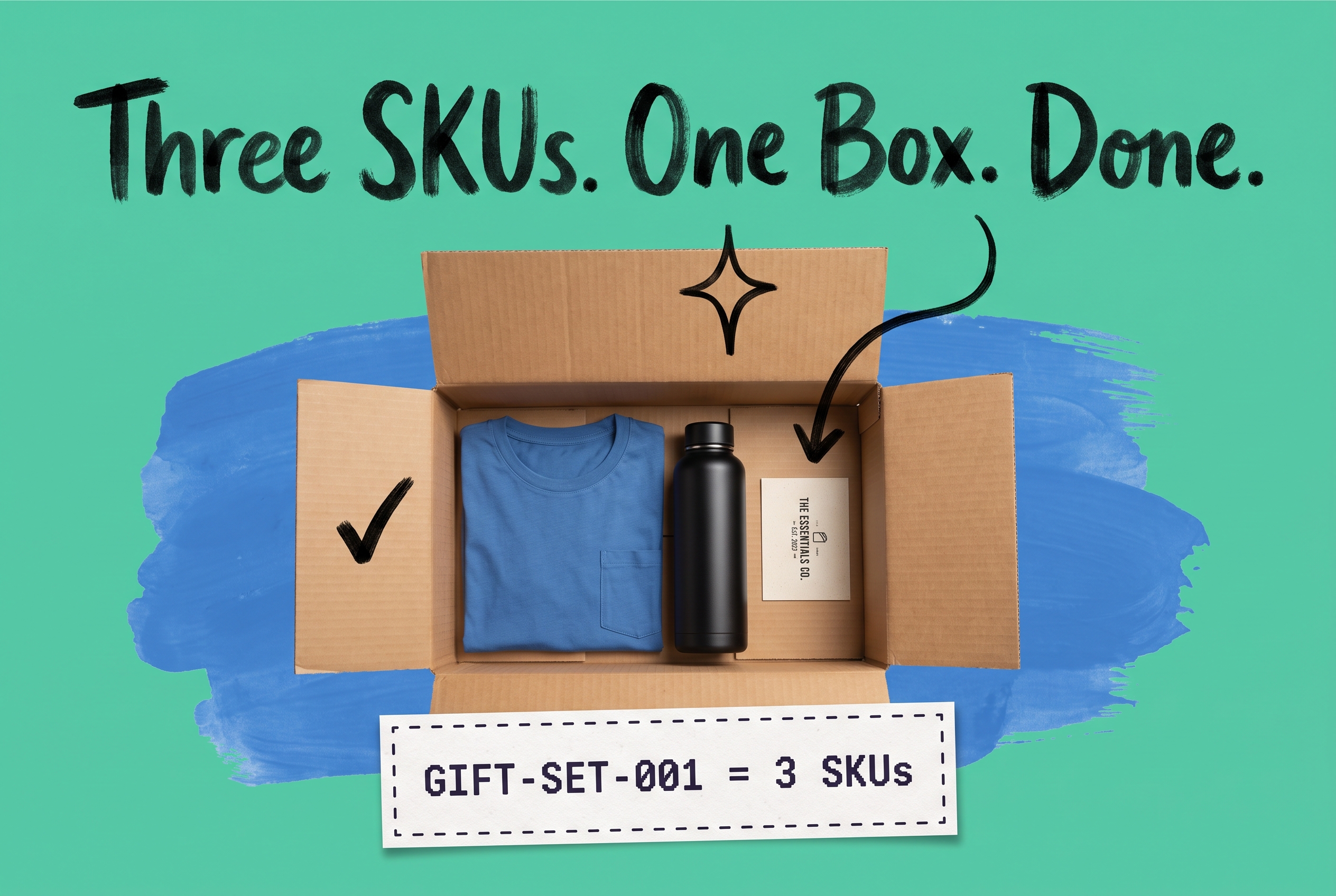
Your warehouse picks a t-shirt, a water bottle, and a branded card. They fold everything into a gift box, seal it, and ship it as one unit. That's kitting.
It sounds simple until you're running 500 orders a day with six components per kit and three warehouse locations. Then you're asking: why are we short on lids again, and which location has enough TSHIRT-BLU-M to fill today's bundle orders?
This guide explains what kitting means in fulfillment, how it differs from pre-kitting, and how growing brands manage the operational complexity it creates — from tracking inventory at the component level to deciding whether kitting in warehouse makes more sense than outsourcing to a 3PL.
What Is Kitting?
Kitting is the process of assembling multiple individual SKUs into a single shippable unit to fulfill an order. Each item in the kit carries its own inventory record, but they ship together as one package — often assigned a kit SKU or bundle product ID in your order management system.
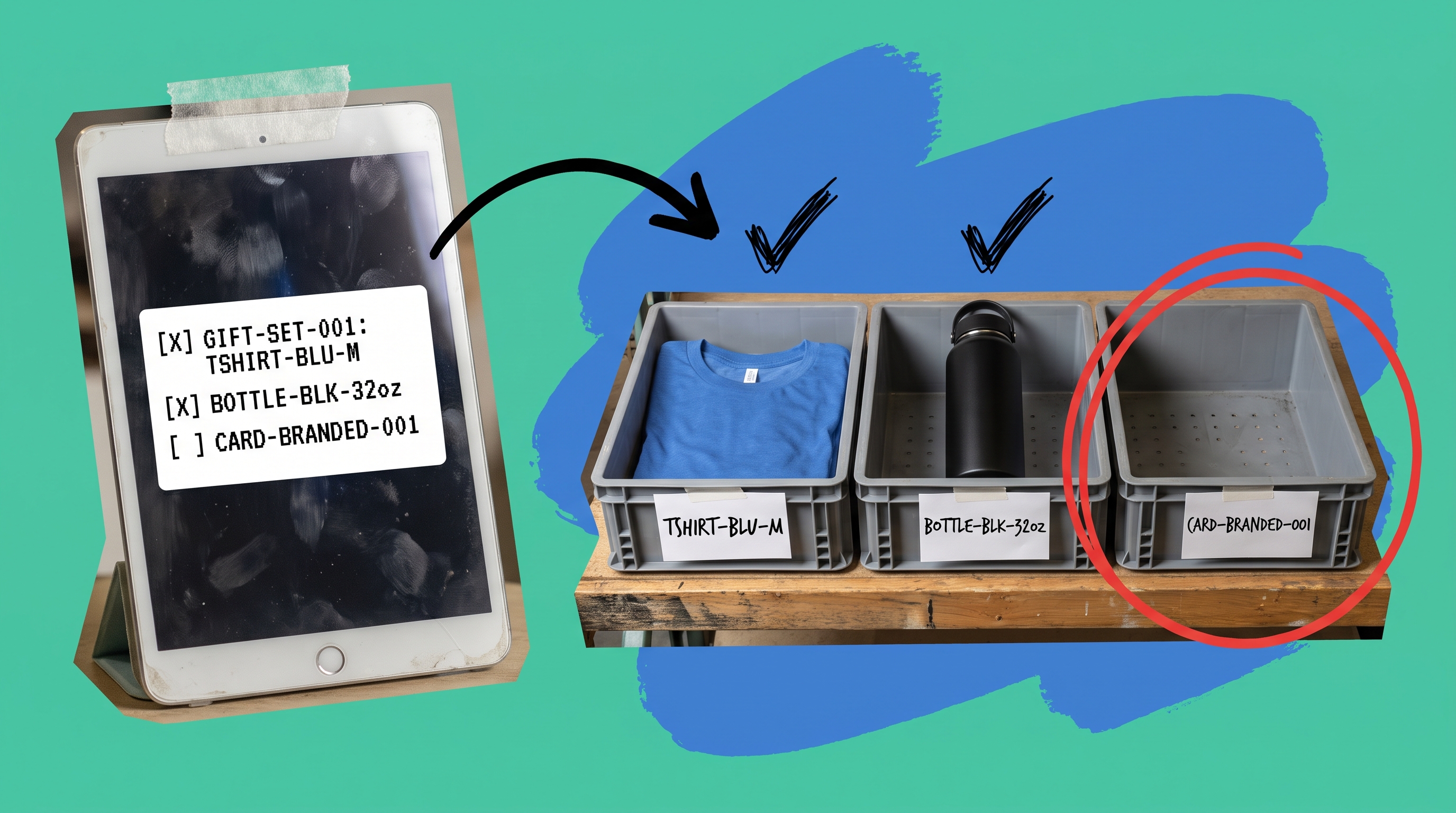
The kit itself is typically built at the point of order: you pull TSHIRT-BLU-M, BOTTLE-BLK-32oz, and CARD-BRANDED-001 from separate bin locations, combine them in a poly mailer or gift box, apply a label, and hand the package to the carrier as one shipment.
You'll find kitting across virtually every product category: subscription boxes, gift sets, promotional bundles, hardware with accessories, welcome kits, and DTC brand boxes.
Kitting vs. Pre-Kitting: The Difference That Shapes Your Inventory Strategy
These two terms are used interchangeably, but they describe very different workflows — and the difference has real implications for how you manage stock.
Kitting (build-to-order) means you assemble the bundle when the order comes in. Components stay as individual sellable units until the moment of fulfillment. If the promotion ends or demand shifts, you still have TSHIRT-BLU-M available for individual sale. Flexibility is the advantage. Assembly time per order is the cost.
Pre-kitting means you assemble bundles in advance and store the finished kit as a single inventory unit. A picker grabs one pre-kitted box rather than hunting for six components. Fulfillment is faster — but you've committed your components early. A pre-kit that doesn't sell at projected volume leaves you with boxes to break down and components to reclassify.
Most brands start with on-demand kitting and shift their fastest-moving bundles to pre-kitting once demand is stable enough to justify the early assembly investment.
How Kitting Works: The Fulfillment Workflow
A standard kitting and assembly workflow runs through these stages:
- Order received — A customer orders GIFT-SET-001 (your spring bundle).
- BOM lookup — Your system checks the bill of materials: GIFT-SET-001 requires TSHIRT-BLU-M + BOTTLE-BLK-32oz + CARD-BRANDED-001.
- Component pick — Pickers pull each item from its bin, guided by a pick list or barcode scan. Three separate picks for one outbound order.
- Assembly — Items are combined, packaged, and (for gift kits) wrapped, tagged, or inlaid with tissue paper or an insert card.
- Quality check — The kit is verified against the BOM: correct items, correct quantities, undamaged condition.
- Ship or stage — For build-to-order kitting, the kit ships immediately. For pre-kitted stock, it goes to a staging bin or finished-goods location.
Every step deducts multiple SKUs from inventory simultaneously. Across 200 orders, that's 600 component deductions happening in parallel — and if your inventory counts are a few hours stale, you'll oversell a component you don't actually have.
Kitting in Your Warehouse: When In-House Makes Sense
Doing kitting and assembly in-house gives you the most control over packaging quality, personalization, and turnaround time. It's the right call when:
- Kits are customizable — If customers can choose components (size, color, add-ons), you can't pre-kit. The bundle is assembled to spec per order.
- Assembly is fast and simple — Under 3 minutes per unit with no specialized tooling means your warehouse team can absorb the work without dedicated assembly stations.
- You're testing a new bundle — Launch first, assess demand, then decide whether to pre-kit or outsource. In-house lets you move quickly without locking into a 3PL setup fee.
- Margins support the labor — Kitting adds assembly time per unit. Make sure the bundle's AOV justifies the added fulfillment cost before you commit.
The cost that surprises most operators isn't labor — it's inventory complexity. You're now managing component stock across multiple locations, reserving components against open orders before they ship, and forecasting demand at the ingredient level rather than the bundle level. That requires systems, not spreadsheets.
When to Outsource: 3PL Kitting Services
3PL kitting services make sense when your kit design is stable and volume is high enough to justify the per-unit assembly fee. Providers like ShipBob and Whiplash offer kitting as a fulfillment add-on, priced per item handled or per kit assembled.
Consider outsourcing kitting when:
- Volume is consistent and predictable — 3PLs need run-rate volume to price efficiently; sporadic kit runs cost more per unit.
- The kit doesn't change often — Every design change requires updated assembly instructions and a re-training cycle at the 3PL.
- Floor space is constrained — Kitting takes up staging area. Outsourcing moves that off your warehouse footprint.
- You're running a seasonal campaign — A holiday gift set run is a natural fit for contracted 3PL kitting. You're not adding headcount for a 6-week demand spike.
One thing to plan for: when a 3PL assembles your kits, your component inventory lives in their system. If you're also selling those components individually on Shopify or Amazon, you need a central layer that aggregates component counts across all locations — otherwise you'll double-commit stock that's already been earmarked for kit assembly.
The Inventory Problem Kitting Actually Creates
Here's what catches most growing brands flat-footed: kitting doesn't just complicate fulfillment — it breaks the inventory model most platforms are built on.
When you sell GIFT-SET-001, you're not selling one SKU. You're depleting TSHIRT-BLU-M, BOTTLE-BLK-32oz, and CARD-BRANDED-001. If your inventory system tracks the bundle as a standalone product without deducting components, you'll oversell the moment you also sell those items individually on any other channel.
The model you need has three layers:
- Component inventory — TSHIRT-BLU-M: 240 units available
- Virtual kit inventory — GIFT-SET-001: can assemble 80 units (capped by CARD-BRANDED-001 at 80 units, the limiting component)
- Demand reservation — Open orders deduct component stock before kits ship, so you can't re-sell what's already committed
Shopify's native inventory doesn't do this automatically. Neither does any single-channel tool built around finished-goods tracking. The moment you add a second channel, a second warehouse, or a 3PL handling kit assembly, you need a system that maintains accurate component counts across all of them in real time.
How OmniOrders Handles Kitting and Assembly Operations
OmniOrders manages kitting at the operational level — not just as a catalog feature, but as a fulfillment workflow connected to your actual inventory positions.
When an order for GIFT-SET-001 arrives, OmniOrders resolves the BOM and deducts each component from the correct location. If you're running multiple warehouses, the no-code automation engine routes the kit assembly to whichever location has all components in stock — no manual bin-checking required. You can set rules like "assign bundle orders to the Chicago warehouse unless TSHIRT-BLU-M stock drops below 50 units, then route to Dallas" and they run automatically.
On the forecasting side, OmniOrders' AI inventory forecasting operates at the component level. It doesn't just predict GIFT-SET-001 sales — it forecasts TSHIRT-BLU-M depletion across every order type that consumes it (individual sales, multiple bundle SKUs, 3PL transfers). Your reorder points for components reflect their full demand picture, not just what one bundle is doing.
The integrations layer ties your 3PL kitting workflows into the same real-time inventory picture: when a 3PL receives components and assembles kits, those movements update your available-to-sell count across every channel without a manual sync.
Stop Managing Kitting by Spreadsheet
Kitting scales your average order value and strengthens customer experience — but it adds real complexity underneath. Component inventory depletion, BOM routing, multi-location coordination, and 3PL visibility all have to work together for kitting to run cleanly at volume.
The brands that scale bundle operations without warehouse chaos aren't necessarily the ones with the most floor space. They're the ones with accurate, real-time component-level inventory across every channel — and automated rules handling the routing decisions they used to make manually.
Explore OmniOrders' fulfillment features to see how the no-code automation engine and AI forecasting handle kitting workflows end-to-end. When you're ready to see what it costs, check pricing.
Frequently asked questions
What does kitting mean in logistics?
In logistics, kitting is the process of grouping multiple items into one shipment unit per order, rather than picking and shipping each item separately. The assembled group — the "kit" — typically ships under a single SKU and is treated as one outbound package.
What is kitting in manufacturing?
In manufacturing, kitting means gathering all the parts, components, and materials required for a production job into a single organized set before the job begins. The goal is the same as fulfillment kitting: have everything needed in one place before work starts, so the process doesn't stop halfway through for a missing part.
What's the difference between kitting and bundling?
Bundling is a product and pricing strategy — selling two or more items together, often at a combined price. Kitting is the fulfillment operation that makes bundling work: the physical act of assembling those items into a single shippable unit. You bundle in your catalog; you kit in your warehouse.
Is kitting the same as pick and pack?
Not exactly. Pick and pack is the general fulfillment process of pulling ordered items from shelves and packing them for shipment. Kitting is a specific variant where multiple component SKUs are assembled into a new combined unit — often with packaging steps, a quality check, and a distinct kit SKU — rather than simply boxing individual items.
When should I start outsourcing kitting to a 3PL?
Outsource kitting when your bundle design is stable, volume is consistent enough to forecast, and you want to avoid adding assembly floor space or headcount. Keep it in-house when kits are customizable, you're still testing demand, or you need the flexibility to change bundle compositions quickly.
Start your 14-day free trial
See how OmniOrders connects your sales channels, 3PLs, and carriers into one operational layer — free for 14 days, no credit card.