










US Orders From One Warehouse, International From Another: How to Set the Rule
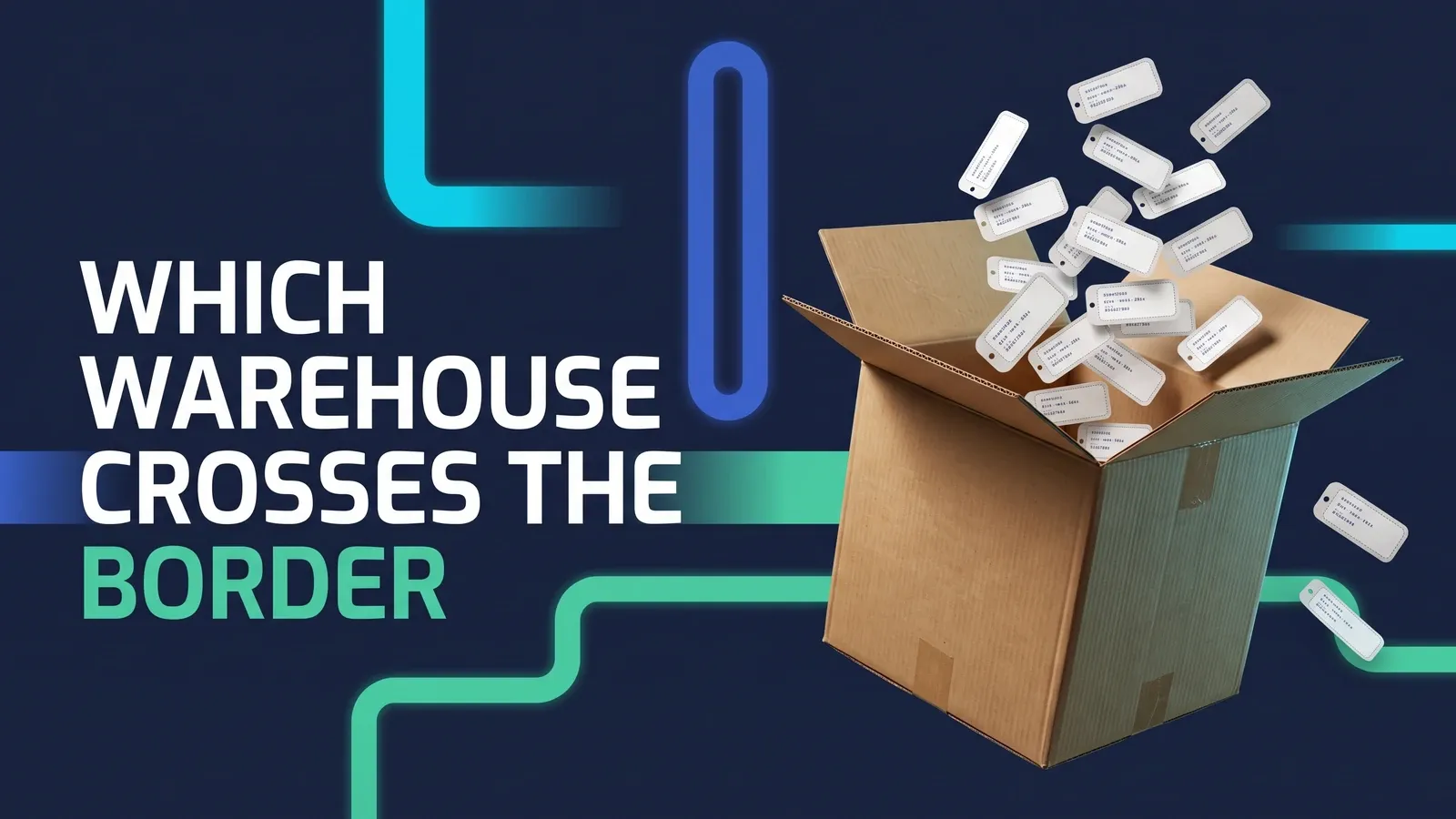
The rule that decides which location fills a cross-border order is usually a distance rule. For orders that cross a border it should be a customs and tax rule first, and 2026 has made that harder to ignore: the US wrote its suspension of low-value duty relief into regulation, and the EU started charging duty on low-value parcels.
None of what follows is tax or legal advice, and the treatment of any particular parcel depends on facts this post cannot see. Take it as the set of questions your routing rule should be asking, and settle the answers with your broker and your tax adviser.
The rule most retailers are running
Ask a retailer how international orders get routed and the answer is usually: nearest location that has the stock, fall back to the main warehouse. It is a reasonable rule, and it was written when duty on a small parcel was, in these markets, usually nothing.
Be precise about what was free, though, because the loose version of this story is wrong. The relief was from customs duty, not from VAT: the EU's Import One-Stop Shop has handled VAT on low-value imported goods since July 2021, and UK guidance charges supply VAT at the point of sale on consignments of 135 pounds or less. What has gone is the duty-free floor, not the paperwork.
What changed for parcels entering the United States
This matters to a US seller only where a US order can ship from a location outside the US, such as a store in Canada or a partner warehouse abroad. If every US order ships domestically, skip to the EU.
US Customs and Border Protection issued an interim final rule, effective 24 June 2026, providing that "The exemption provided in paragraph (a) of this section is suspended for merchandise arriving via all modes other than through the international postal network." That is the exemption which previously let shipments valued at 800 dollars or less enter without duty on a simplified process.
The consequences are in the same document. Those shipments "are also unable to use the special informal entry procedures applicable to articles claiming the de minimis exemption. Therefore, these shipments will need to use an appropriate entry type," and "This leaves Entry Type 11 as the main appropriate informal entry method for these shipments, although formal entry remains an option."
Three qualifications matter before anyone relocates inventory on the strength of it. First, the 2026 rule put an earlier suspension on a regulatory footing rather than starting one: Executive Order 14324, signed on 30 July 2025, had already suspended the exemption for most imports, and after a February 2026 Supreme Court decision Executive Order 14388 continued the suspension for postal shipments. Second, the post office is not a way round it. A companion interim final rule published the same day suspends the exemption "for imports valued at $800 or less arriving through the international postal network," effective 24 July 2026, and replaces it with a new postal informal entry process. Third, both are interim final rules, not a repealed exemption, so treat them as the current state rather than a settled one.
This post will not put a figure on the duty. It depends on classification and origin, so get your actual rates for your actual goods before you model anything.
What changed for parcels entering the EU
The European Commission announced in November 2025 that duty relief for low-value parcels is being abolished, describing the position it replaces: "parcels valued below EUR 150 that are sent from a third country to a consumer in the EU are exempted from customs duties." The Council "decided on an earlier application date of the measure already in 2026," with an interim arrangement running "until mid-2028, when the EU Customs Data Hub" is operational, and separately mandated "an e-commerce handling fee as of November 2026". On 21 September 2026 the Commission adopted a delegated regulation setting that fee at "EUR 2 per item", applying ten days after its publication in the Official Journal, so check whether it is in force when you read this.
Guidance published on 8 June 2026 sets out the interim arrangement. From 1 July 2026 a flat 3 euro customs duty applies per item on low-value consignments up to 150 euro imported from outside the EU through distance sales to consumers, described as "a flat fee, which will apply until 1 July 2028, after which normal customs duties will apply," and applying "regardless of VAT scheme (IOSS, Special Arrangements, or standard VAT)."
Two details bear on routing. It is assessed per item by tariff classification, illustrated as "1 T-shirt + 1 watch = EUR 6 (2 items)" against "5 T-shirts = EUR 3 (1 item)". And it falls on "The declarant of the good, i.e. seller or importer of the good (IOSS holder, special arrangements user, or their indirect representative)", with the guidance stating that the charge "is not a tax on consumers".
VAT is a separate regime from both charges. The Import One-Stop Shop has covered distance sales of imported goods up to 150 euro, excluding excise goods, since July 2021. It is an elective scheme: a business that chooses to use it and is established outside the EU generally has to "appoint an intermediary" established in the EU, who becomes "the person liable to pay VAT and to fulfil the VAT obligations."
Splitting an order may create a second charge, in one specific case
This is the routing consequence worth working through, and it is narrower than it first looks.
The 3 euro charge is assessed on a consignment, per item by tariff classification, and the worked example is clear that quantity of the same thing does not multiply it: five identical shirts are one item at 3 euro. Now route that order the way a speed-optimised rule would, filling three from one location and two from another. If both of those locations sit outside the EU, you have created two import consignments where there was one, each assessed in its own right.
The condition is the whole point. If one of the two locations is inside the EU, that portion is not an import at all and no such charge arises on it. The doubling only appears when every location involved is outside the EU, which is exactly the position of a seller filling EU orders from, say, a US warehouse and a UK one. This is a reading of how the two published documents fit together rather than a ruling, and the guidance does not address split orders directly, so confirm the per-consignment treatment with your broker before changing anything.
Keep the magnitude straight as well. Three euro is small next to a second pick, a second label and a second last-mile leg, and it is nowhere near a reason to hold an order and take the service hit. It is one more line in the cost of a fulfilment choice, which is the same arithmetic we ran on the real cost per order of shipping from a store: count every line, then decide.
The UK shows why this is a stock-placement decision
The UK's customs duty relief on consignments of 135 pounds or less is going too: a government consultation response published in July 2026 says it has "decided to accelerate the delivery by 6 months to October 2028 at the latest." The VAT guidance is where the underlying point shows most clearly.
Consignments of 135 pounds or less that are outside the UK and sold directly to customers in Great Britain "will have UK supply VAT charged at the point of sale", and that limit "applies to the value of a total consignment that is imported, not the separate value of individual items." In business-to-business sales the seller need not charge it where "the customer gives them their VAT registration number". Above the threshold, "Normal VAT and customs rules will apply on importation".
Then the line that reframes the question: "If you are an overseas seller who owns goods of any value that are located in the UK at the point of sale you must register and account for VAT on any sales."
Read the conditions in that sentence, because they carry it: an overseas seller, who owns the goods, with the goods in the UK when the sale happens. Where those hold, putting a pallet in a UK warehouse is a registration decision as much as a fulfilment one. If the person choosing the warehouse is not the person handling tax, that is the mismatch worth fixing, and it is why stock placement belongs in this conversation rather than next to it.
Can that location even ship the order?
One constraint outranks all of the above: not every location can export.
Shipping across a border needs commercial invoices, tariff codes on the product data, and people or software that produce customs documents reliably. A warehouse set up for international orders usually has that; a retail store often does not. So for a retailer whose stock sits largely in stores, the honest answer to "which location ships the international order" may be that only one or two can, whatever the distance rule prefers. Establish which locations are export-capable before tuning anything else.
So what should the cross-border rule say?
This ordering applies to orders crossing a border. Domestic orders should keep optimising for transit time.
First, which locations can produce export documentation at all. Second, which entity is the importer in the destination market. In business-to-business contracts Incoterms are the vocabulary for writing that allocation down — the International Chamber of Commerce publishes "a set of eleven three-letter trade terms, reflecting business-to-business practice in contracts for the sale and purchase of goods", with the 2020 edition in force since 1 January 2020. For sales to consumers, settle the importer question with your broker. Third, where the stock is at the moment of sale and what holding it there obliges you to do. Fourth, what the parcel meets on arrival from each candidate location. Then transit time and carrier zone, as the tie-breaker among whatever survives.
Before you touch the routing rules
Two things have to be true first, and neither is a routing change.
You need one inventory position that every candidate location reads from, or the rule will route against numbers that disagree. Our piece on keeping one source of truth across stores and marketplaces covers what has to hold for that.
And the domestic rule should be sound before you complicate it. If that groundwork is open, start with how to decide which location ships an order.
The outcome to design against is not a slow delivery. It is a parcel that meets an unexpected charge and is refused at the door, leaving you with the outbound cost, the refund, and a unit that may or may not come back. Trading a transit day for that is a poor exchange, and a rule that only prices distance cannot see it coming.
Frequently asked questions
Should we hold stock in every market we sell to?
Not as a default, because holding stock somewhere often brings obligations with it. UK guidance is explicit that an overseas seller who owns goods of any value located in the UK at the point of sale must register and account for VAT on any sales there. Other markets set their own rules, so check each one. Place stock where volume justifies the compliance work, not where the map looks tidy.
Who actually pays the new EU charge?
The Commission guidance names the declarant, meaning the seller or importer of the good, including an IOSS holder, a special arrangements user or their indirect representative, and states the 3 euro duty is not a tax on consumers. Whether any of it is passed on at the door depends on how the parcel is declared and by whom, so ask your carrier or broker how it is handled on each of your lanes.
What is the first thing to change in our routing rules?
Separate destinations that cross a border from destinations that do not, and stop running both through one distance rule. Domestic orders can keep optimising for transit time. Cross-border orders need the rule to know whether the fulfilling location can produce export paperwork at all, which entity imports, what holding stock there obliges you to do, and what the parcel meets on arrival.
Start your 14-day free trial
See how OmniOrders connects your sales channels, 3PLs, and carriers into one operational layer — free for 14 days, no credit card.