











Ecommerce fraud prevention: how to stop fraudulent orders before you ship
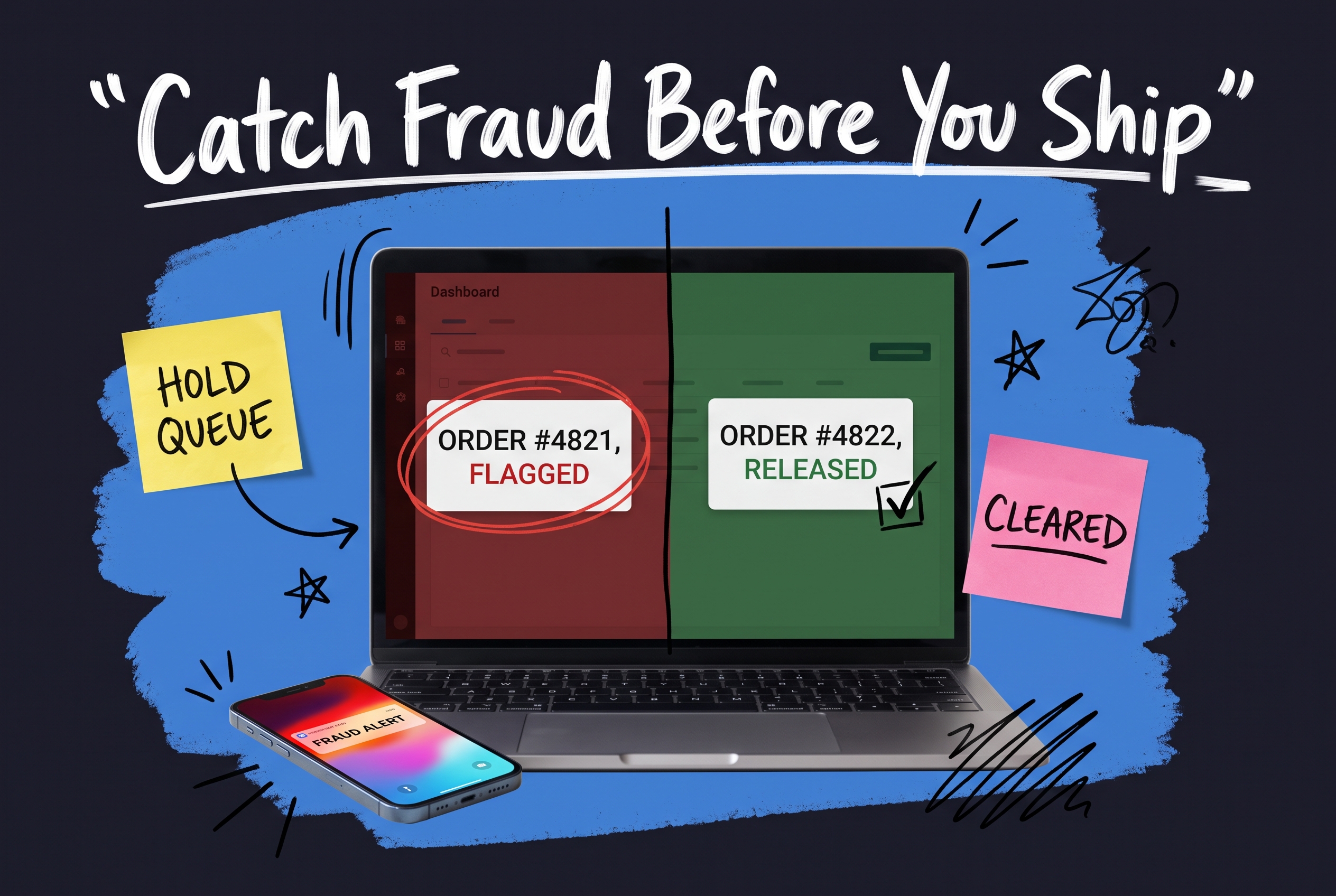
Fraud doesn't cost you money when someone places a fake order. It costs you money when you ship it.
By the time a chargeback lands, you've already picked the product, packed it, handed it to a carrier, and paid for shipping. The order is gone. The payment reverses. And you owe a dispute fee — typically $15 to $25 per dispute — regardless of outcome.
For a multi-channel brand doing 500 orders a day across Shopify, Amazon, and wholesale, even a 0.5% fraud rate translates to real margin erosion. Not because individual fraud orders are catastrophic. They're not. But because undetected fraud patterns repeat: same shipping address clusters, stolen card batches, unusual channel behavior. By the time you spot the pattern, you've shipped 40 orders into the same network.
This is the pre-ship operator playbook — what to screen, when to hold, and how to release clean orders fast enough that you don't wreck your fulfillment SLAs in the process.
What kinds of fraud hit multi-channel brands most
Three types show up consistently at the $1M–$20M GMV range.
Card testing. A fraudster gets a batch of stolen card numbers and needs to find which ones still work. They run small orders — often under $10 — through your checkout to test for declines. One clears; they immediately place a bigger order. The tell: sudden spikes in sub-$10 transactions, often from brand-new accounts, billing addresses clustered around the same ZIP codes.
Account takeover. A customer's credentials get stolen. The fraudster logs in, swaps the shipping address, and places an order using the saved card. You see a returning customer with order history — it just isn't actually them. The tell: a shipping address change right before an order, and items that look nothing like the account's usual purchases.
Triangulation fraud. This one takes longer to catch. A fraudster sets up a fake storefront, sells your product to a real buyer, collects payment, then orders from you using a stolen card to ship directly to that buyer. You fulfill what looks like a legitimate order. When the stolen card gets reported, the chargeback is yours. The buyer got their item. The fraudster kept the spread. The tell: ship-to addresses that match buyer addresses on other marketplaces.
Knowing which type you're dealing with changes what you look for.
Risk signals worth checking before you ship
The goal of pre-ship ecommerce fraud detection isn't to block every order that looks odd. It's to hold the orders that warrant a second look, review them fast, and release the clean ones without delay.
These signals have the highest correlation with fraud at the ops level:
Billing–shipping mismatch on high-value orders. A billing address in one state and a ship-to in another isn't automatically fraud. On an order over $150, combined with other signals, it's worth a check.
IP geolocation vs. billing address mismatch. Order placed from an IP in Eastern Europe, billing address in the customer's home state — that's a meaningful gap. Fraud scoring tools handle this automatically, but you can build basic rules around it yourself.
First-time customer, high AOV, next-day shipping. A new account placing a $300+ order with overnight shipping is a common fraud pattern. Legitimate first-time buyers in a hurry exist. The combination of all three — new, expensive, urgent — is the flag.
Multiple failed payment attempts before success. One declined card before a successful one is normal. Three or more failed attempts before a card clears often means the buyer is cycling through a stolen card list.
Order velocity from the same address or email domain. Five orders from the same shipping address in 24 hours, from what appear to be different customers, is a card testing signal.
Device fingerprint mismatch. If the same device has placed orders under five different email addresses this week, that's a hard hold.
The problem isn't knowing these signals exist. It's catching them at the order level before your fulfillment routing kicks in.
Building a pre-ship fraud screening workflow
The practical version of ecommerce fraud prevention is a hold-and-review queue. Not a block list.
Blocking orders on ambiguous signals costs you real customers. A chargeback rate of 0.0% sounds good until you realize you've been quietly declining 2–3% of legitimate orders.
The workflow that works:
Score at order creation. Every order gets a fraud risk score the moment it enters your system — from a third-party tool (Signifyd, NoFraud, Kount) or from rules you've defined yourself. The score reflects how many risk signals are present and how closely they track with your historical fraud patterns.
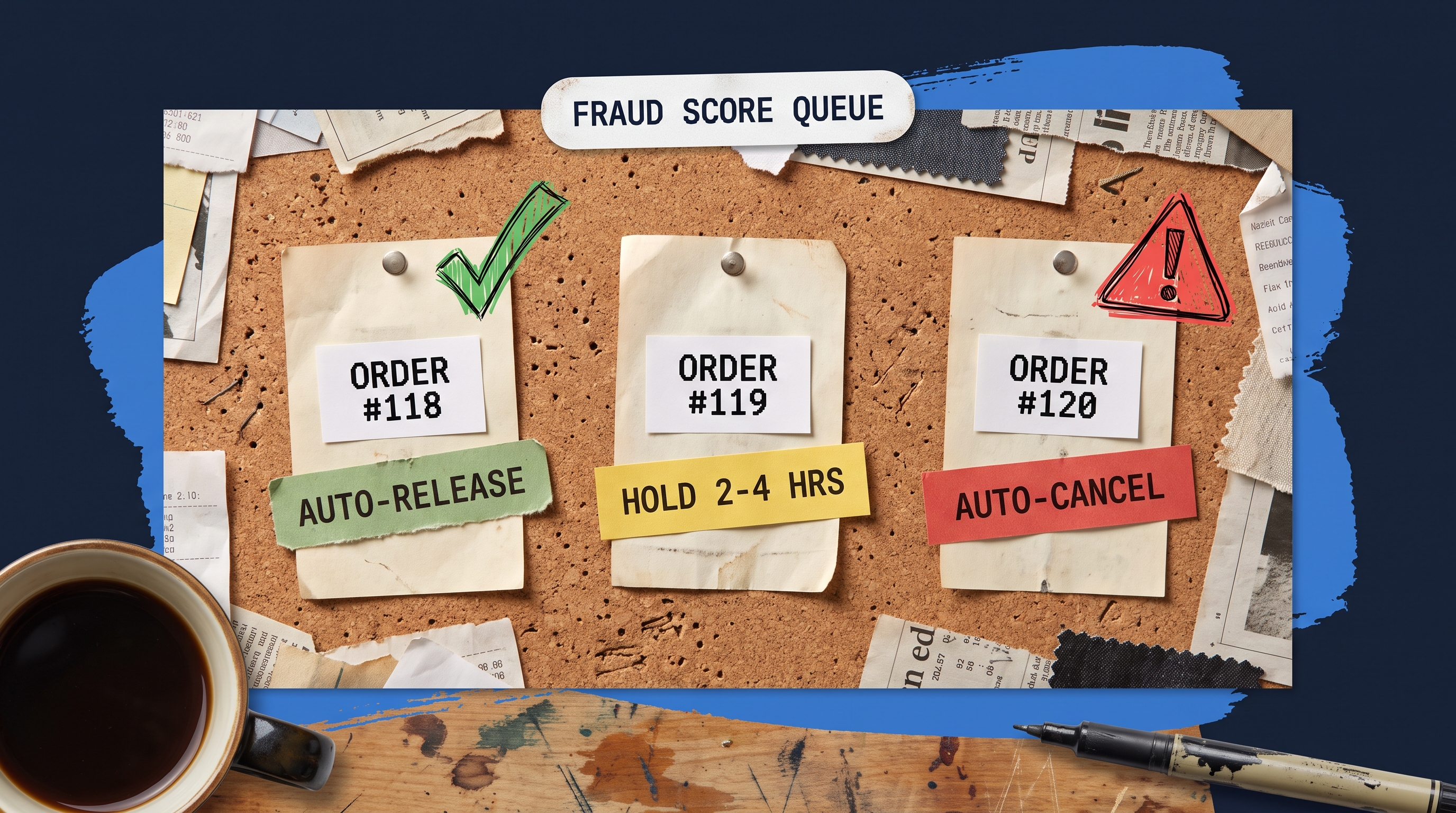
Segment into three buckets:
- Low risk → auto-release to fulfillment
- Medium risk → hold for manual review (target: reviewed within 2–4 hours)
- High risk → auto-cancel (reserve this threshold for scores above your verified fraud floor only)
Process the hold queue twice daily. Morning and afternoon works for most teams. Most held orders take 60 seconds to resolve: check the signals, call the customer if the order value warrants it, release or cancel. This isn't about a perfectly empty queue. It's about speed.
Release held orders with priority. A held order that gets reviewed and released six hours later may have already missed a carrier pickup. When you release from fraud hold, that order needs to jump the fulfillment queue to its original priority. Manual re-queuing kills the SLA you just saved.
Automating the fraud-hold queue
Fraud screening as a manual process works until order volume scales or patterns get harder to catch.
The step up is rule-based automation inside your order management system.
What that looks like in practice:
- Trigger: Order created with fraud score ≥ 65, OR first-time customer + AOV > $200 + overnight shipping selected
- Action: Route to "Fraud Hold" queue; do not pass to warehouse for picking
- Timer: Hold unreviewed after 4 hours → escalate to supervisor notification
- Release: Reviewed and approved → immediate re-route at standard fulfillment priority
- Cancel: Reviewed and rejected → cancel order, process refund, log signal for pattern analysis
Rule-based automation has two advantages that third-party fraud tools alone don't give you. You control the logic — a score of 65 means something specific to your product category, your average order value, your customer base. And the fraud decision happens in the same system as the fulfillment decision. No handoff delay between "hold this" and "ship everything else."
OmniOrders' no-code rules engine lets you build this workflow without engineering support. Define hold conditions on fraud score, order attributes, or channel-specific flags, and set routing actions that fire automatically when those conditions are met. Cleared orders return to the fulfillment queue at priority — no manual rekeying, no ops team chasing down which orders got stuck in the hold.
Chargeback prevention as a downstream benefit
Ecommerce fraud prevention and chargeback protection aren't the same problem. They're connected.
A chargeback happens when a cardholder disputes a transaction. Fraud chargebacks — where the cardholder genuinely never placed the order — are the ones you almost always lose. Pre-ship screening addresses these directly: if the fraudulent order never ships, there's no chargeback to dispute.
Friendly fraud chargebacks — a customer claims non-delivery on a legitimate order — require different protection: delivery confirmation, tracking data, signed proof of delivery on high-value shipments. Your OMS should be capturing and surfacing this automatically when you respond to a dispute.
The math: a 0.1% reduction in chargeback rate on $5M in annual revenue saves roughly $5,000 in product cost plus dispute fees. That's a workflow worth building.
Ecommerce fraud detection tools and where each one fits
Shopify-native fraud analysis. Shopify flags orders with common risk indicators — billing/shipping mismatch, failed payment attempts, known proxy IPs. It's a starting point. It doesn't cover Amazon or wholesale, and it doesn't automate routing decisions.
Third-party fraud scoring tools. Signifyd, NoFraud, and Kount provide machine learning-based fraud scores and, on higher tiers, chargeback guarantees. Use their score as an input to your OMS rules, not as a standalone solution.
Your OMS rules engine. This is where fraud decisions become fulfillment decisions. The OMS is where a score of 72 becomes "hold this order" and a cleared review becomes "ship now." Without OMS integration, fraud scoring is advisory. With it, the screening is built into the workflow.
The combination that scales: fraud scoring tool → score feeds OMS → OMS applies hold/release rules → warehouse only sees cleared orders.
Stop fraud at the order level, not after the ship
Most brands treat fraud prevention as a separate layer — a report to check at the end of the day, a manual queue that runs parallel to fulfillment. The brands that keep fraud costs down treat it as part of the workflow: signals captured at order creation, holds applied automatically, cleared orders released without delay.
If you're managing orders across multiple channels and warehouses, OmniOrders' rule-based routing lets you build the fraud-hold workflow without custom development. Define your hold conditions, set your review SLAs, and release clean orders directly to pick-and-pack — all from one system.
[See how OmniOrders handles multi-channel order routing →]
Frequently asked questions
What is the most common type of ecommerce fraud?
Card testing and account takeover are the most frequent at the mid-market level. Card testing validates stolen card numbers by running small transactions before placing larger orders. Account takeover uses stolen login credentials to change shipping addresses and use saved payment methods.
How do I prevent chargebacks from ecommerce fraud?
The most effective chargeback protection is catching fraud before the order ships. Build a pre-ship hold queue using fraud risk scores and order attribute rules in your OMS. For friendly fraud chargebacks, maintain delivery confirmation and tracking data you can surface in dispute responses.
Does Shopify have built-in fraud prevention?
Shopify flags orders with common risk indicators but doesn't automate fulfillment decisions or cover other sales channels. Multi-channel brands need an OMS-level rules engine to apply consistent fraud screening across Shopify, Amazon, Walmart, and wholesale simultaneously.
What fraud score threshold should I use to hold orders?
Start conservatively: hold for manual review at 60–70, auto-cancel only above 90. Review your hold queue weekly for the first month to calibrate. If you're releasing 95%+ of held orders, the threshold is probably too low. If you're holding less than 0.5% of all orders, it may be too high.
How do I stop Shopify fraudsters from hitting my store repeatedly?
Use device fingerprinting, email and IP blocklists, and address-level hold rules. A rule that holds any order from an address with a prior chargeback is a straightforward starting point. Coordinate with your payment processor — most have built-in velocity rules that block repeated attempts from the same device or card number.
Start your 14-day free trial
See how OmniOrders connects your sales channels, 3PLs, and carriers into one operational layer — free for 14 days, no credit card.